Xanadu Quantum Technologies (XNDU), a Canada-based photonic quantum firm, has filed a new Form F-1 with the SEC, giving investors a detailed look at its business, finances, and risks following its recent SPAC merger. At the same time, the filing opens the door for a large number of existing shareholders to sell stock, which could weigh on shares in the near term.
Claim 55% Off TipRanks
New trading tool for IBM bullsThe company, which develops quantum computing systems, completed its merger with Crane Harbor Acquisition Corp. in March 2026. This filing is part of the next step in that process and allows early investors, sponsors, and insiders to resell shares on the public market.
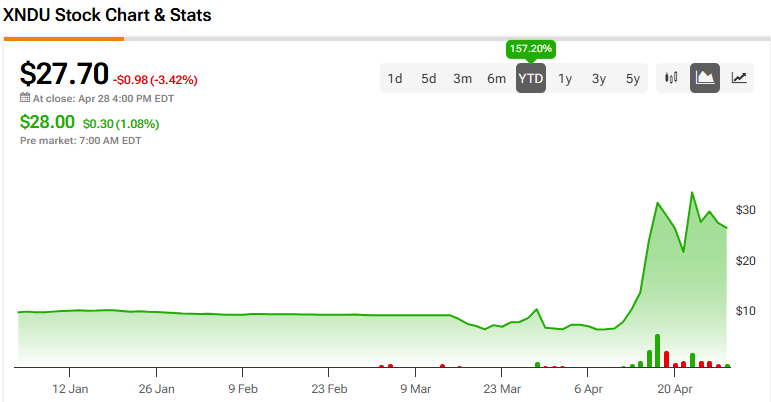
Meanwhile, XNDU shares dropped 3.42% on Tuesday, closing at $27.70.
Large Share Sales Could Pressure the Stock
The most important takeaway from the filing is the scale of shares being registered. Xanadu is allowing the resale of up to 293.7 million Class B shares held by existing investors. In contrast, the company has just over 43 million Class B shares currently outstanding.
This is a significant gap. If even a portion of those shares is sold, it could increase supply in the market and put pressure on the stock price. The company also notes that it will not receive proceeds from these sales, except for a small amount tied to warrant exercises.
That means the filing is mainly about giving liquidity to early investors rather than raising fresh capital for the business.
Early Stage Business with High Execution Risk
At the same time, the filing lays out the company’s long-term vision and the challenges it faces. Xanadu describes itself as a “leading quantum computing company developing full-stack quantum computing solutions.”
However, the business is still in an early stage. The company reported about $4.6 million in revenue for 2025 and a net loss of $70.7 million.
It also makes clear that key technology milestones are still ahead. In fact, the filing states that the company “has not produced a commercially scalable, fault-tolerant quantum computer.”
Indeed, quantum computing remains a developing field, and Xanadu’s future depends on solving major technical challenges over the next several years.
In addition, the company faces financial and customer concentration risks. It says it expects to continue generating losses and will require more capital to fund research and growth.
Competitive Landscape and Market Uncertainty
Meanwhile, Xanadu operates in a highly competitive space. Its rivals include large technology firms such as Alphabet (GOOGL), International Business Machines (IBM), and Microsoft (MSFT), as well as smaller pure-play companies like IonQ (IONQ) and Rigetti Computing (RGTI).
The company also notes that the broader quantum computing market is still developing and may not grow as expected. Adoption remains uncertain, and it may take years before commercial demand reaches scale.
Bottom Line
Overall, the F-1 filing provides a clear view of both the opportunity and the risk. Xanadu is working on advanced technology with long-term potential, but it is still far from commercial scale.
At the same time, the large number of shares being registered for resale could create near-term stock pressure as early investors gain the ability to exit positions.
For investors, the story combines long-term promise with near-term uncertainty, making it a complex name to watch in the emerging quantum computing space.
Is Xanadu a Good Stock to Buy?
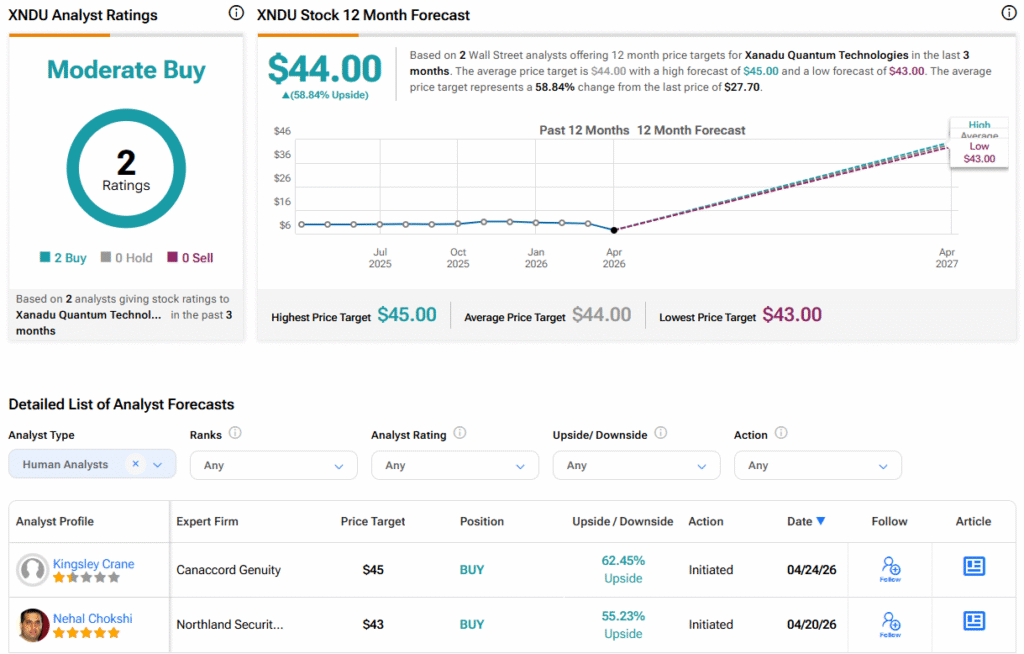
Turning to the Street, Xanadu Quantum Technologies is thinly watched for now and has a Moderate Buy consensus view, based on two analysts’ ratings. The average XNDU stock price target is $44, which implies a 58.84% upside from the current price.