Micron Technology (MU) has become one of the most dramatic AI winners in the market, with the chip stock rising 720% over the past year. That kind of move naturally raises a question that investors are now asking more often: Will Micron split its stock in 2026? It’s worth noting that no announcement has been made, and a stock split would not make the company more valuable, since it simply divides the same business into more shares. However, it could make the stock feel more accessible to retail investors, especially now that the share price has recently traded as high as $818.67.
Claim 55% Off TipRanks
Forget margin or options. Here's how the pros trade NVDAIn addition, the argument for a split is strengthened by what has happened with other AI stocks. Chipmaker Nvidia (NVDA), for example, used stock splits during its own AI-driven rally to keep retail interest and trading activity strong. Micron is now in a similar position, at least from a share-price perspective. In addition, Micron’s Canadian Depositary Receipts have already completed a 5-for-1 split in March 2026, which has only added to speculation that the main Nasdaq-listed MU shares could eventually follow suit.
There is also history behind the idea. During the 1990s and dot-com period, Micron split its stock three times in six years, with splits in 1994, 1995, and 2000. This matters because management has historically used splits during periods of strong growth and rising investor attention. Now that the stock is far above its old highs, the setup appears more favorable than it has been at any point in the past two decades.
Why Is a Micron Stock Split Being Discussed?
The real reason a split is even being discussed, though, is Micron’s financial performance. The company has become a major beneficiary of demand for AI memory, especially high-bandwidth memory like HBM3E. In Fiscal Q2 2026, Micron reported record revenue of $23.86 billion, up 196% year-over-year. Even more importantly, its HBM4 supply is already fully booked through 2026, which gives the company strong visibility into future demand. Moreover, with Deutsche Bank (DB) and DA Davidson recently providing $1,000 price targets, the pressure for a split may continue to build if the stock keeps climbing.
Is MU Stock a Good Buy?
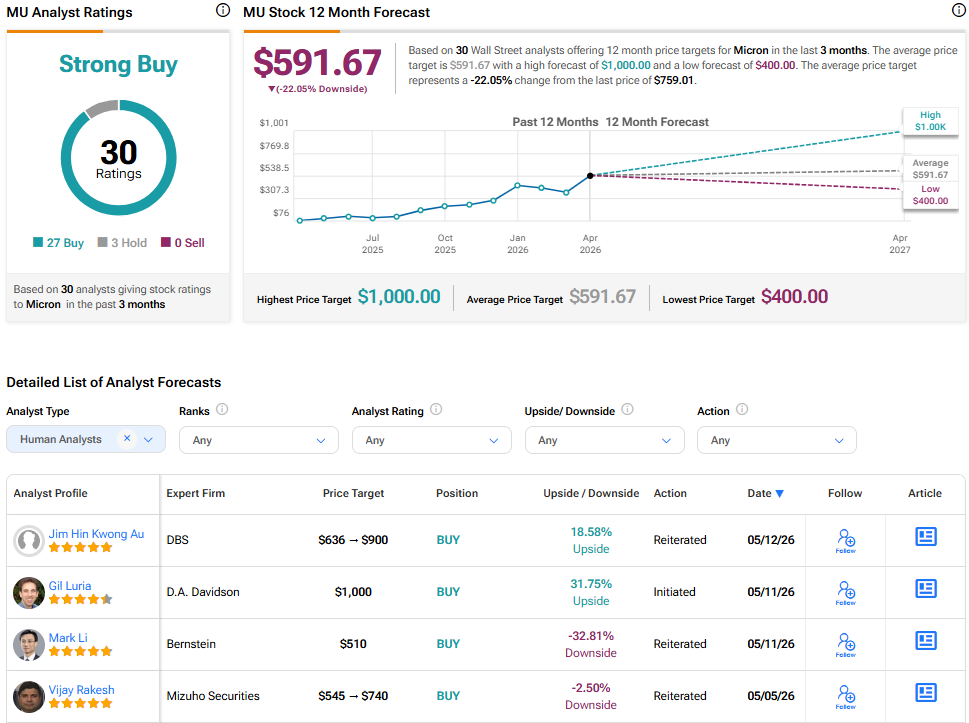
Turning to Wall Street, analysts have a Strong Buy consensus rating on MU stock based on 27 Buys, three Holds, and zero Sells assigned in the past three months, as indicated by the graphic below. Furthermore, the average MU price target of $591.67 per share implies 22.1% downside risk.