


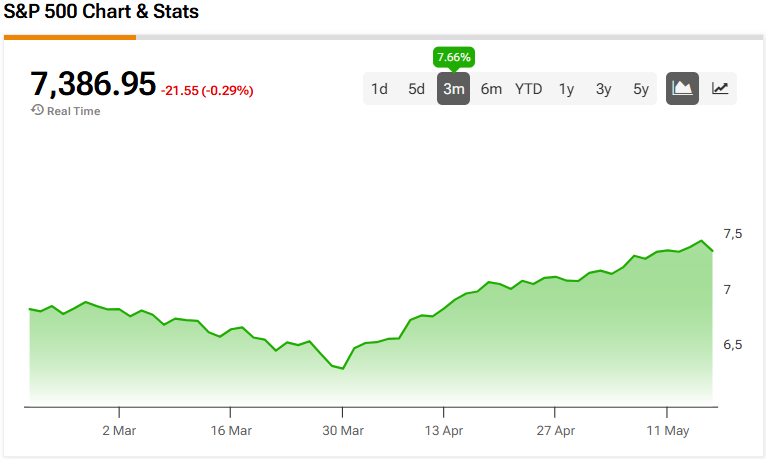
U.S. stocks are moving lower on Monday, with the S&P 500 (SPX) down 0.5% and the Nasdaq (NDX) falling 1%, as rising oil prices and persistent geopolitical tensions weighed on sentiment before the opening bell. West Texas Intermediate crude climbed 1.5% to trade at $107 per barrel, while Brent crude added another 1.6% to $111, extending the recent rise across energy markets.
Meet Samuel – Your Personal Investing Prophet
- Start a conversation with TipRanks’ trusted, data-backed investment intelligence
- Ask Samuel about stocks, your portfolio, or the market and get instant, personalized insights in seconds
Investors remain focused on developments surrounding the Iran-US conflict after President Donald Trump warned Sunday that “the clock is ticking” for an agreement or there “won’t be anything left,” despite ongoing negotiations between both countries.
Last week’s hotter-than-expected inflation readings further reduced expectations that the Federal Reserve could begin lowering rates anytime soon, adding additional pressure across equities and bond markets alike.
Against that backdrop, Goldman Sachs economist Dominic Wilson believes markets are entering a more complicated phase following the rally since early April. Wilson wrote that “the risks of relief” are becoming more visible as investors move past fears surrounding a deeper geopolitical crisis and begin compressing risk premia across several asset classes. According to Wilson, that shift helped drive a strong recovery in U.S. equities, emerging markets, commodity-linked currencies, and AI-related assets despite elevated oil prices and bond yields.
Still, Wilson warned that “the distribution of risks is more balanced” after the rebound, arguing that investors may now be underestimating the possibility of another escalation involving Iran or a prolonged disruption in the Strait of Hormuz. He believes such a scenario could push oil prices and interest rates even higher while weighing on economic growth prospects.
Furthermore, while markets remain enthusiastic about AI and booming hyperscaler spending, Wilson believes investors may eventually grow less comfortable with the combination of rising equity prices alongside elevated Treasury yields. Wilson continues seeing strong momentum across semiconductors and memory suppliers benefiting from AI infrastructure demand, though he cautioned that the market may eventually “build a valuation overhang” if expectations continue climbing too aggressively.
At the same time, Wilson does not believe markets are necessarily approaching an imminent collapse. Instead, he expects “volatility rise alongside further equity price increases,” as investors continue balancing resilient economic growth, elevated inflation pressures, geopolitical uncertainty, and the enormous capital flows moving into artificial intelligence infrastructure.
Disclaimer: The opinions expressed in this article are solely those of the featured economist. The content is intended to be used for informational purposes only. It is very important to do your own analysis before making any investment.