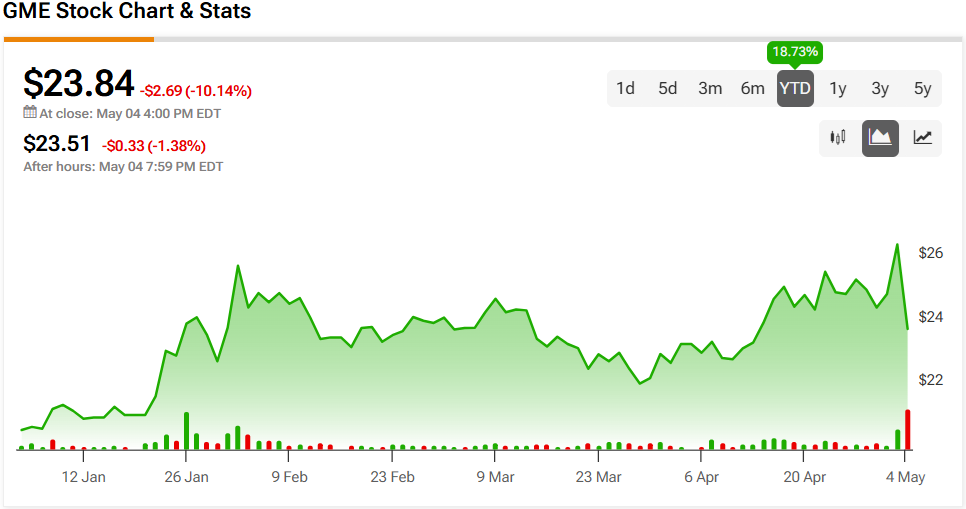
GameStop’s (GME) latest move has investors trying to process a proposal that would have seemed unthinkable not long ago, with reports pointing to a $56 billion bid for eBay (EBAY) that would combine cash and stock in equal parts.
Claim 55% Off TipRanks
- Unlock hedge fund-level data and powerful investing tools for smarter, sharper decisions
- Discover top-performing stock ideas and upgrade to a portfolio of market leaders with Smart Investor Picks
The idea is simple on the surface yet complex underneath, as CEO Ryan Cohen appears to be pushing GameStop beyond its legacy retail identity toward a broader e-commerce and collectibles platform, where both companies already see meaningful traction. At the same time, eBay has been showing improving growth and operational momentum, which raises the question of whether this is an opportunistic strike or a bet that scale and strategy can unlock something much bigger.
Michael Burry, who has previously invested in GameStop, does not sound surprised by the direction, opening with the blunt remark that the move “makes perfect sense,” before adding that when enormous sums are involved, “bet on craven greed.” That framing suggests he sees the deal as being driven more by financial considerations, like how it’s structured and financed, than by how well the two businesses actually fit together. Burry also expresses skepticism about how the process unfolds, noting that he can “only imagine eBay will reject GameStop’s offer out of hand.
Burry’s deeper concern comes through in how he characterizes the structure and implications of the deal, arguing that it is not “revolutionary or ground-breaking in nature,” and instead leans on what he describes as a very conventional mix of dilution and debt. Paraphrasing his view, the worry is not just about valuation, but about the burden that comes with financing a transaction of this size, especially if leverage climbs to levels that could limit flexibility and long-term competitiveness. Burry reinforces that risk by pointing to extreme leverage scenarios that border “on distressed,” implying that execution would have to go nearly perfectly to justify the financial strain.
At the same time, Burry does not dismiss the strategic ambition behind the move, acknowledging that Cohen is likely targeting a large opportunity in collectibles and secondary markets, which he suggests could reach into the hundreds of billions. Burry even expresses a degree of support for the attempt, writing that he does “support the effort,” while making it clear that the path forward is narrow and filled with execution risk. That mix of cautious backing and structural concern helps explain why he is trimming exposure, admitting that he may “sell to an extent, perhaps all or some.”
Meanwhile, Baird’s Colin Sebastian assigns a relatively low probability of success mainly because he questions both the strategic logic and the likelihood the deal actually goes through.
First, the analyst believes the proposal is built on a shift in direction that may not be justified. The deal assumes eBay would move away from a technology-led marketplace model toward a cost-optimization approach, which he sees as a questionable pivot given that eBay has already returned to growth. In other words, the transaction appears to be trying to “fix” a business that is no longer clearly broken.
Second, Sebastian points out that eBay’s fundamentals have improved, with GMV and revenue tracking around e-commerce market levels and shares performing strongly. That makes it harder to argue that such a large and disruptive deal is necessary in the first place.
Third, while the transaction may look accretive on paper, Sebastian argues that the value creation leans more on financial engineering than on real operating synergies. That raises concerns about long-term competitiveness rather than strengthening it.
Finally, Sebastian flags execution and approval risk. Given the strategic mismatch and the nature of the proposal, he sees a low probability that eBay’s board would accept the offer, including the potential for defensive measures such as a poison pill.