


Vanguard S&P 500 ETF (VOO), Schwab U.S. Dividend Equity ETF (SCHD), and NEOS Nasdaq-100 High Income ETF (QQQI) all provide income, but they do so in different ways. VOO tracks the broad market, and its distributions come from the regular dividends paid by large S&P 500 (SPX) companies rather than from an income-focused strategy. Meanwhile, SCHD pays dividends from the companies it owns, while QQQI generates most of its income through an options strategy.
Meet Samuel – Your Personal Investing Prophet
- Start a conversation with TipRanks’ trusted, data-backed investment intelligence
- Ask Samuel about stocks, your portfolio, or the market and get instant, personalized insights in seconds
For income investors, the key measure is dividend yield — the cash paid relative to the fund’s price. Currently, QQQI offers the highest yield of roughly 14%–15%; SCHD yields about 3%–4%; while VOO yields around 1%–2%.
Using the TipRanks’ ETF Comparison Tool, we have placed SCHD, QQQI, and VOO ETFs against each other to find the best dividend ETF for investors in 2026.

Is VOO a Good ETF to Invest in?
VOO pays dividends on a quarterly basis, passing along the regular dividends received from the S&P 500 companies it holds. Most recently, the ETF paid a dividend of $1.87 per share on March 31, 2026. As shown in the VOO dividend history table, recent payments have generally ranged from about $1.70 to $1.87 per share each quarter. The ETF also has the lowest expense ratio among the three at 0.03%.

In terms of holdings, VOO ETF is heavily weighted toward technology but also includes major exposure to financials, healthcare, consumer, and industrial stocks, giving investors broad, large-cap diversification. VOO holds 507 stocks with total assets worth $825.92 billion. Its top five holdings are Nvidia (NVDA), Apple (AAPL), Microsoft (MSFT), Amazon (AMZN), and Alphabet (GOOGL).
According to TipRanks’ unique ETF analyst consensus, determined based on a weighted average of analyst ratings on its holdings, VOO is a Moderate Buy. The Street’s average price target of $760.55 implies an upside of 25.57%.

Is SCHD ETF Really a Good Investment?
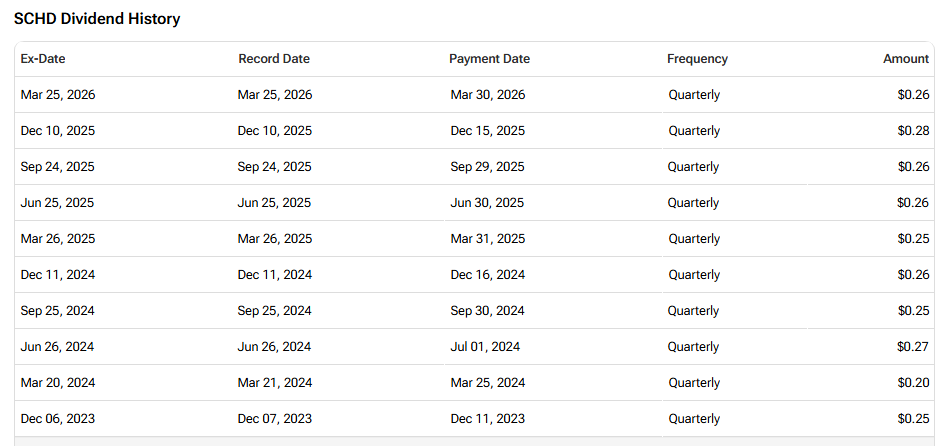
SCHD pays dividends on a quarterly basis, using the cash income generated by its underlying holdings. Most recently, the ETF paid a dividend of $0.26 per share on March 30, 2026. As shown in the SCHD dividend history image, payouts in 2024 and 2025 have generally ranged between $0.25 and $0.28 per quarter. The ETF has an expense ratio of 0.06%.
In terms of holdings, SCHD focuses on companies that regularly pay dividends, with large positions in industrial, healthcare, energy, and consumer staples stocks rather than fast-growing tech firms. The fund holds 102 stocks and manages about $84.67 billion in assets. Its top five holdings include Chevron (CVX), ConocoPhillips (COP), Verizon (VZ), Merck (MRK), and Texas Instruments (TXN).
According to TipRanks’ unique ETF analyst consensus, determined based on a weighted average of analyst ratings on its holdings, SCHD is a Moderate Buy. The Street’s average price target of $34.74 implies an upside of 13.39%.

What Is the Price Target for QQQI?
QQQI follows a very different model. The ETF pays monthly dividends, driven mainly by an options-based income strategy tied to the Nasdaq-100. As shown in the QQQI dividend history table, recent payouts have mostly ranged between $0.61 and $0.64 per share, with the latest payment at $0.61 in March 2026. The ETF has an expense ratio of 0.68%.

In terms of holdings, QQQI is centered on large technology and internet companies because it is based on the Nasdaq-100. The fund holds 104 stocks and manages about $9.43 billion in assets. Its top 5 holdings are Nvidia (NVDA), Apple (AAPL), Microsoft (MSFT), Amazon (AMZN), and Tesla (TSLA).
According to TipRanks’ unique ETF analyst consensus, determined based on a weighted average of analyst ratings on its holdings, QQQI is a Strong Buy. The Street’s average price target of $76.93 implies an upside of 52.28%.

Conclusion
QQQI stands out for both income and upside. It offers the highest yield among the three and also has the strongest upside potential of over 50% based on analyst estimates. However, that higher income comes with a higher expense ratio and more risk because it relies on an options strategy.
SCHD offers a more balanced approach. It provides steady dividends, lower costs, and moderate upside, making it a solid choice for income-focused investors who want stability. Meanwhile, VOO offers the lowest yield but gives broad exposure to large U.S. companies, making it better suited for long-term growth.