


With global headlines filled with uncertainty, investors can be forgiven for seeking safe harbors to park their money. While T-bills and savings accounts offer guaranteed returns, they also forgo the potential upside if equities continue to recover their swagger in the months ahead.
Claim 55% Off TipRanks
- Unlock hedge fund-level data and powerful investing tools for smarter, sharper decisions
- Discover top-performing stock ideas and upgrade to a portfolio of market leaders with Smart Investor Picks
That trade-off is pushing many toward ETFs, which offer a simple way to stay invested while spreading risk across a broad mix of assets. Still, not all ETFs are built the same, with differences in cost, size, and exposure playing a key role in how they perform.
The Vanguard S&P 500 ETF (VOO) is one such option, and it tends to be a popular one. VOO is designed to mimic the performance of the S&P 500, which is made up of some of the biggest companies traded on U.S. equity markets.
VOO has come to rely heavily on large technology companies, many of whom have enjoyed turbocharged growth this decade. This has helped VOO to deliver gains of 30%, 77%, and 247% over the past 1-, 3-, and 10-years, and its expense ratio of 0.03% makes it a very cheap investment to hold.
The beginning of 2026 proved to be a different story, however, as worries over AI capex spending and a potential bubble proved to be a drag on many tech stocks. War in the Middle East didn’t help matters either, and VOO has only recently emerged into positive territory for the year.

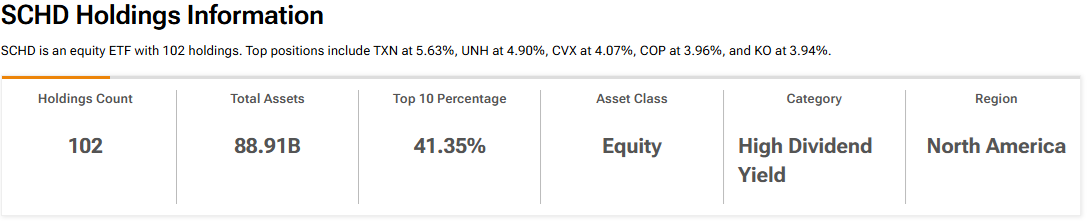
Meanwhile, for investors concerned about all this volatility, the Schwab US Dividend Equity ETF ($SCHD) offers another layer of security. SCHD only sources its investments from companies with at least 10 years of dividend payments, and its dividend yield of 3.38% is higher than much of the competition.
The Magnificent 7 tech stocks, which comprise such a large portion of VOO and other tech-focused ETFs, aren’t a part of SCHD’s portfolio. The ETF is more defensively minded in that respect, and its investments come from a wide variety of sectors that reflect an emphasis on consistency over sharp growth.
Though its expense ratio of 0.06% is twice that of VOO, SCHD’s performance this year of 15% also outshines its tech-tilting counterpart.
According to investor David Dierking, this approach makes SCHD the obvious choice in the current climate.
“That strategy aligns with what investors are looking for right now. It may even be a better investment than the Vanguard S&P 500 ETF at the moment,” the investor opined.
Dierking points out that the uncertain geopolitics are making investors a bit leery of growth stocks. He expects that narrative to be the overriding one for the coming year, which would give the edge to the types of defensive and dividend-paying stocks that make up the SCHD.
That’s not to say that Dierking is ready to leave VOO behind, however. While the path forward won’t necessarily be smooth, over the long haul, the investor predicts it will be the more lucrative one.
“Over the longer term, say a decade or more, the Vanguard S&P 500 ETF probably wins out. Its overweights to tech and growth stocks are likely to perform better despite the added volatility along the way,” concludes Dierking. (To watch Dierking’s track record, click here)

Disclaimer: The opinions expressed in this article are solely those of the featured investor. The content is intended to be used for informational purposes only. It is very important to do your own analysis before making any investment.