



Income-focused dividend ETFs are often seen as a way to balance growth with steady cash flow, combining diversified exposure with regular payouts. For investors looking to generate income without giving up participation in the broader market, these funds can play a useful role in a portfolio.
Claim 55% Off TipRanks
- Unlock hedge fund-level data and powerful investing tools for smarter, sharper decisions
- Discover top-performing stock ideas and upgrade to a portfolio of market leaders with Smart Investor Picks
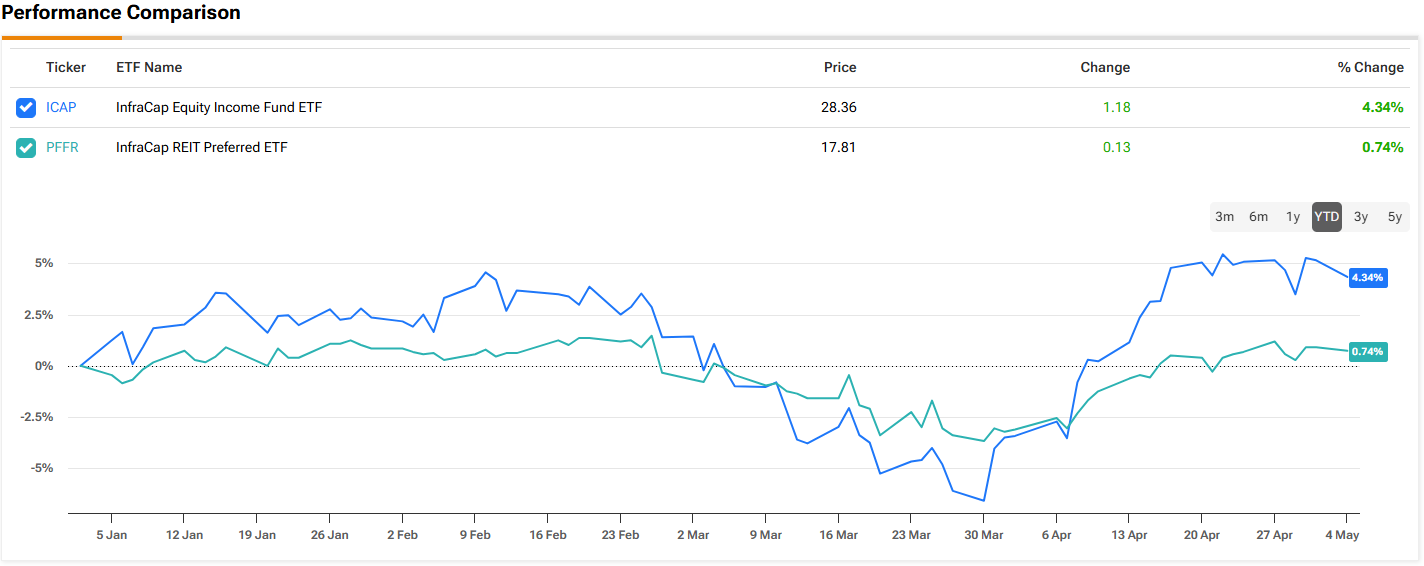
That said, not all income-oriented ETFs take the same approach. Two funds that stand out in this space are the InfraCap Equity Income Fund ETF (ICAP) and the InfraCap REIT Preferred ETF (PFFR).
ICAP, for its part, casts a wide net across the equity market, holding a mix of large-, mid-, and small-cap stocks across 81 positions. Still, with just under $100 million in assets under management, it remains a smaller player compared to more established, broad-market ETFs.
Nevertheless, ICAP has delivered some solid results in recent years, posting a total return of ~31% and a dividend yield of 9.34% over the past twelve months. That performance doesn’t come cheap, with the ETF carrying an expense ratio of 1.64%, while broader measures of total costs can push closer to the mid-2% range.
Top investor Michael Del Monte, however, thinks the expense is justified.
“With active sector allocation and security selection, I believe ICAP is set up to generate returns for shareholders,” states the 5-star investor, who is among the top 1% of stock pros covered by TipRanks.
The investor likes the ETF’s “macro-driven, bottom-up selection process,” spotlighting big names such as MRVL, AMZN, and CFG that are among its largest holdings. He also points out that sector themes offer an “appealing, diverse strategy,” with electric utilities, semiconductors, and homebuilding leading the charge.
In particular, Del Monte cites the growing demand for electricity – in no small part due to thirsty data centers – makes the utility sector even more interesting, as it could expand beyond its historically defensive label to drive both value and growth.
ICAP’s covered call approach has the potential to provide further income, though Del Monte acknowledges that this can create some “drag” on the ETF’s NAV. However, the investor is ready to take the bitter with the sweet, ultimately deciding that now’s the time to grab hold of ICAP.
“Infrastructure Capital Equity Income ETF is rated Buy for its dynamic, actively managed approach to income and total return,” sums up Del Monte. (To watch Del Monte’s track record, click here)

On the other side of the spectrum sits PFFR, a passive index tracker that looks to the real estate market. The ETF has roughly $120 million in assets under management, all sourced from preferred securities issued by REITs. Its expense ratio is 0.45%.
Elevated interest rates have been quite the hindrance to PFFR’s performance over the last year, though its dividend yield of ~8% softens the blow of its decreasing share price.
Going forward, investor Prakhar Agarwal is optimistic that its performance will improve.
“PFFR could see a meaningful enhancement in total returns in addition to an ~8% dividend yield,” states the investor, adding that additional the potential for a decline in interest rates “increases the appeal.”
Agarwal isn’t turned off by PFFR’s subpar returns over the past few years, laying the blame on rising interest rates that pressured the REIT market. He suggests that the upcoming changing of the guard at the Fed could coincide with a different stance on interest rates. If that occurs, it could trigger “meaningful capital appreciation” for investors.
While Agarwal cautions against going overboard, he is bullish enough to issue a Buy rating for now. (To watch Agarwal’s track record, click here)
Disclaimer: The opinions expressed in this article are solely those of the featured investor. The content is intended to be used for informational purposes only. It is very important to do your own analysis before making any investment.