


Uniswap (UNI-USD) now shares protocol fees with holders, and that marks a real shift in what the token offers, keeping me cautious but bullish. For years, the platform generated strong fee income without passing it on to UNI holders, but that changed since December 2025. While risks remain and the price has yet to react, the move gives UNI a clearer path to value over time.
Meet Samuel – Your Personal Investing Prophet
- Start a conversation with TipRanks’ trusted, data-backed investment intelligence
- Ask Samuel about stocks, your portfolio, or the market and get instant, personalized insights in seconds
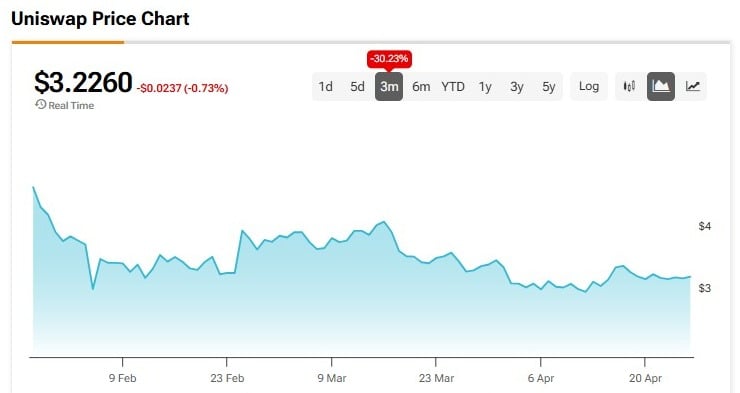
Uniswap is the world’s largest decentralized exchange (DEX), where anyone can swap crypto tokens directly from their wallet without a middleman. UNI currently trades around $3.27, with a market cap of roughly $3 billion, down more than 90% from its 2021 all-time high. The UNIfication vote did not immediately move the price. What it changed was what UNI actually is, evolving from a basic governance token into a real asset that finally holds direct value.
What the Fee Switch Actually Does
To understand why this matters, it helps to know how Uniswap works. When someone swaps tokens on the platform, they pay a nominal trading fee. Until December 2025, every cent of that fee went directly to liquidity providers, that is, those who deposit tokens into Uniswap’s pools to make trading possible. So UNI holders governed the protocol but received no financial benefit from it.
The UNIfication proposal changed that by activating a “fee switch,” a mechanism built into Uniswap’s code that redirects a portion of trading fees to the protocol itself. On December 25, 2025, 125,342,017 UNI voted in favor of the proposal. Just 742 voted against. That is 99.9% approval, one of the most decisive governance votes in decentralized finance history.
How the New Fee Structure Works
Under the new model, liquidity providers on Uniswap v2 — the passive, ERC-20 token-based standard — see their fee share reduced slightly, from 0.3% to 0.25%, per trade, with the remaining 0.05% now going to the protocol. On v3, the efficiency-focused model utilizing non-fungible tokens (NFTs) such as ERC-721, the protocol captures between 16.7% and 25% of liquidity provider fees, depending on the pool. These protocol fees are then used to buy back and burn UNI tokens, permanently removing them from circulation.
Alongside activating the fee switch, Uniswap Labs did something equally significant: it stopped charging its own fees on the Uniswap website, wallet, and Application Programming Interface (API). Users now pay nothing to access the interface. That removes a conflict of interest and repositions Uniswap as neutral infrastructure, with protocol-level revenue now being the only economic engine.
To mark the transition, the protocol also executed a one-time burn of 100 million UNI from its treasury on December 28, 2025, worth roughly $596 million at the time. This retroactively compensates long-term holders for the years when fees could have been used to burn supply but were not.
Early Signs Are Encouraging
The mechanism is already working. Since activation, Uniswap has burned over $5.5 million in UNI, and the protocol continues to expand. In February 2026, governance voted to extend the fee switch to eight additional blockchain networks beyond the Ethereum (ETH-USD) mainnet. That expansion means the burn rate should accelerate as trading volume on networks like Base, Arbitrum (ARB-USD), and Unichain grows.
Uniswap’s trading volume reached $27.6 billion in April 2026 alone, maintaining its dominant position among DEXs even as broader market activity slowed. That volume scale is what makes the burn mechanism meaningful. More trading means more fees captured, which means more UNI destroyed.
What This Means for Liquidity Providers
A reasonable concern is whether taking fees from liquidity providers will drive them away. If liquidity providers leave, trading pools become thinner, spreads widen, and the platform becomes less attractive, which would reduce volume and undermine the very burn mechanism the fee switch depends on.
Uniswap is addressing this through a new feature called the Protocol Fee Discount Auction. The idea is to capture extra value that automated trading bots currently extract from Uniswap’s pools on each trade and redirect a portion of it back to liquidity providers. Whether this fully makes up for the fee cut remains to be seen, but it shows that governance is actively working to keep liquidity providers from dropping off.
The Competitive Context
Uniswap has processed over $4 trillion in lifetime volume and leads all DEXs by a wide margin. Competitors like SushiSwap (SUSHI-USD) and Curve (CRV-USD) have fee-sharing models but operate at a fraction of Uniswap’s scale. Its liquidity depth makes it the default for most token swaps, a position smaller rivals cannot easily replicate.
The Risks Are Real
The central risk is volume dependency. In a prolonged crypto downturn, trading activity falls sharply. Fewer swaps mean fewer fees captured, resulting in a slower burn rate. The deflationary story depends entirely on sustained trading volume, and that is never guaranteed in crypto markets.
Regulatory uncertainty also remains. The previous United States Securities and Exchange Commission (SEC) sent Uniswap a Wells Notice, a formal warning that signals potential enforcement action, and while the regulatory environment has since improved, future actions cannot be ruled out. Any serious legal challenge could dampen volume and disrupt the fee mechanism.
A Clear Shift, with Conditions
For the first time, holding UNI means holding a stake in a protocol that captures its own revenue. The burn mechanism is live, the 100 million UNI are gone permanently, and the expansion to new chains is underway. These are structural changes, not promises.
However, the investment case depends on Uniswap maintaining its volume lead and liquidity providers staying engaged. At $3.27, the market is pricing in continued skepticism. The bull case is that sustained volume and the expanding fee switch close the gap between what Uniswap earns and what UNI reflects.