



Uber’s (UBER) platform expansion and strong growth keep the bull case alive, even after a rough stretch for the stock. Shares are down over 20% over the past six months, while the S&P 500 (SPX) is up more than 6% over the same period. I view that underperformance as an opportunity rather than a warning sign.
Claim 55% Off TipRanks
Forget margin or options. Here's how the pros trade TSLAUber remains a global leader in Mobility and Delivery, continues to expand into new use cases, and is building a broader platform that could support durable earnings and free cash flow growth. Q1 results on May 6 indicate record cash generation and significant margin expansion, underscoring Uber’s successful transition into a highly profitable, scalable platform. For these reasons, I remain bullish on UBER.
Uber Is Moving beyond Rides and Food Delivery
Uber’s recent GO-GET event offered a clear look into management’s long-term strategy. The company announced a major expansion into travel through a partnership with Expedia (EXPE), giving users access to more than 700,000 hotel properties globally. Uber One members will benefit from 10% back in credits on hotel bookings and at least a 20% discount on thousands of properties.
This move is part of a broader shift. Uber is no longer just a ride-hailing or food delivery platform — it is evolving into an “everything app” for local and travel-related services. Features like Travel Mode, Voice Bookings, Shop for Me, and Eats for the Way are all designed to increase user engagement and drive higher usage frequency.
The expansion of One Search, which aggregates transportation, food, and shopping into a single interface, further reinforces this strategy. As Uber integrates more services into one platform, it strengthens its ecosystem and makes it harder for users to leave.
Core Growth Still Looks Healthy
Beyond new initiatives, Uber’s core business remains strong. Q1 gross bookings grew 21% year-over-year to $53.7 billion, exceeding expectations. Adjusted EBITDA grew nearly 33%, reflecting continued operating leverage. Mobility bookings increased about 20%, while Delivery bookings accelerated 23%, showing strength across both segments.
Another positive is that Uber’s growth is not coming from just one lever. Premium offerings like Uber Black and alternative formats like Uber Moto are growing at strong double-digit rates. This diversification suggests Uber is still uncovering new demand pockets within its existing network.
Uber One remains a key growth driver, with membership surpassing 50 million users in April, up 50% year-over-year. Today, 20% of eligible consumers are active across both businesses — Mobility and Delivery — and this rises to 40% for Uber One members. So, 40% of customers use multiple products, boosting retention and lifetime value. On the Delivery side, growth remains robust, supported by grocery, retail, and advertising.
AV Risk Is Real, but Uber Is Building a Strategy
Autonomous vehicles (AV) remain one of the biggest long-term uncertainties for Uber. Critics argue that AV operators such as Waymo and Tesla (TSLA) could eventually disrupt the ridesharing model, particularly in dense urban markets where economics are most attractive.
However, Uber is not ignoring this risk. Instead, it is positioning itself as a platform that enables AV adoption rather than competing directly in building vehicles. The company has formed partnerships with multiple AV players, including Zoox, WeRide (WRD), Baidu’s Apollo Go (BIDU), Nuro, and others.
The Zoox partnership, for example, will bring robotaxi services to Las Vegas this year and Los Angeles in the near future. Uber is also building infrastructure around fleet management, financing, insurance, and operations — essentially creating a plug-and-play ecosystem for AV partners. This approach could prove powerful. If the AV market ends up being fragmented globally, Uber’s platform could act as the aggregation layer connecting supply and demand, much like it does today with human drivers.
Valuation Looks Attractive
From a valuation perspective, Uber appears cheap relative to its growth potential. The stock currently trades at a P/E ratio of about 16.9, compared to a sector median closer to 26.
I also calculated Uber’s intrinsic value using 12 valuation models, including P/E multiples, EV/EBITDA multiples, and a 10-year discounted cash flow model. My fair value estimate is around $100 per share, implying more than 26% upside from current levels.
Wall Street’s View
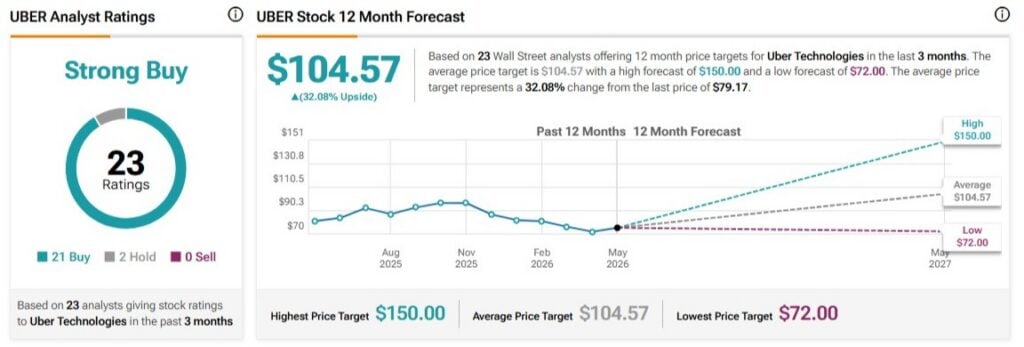
According to TipRanks, Uber carries a Strong Buy consensus rating, with 21 Buy, two Hold, and no Sell ratings. Based on 23 Wall Street analysts, the average 12-month price target stands at $104.57, representing approximately 32.08% upside from the current price of $79.17.
Conclusion
Uber is not without risks, particularly around autonomous vehicles and macroeconomic uncertainty. However, the company’s fundamentals remain strong. Core Mobility and Delivery businesses continue to grow at healthy rates, while new initiatives are expanding the total addressable market.
The platform strategy is becoming clearer, with Uber evolving into a multi-service ecosystem that drives higher engagement and monetization. At the same time, valuation remains reasonable relative to growth, and free cash flow generation is improving meaningfully.
After a significant pullback in the stock, the risk-reward profile looks increasingly attractive. For long-term investors willing to look past near-term volatility, I continue to see Uber as a compelling growth story.