U.S. humanoid makers like Tesla (TSLA) were slammed as being too slow compared with Chinese rivals set to export thousands of robots around the world.
Claim 55% Off TipRanks
Trade TSLA with leverageChina Spots the Next Big Thing
According to a new report from investment bank Morgan Stanley (MS), U.S. companies, like Tesla working on its Optimus robot, have focused to date on high-cost and high-spec humanoid prototypes. They have an emphasis on testing before ramping up production, while China in comparison has been much quicker to roll out models.
Indeed, Tesla in its recent Q1 results said that preparations for the company’s first large-scale Optimus factory “will begin shortly in Q2.” The first-generation production line will be located at Tesla’s Fremont plant, where the Model S and Model X assembly lines will be converted for Optimus production. Tesla said this line could potentially produce 1 million robots per year.
However, this is still behind Chinese rivals like Unitree and Agibot whose robots have been seen dancing, running and twirling for many months now in the fields of defense, sport, entertainment and logistics. China dominates the humanoid market which, according to Goldman Sachs (GS), could grow from about $3 billion in 2023 to as much as $38 billion by 2035.
Morgan Stanley’s chief Asia economist Chetan Ahya said China has a track record of spotting the next big growth areas early and planning ahead citing China’s now-dominant EV and battery industries. “The robotics industry has followed a similar path,” he said.
Chinese Manufacturing Expansion
Ahya said that over the last couple of years robotics has shifted from the lab to the real world, with Chinese tech parks, factories and universities among those deploying humanoids. It is also begin to dominate inputs and components including crucial parts of a humanoid such as dexterous hands.
That means it now has an edge over rivals in the U.S., Japan and South Korea, which rely on Chinese supplies.
China’s investments and early lead over the U.S. in the development of humanoid robotics would help power the next phase of its global manufacturing and export dominance, Morgan Stanley said. It sees China’s share of global manufacturing expanding to 16.5% by 2030, up from 15% today.
However, Morgan Stanley warned that China’s lead could also bring with it the threat of humanoid protectionism with tariffs and other regulatory restrictions put in place. That could be down to concerns over technical dependence or Chinese humanoids being seen as a security threat.
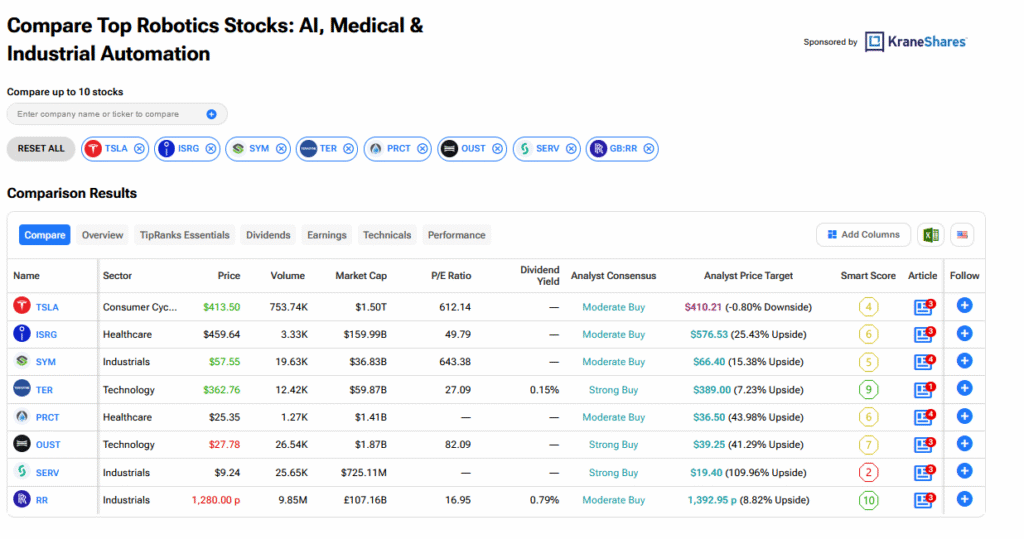
What are the Best Robotics Stocks to Buy Now?
We have rounded up the best Robotics stocks to buy now using our TipRanks comparison tool. As can be seen below, Serve Robotics (SERV) has the best upside of 109.96%.