It was not all that long ago that home improvement giant Home Depot (HD) was convinced that the supply chain would never be a big player in its operations. CFO Richard McPhail once reportedly noted: “Supply chain is important but it will never be a competitive advantage of the Home Depot.” McPhail ate his words nearly 20 years later, declaring, “…the exact opposite is true.” This realization has value, but shareholders still left, sending Home Depot shares down modestly in Wednesday morning’s trading.
Claim 55% Off TipRanks
- Unlock hedge fund-level data and powerful investing tools for smarter, sharper decisions
- Discover top-performing stock ideas and upgrade to a portfolio of market leaders with Smart Investor Picks
McPhail took his lumps, and continued, “It fills me with pride when I talk to my investors about how our supply chain is absolutely a strategic weapon.” Home Depot put a lot of investment, and a lot of design work, into reconsidering its supply chain and how it works. Back in the 2000s, Home Depot routinely had products shipped from vendors to stores, an inefficient model that could not scale.
But Home Depot pivoted, starting to build “rapid-deployment centers” that could better supply individual store needs by giving vendors centralized locations to ship to. Home Depot could then disseminate replacement product as needed, thus improving efficiency and giving customers a better overall experience.
An Iconic Brand
This was good news for Home Depot as it was, but then, USA Today released a report that declared Home Depot part of its list of “Iconic Brands.” The listing was established as part of the United States’ 250th anniversary this year, and shows off some of the best in American business.
How did USA Today pick Home Depot? That supply chain was certainly a help, but Home Depot started out with an idea that had a hand in fundamentally shaking up American retail. The report notes that Home Depot was one of the first entrants in the big box store concept. That concept remains in place today, even though it has been somewhat shaken by online shopping in recent years. The report’s capstone: “Home Depot did not invent DIY culture, but it did institutionalize it.”
Is Home Depot a Good Long-Term Buy?
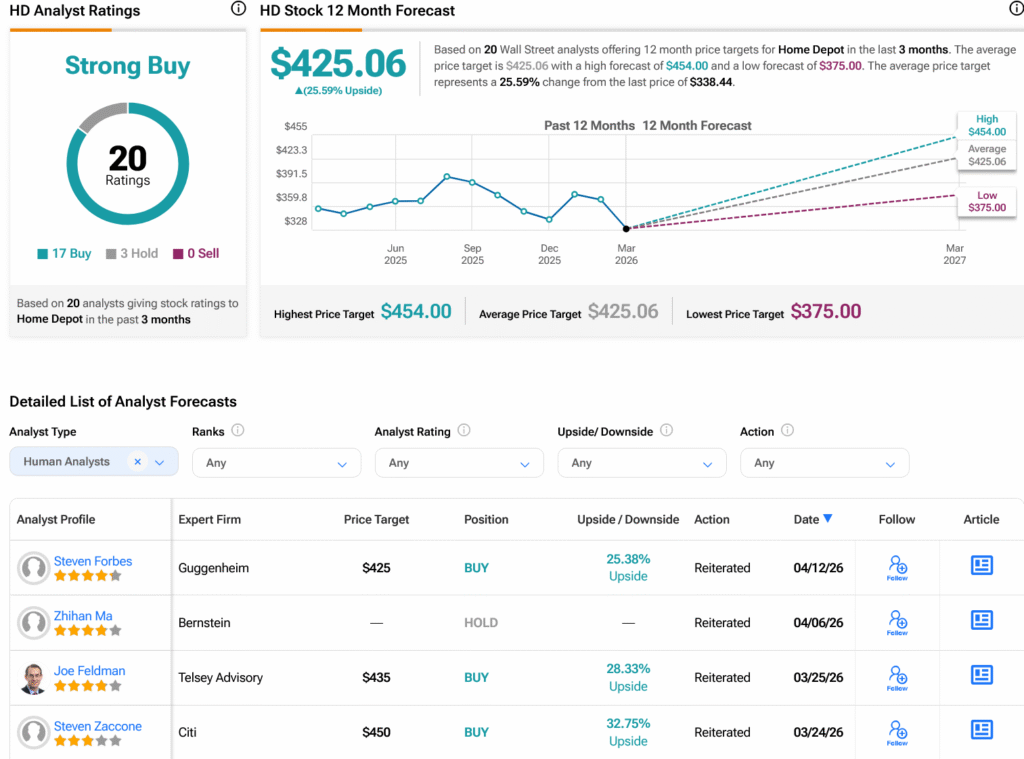
Turning to Wall Street, analysts have a Strong Buy consensus rating on HD stock based on 17 Buys and three Holds assigned in the past three months, as indicated by the graphic below. After a 0.95% loss in its share price over the past year, the average HD price target of $425.06 per share implies 25.59% upside potential.