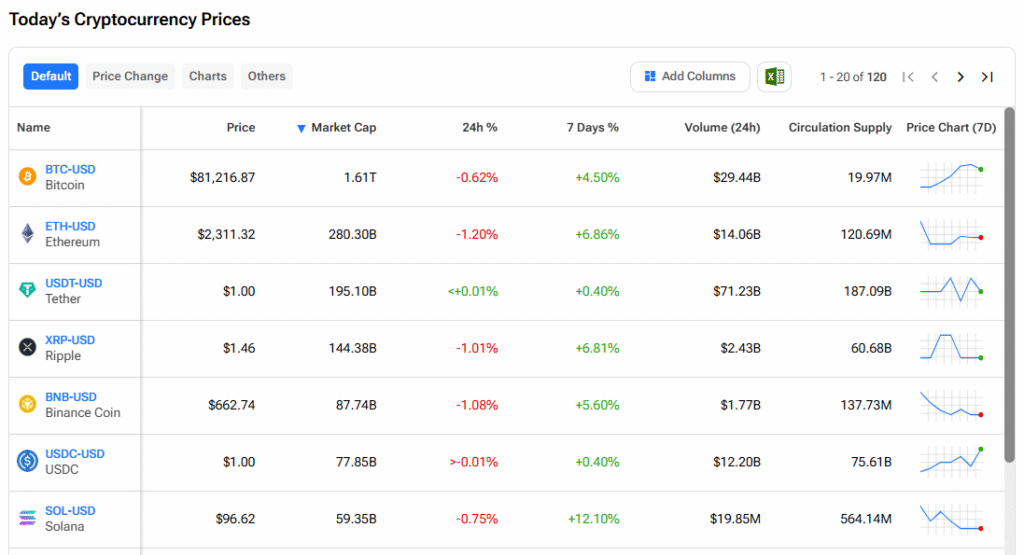
Stablecoins are no longer just tools for crypto traders or liquidity flows inside digital asset markets. They are increasingly becoming a real layer of global financial infrastructure, with growing influence across payments, treasury management, remittances, and cross-border settlement. The scale now makes that difficult to ignore. Total stablecoin supply reached a record $321 billion in April 2026, while transaction volume surpassed $33 trillion in 2025, exceeding Visa’s (V) annual payment volume.
Claim 55% Off TipRanks
- Unlock hedge fund-level data and powerful investing tools for smarter, sharper decisions
- Discover top-performing stock ideas and upgrade to a portfolio of market leaders with Smart Investor Picks
With this, the stablecoins’ story no longer looks purely speculative and starts to look more structural.
Why Do Stablecoins Matter
A stablecoin is a digital asset designed to hold a fixed value, usually pegged one-to-one to the U.S. dollar. The two dominant players are Tether (USDT-USD), which holds roughly 58% of the market with a $185 billion market cap, and USD Coin (USDC-USD), which has grown to around $78 billion.
Their core function is simple. Instead of selling Bitcoin (BTC-USD) into dollars and wiring funds through a bank, traders sell into USDT or USDC and move that capital instantly across blockchains. That removes friction and allows markets to operate continuously. Stablecoins now account for 75% of crypto trading volume, making them the default unit of exchange across nearly every exchange and decentralized finance (DeFi) platform.
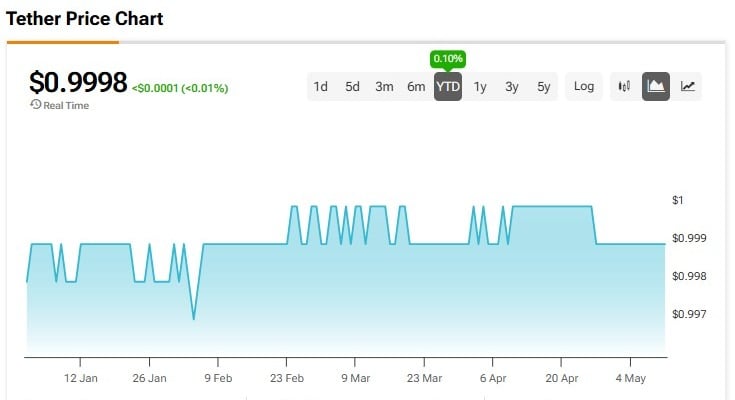
From Crypto Tool to Financial Infrastructure
What has changed is not just how much stablecoins are used, but where. Ran Cohen, CEO of payments platform BridgerPay, describes the shift as a move from crypto plumbing to something much broader. Stablecoins, he says, “started as crypto infrastructure, but they are increasingly becoming a bridge for traditional capital. Not because every bank suddenly wants to become ‘crypto native,’ but because stablecoins solve real financial problems: speed, liquidity, settlement cost, global reach, and operational flexibility.”
That shift is visible in the numbers. Visa has expanded its stablecoin settlement program to nine blockchains, reaching an annualized settlement volume of $7 billion, up 50% in a single quarter. Meta (META) began paying creators in USDC via Stripe in April 2026. The GENIUS Act, signed into U.S. law in July 2025, established a federal framework for stablecoin issuers.
Liquidity Signals and Capital Flows
For investors, one of the most practical implications of stablecoin growth is what it reveals about market liquidity. When stablecoin supply expands, it typically signals fresh capital entering the crypto ecosystem. That capital does not immediately buy Bitcoin or Ethereum (ETH-USD).
Instead, it sits in stablecoin form, ready to be deployed when sentiment turns positive. That dynamic makes stablecoin issuance a leading indicator of market strength rather than a lagging one.
Because transactions occur on public blockchains, analysts can track stablecoin inflows to exchanges, issuance patterns, and wallet movements in real time. Large inflows to exchanges often precede buying activity. Outflows can signal capital moving into longer-term positions or decentralized protocols. This transparency gives crypto investors visibility into capital flows that simply do not exist in traditional markets.

The Cross-Border Opportunity
The most underappreciated part of the stablecoin story is what is happening in emerging markets. Hamish Johnston, Crypto Vertical Lead (EMEA and APAC) at payment infrastructure company dLocal (DLO), says that in the markets his company operates in across Latin America, Africa, and Asia, “the demand isn’t speculative. It’s merchants wanting dollar-denominated settlement, businesses hedging foreign exchange (FX) exposure, and cross-border payments that need to move faster than traditional correspondent banking allows.”
This is the capital flow story that often gets missed. Stablecoins are giving businesses in markets with volatile currencies access to stable, portable dollar liquidity that was previously unavailable to them. That is a structural source of demand that is entirely disconnected from crypto market sentiment.
Regulation Is Clarifying, Not Closing
Regulatory uncertainty has historically been one of the biggest risks cited for stablecoins. That picture is becoming clearer. Europe’s Markets in Crypto-Assets Regulation (MiCA) framework established formal rules for stablecoin issuers in 2024. The 2025 U.S. GENIUS Act established a federal structure requiring reserves to be backed one-to-one by high-quality liquid assets.
These frameworks are removing compliance barriers that slowed institutional adoption. However, they also introduce new constraints. The GENIUS Act, for instance, contains a provision under debate that could prohibit stablecoins from paying yield to holders, which would directly affect products like PayPal USD (PYUSD) by PayPal (PYPL). Regulation in this space is legitimizing, but it is also reshaping which business models survive.
What Investors Should Watch
Stablecoins do not generate returns on their own. However, understanding their role sharpens investors’ reading of broader market conditions. Rising supply signals incoming liquidity. Contraction signals tightening. Exchange inflows signal intent to buy.
The market’s concentration in USDT and USDC is also a risk worth keeping in mind. Any disruption to either issuer, whether from a regulatory action or a reserve transparency crisis, could tighten liquidity quickly across both centralized exchanges and decentralized protocols. The infrastructure that makes markets faster also makes them more interconnected and more exposed to single points of failure.
As Cohen puts it, “the future is about which infrastructure moves value faster, cheaper, safer, and with better data.” That may be true. Yet for investors, the more immediate question is whether the stablecoin market’s growing concentration and regulatory exposure introduce risks that the headline growth numbers do not fully capture.