


SoFi Technologies (SOFI) is entering what could be its most important earnings moment yet, as the company looks to prove its transition from a loss-making lender to a profitable fintech platform. The stock already reflects significant progress, trading well above 30x forward earnings, and pricing in resilient 2.5% U.S. gross domestic product (GDP) growth alongside a potential Federal Reserve rate cut. However, current macro conditions characterized by stickier-than-expected inflation may not support such an optimistic outlook.
Meet Samuel – Your Personal Investing Prophet
- Start a conversation with TipRanks’ trusted, data-backed investment intelligence
- Ask Samuel about stocks, your portfolio, or the market and get instant, personalized insights in seconds
Until the financial technology company’s April 29 earnings release, I maintain a Hold stance on SOFI, as the metrics will help clarify whether the current premium is justified or premature.
Tailwinds: Record 2025 Results Validate the Platform Shift
SoFi’s full-year results in 2025 make a genuine case for the long-term thesis. Adjusted net revenue reached $3.6 billion for the full year, up 38% year-over-year, and Q4 2025 marked the company’s first billion-dollar quarter at $1.013 billion, up 37% year-over-year. Net income also turned positive at $481 million after several years of losses.
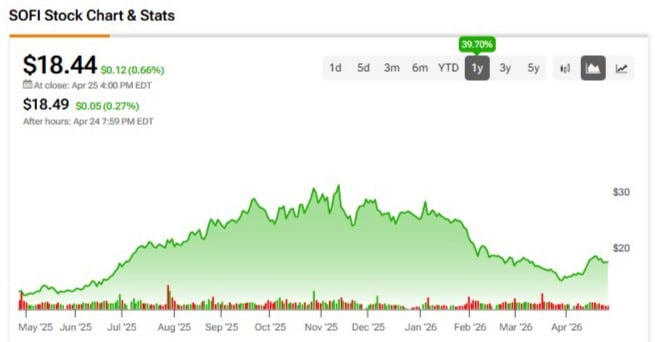
The composition of growth has been the catalyst behind the 48% increase in the SoFi stock price over the past 12 months. Fee-based revenue, driven by the Financial Services and Technology Platform segments, now accounts for over half of total revenue and reduces dependence on net interest income (NII). Total fee-based revenue in Q4 reached $443 million, up approximately 53% year-over-year.
Member count rose 35% year-over-year to 13.7 million, and total products on the platform surpassed 20 million, with 40% of new products opened by existing members.
Beyond the headline numbers, SoFi’s platform credentials are also strengthening. The company became the first nationally chartered U.S. bank to offer XRP (XRP-USD) deposits. Management also launched its Big Business Banking platform, integrating 24/7 fiat and crypto services with partners including Mastercard (MA) and BitGo (BTGO). Forbes also ranked SoFi the number one bank in the U.S. in April 2026, ahead of JPMorgan Chase (JPM) and Bank of America (BAC), based on a customer survey.
Headwinds: Guidance Assumptions Are Softening as Macro Conditions Shift
For 2026, SoFi’s management guided to adjusted net revenue of approximately $4.65 billion, up roughly 30% year-over-year and adjusted earnings per share (EPS) of approximately $0.60. That guidance is built on assumptions the market is already debating: two Fed rate cuts to a 3%–3.25% year-end policy rate and approximately 2.5% real GDP growth, neither of which is the current base case. Barclays (BCS) captured the shift directly, cutting its SOFI stock price target from $28 to $18 in April and noting that sector valuations across consumer finance have pulled back to below historical averages.
This change in the macro outlook could affect investor sentiment toward SoFi and its earnings. Net interest margin declined 12 basis points (bps) sequentially in Q4 2025 to 5.72%, while lending still drives the largest share of segment earnings. A delayed Fed easing cycle could easily compress the spread between loan yields and funding costs, while a softer growth backdrop introduces credit risk.
Personal loan charge-offs rose 20 bps quarter-over-quarter to 2.80%, and 90-day delinquencies increased nine bps. Student loan charge-offs also ticked up.
Compounding the picture, a large Technology Platform client exited before year-end 2025, which meant the loss of a recurring revenue contributor. The Technology Platform segment revenue grew 19% in Q4, trailing the company-wide rate, while management still guides for more than 20% pro forma growth for the full year. In other words, on April 29, SoFi Technologies will deliver the first hard data on whether that target is intact.
At Over 30x Forward Earnings, the Stock Needs Q1 to Deliver
SoFi, which offers no dividend, currently trades at a forward multiple well above 30x, in sharp contrast to peers in consumer finance. For example, OneMain Holdings (OMF) trades at 8x forward earnings and a 7.1% dividend yield. Similarly, SLM (SLM) trades at 8.5x forward earnings with a 2.1% dividend yield. Finally, Ally Financial (ALLY) also has a forward P/E ratio of 8x and a dividend yield of 2.7%.
Adding to the valuation debate, Muddy Waters Research published a short-seller report in March 2026 alleging $312 million in unrecorded debt and calling SoFi a financial engineering treadmill. Management disputed the claims, while CEO Anthony Noto responded by purchasing 28,900 shares in the open market at $17.32, signaling personal conviction.
Therefore, the upcoming earnings report is now a credibility test as much as a financial one, and a clean quarter would understandably go a long way toward resolving the potential accounting controversy.
Is SOFI Stock a Buy, Sell, or Hold?
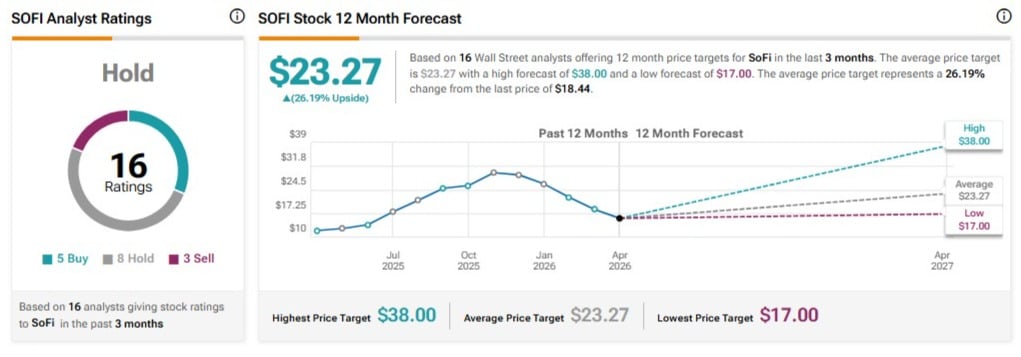
Based on 16 Wall Street analysts covering SoFi stock over the past three months, the stock carries a Hold consensus rating, consisting of five Buy, eight Hold and three Sell ratings. The average price target is $23.27, implying upside of approximately 26.19% from the current price of $18.44, with a high forecast of $38.00 and a low of $17.00.
Conclusion
SoFi Technologies has been building a platform worth owning over a longer horizon. The revenue trajectory is real, profitability has turned, and the shift toward fee-based and capital-light revenue is structural. At over 30x forward earnings, however, I believe the stock already reflects much of that progress, and the macro assumptions underpinning 2026 guidance are now less secure than they were in January.
Yet, results to be released on April 29 could change the calculus. A strong Q1 result showing net interest margin is holding, credit quality is stable, and Technology Platform growth is on track would give the premium a foundation worth paying, and would go some way toward rebutting the Muddy Waters allegations. A cautious update would not. I would hold here and revisit the thesis after the report before committing in either direction.