



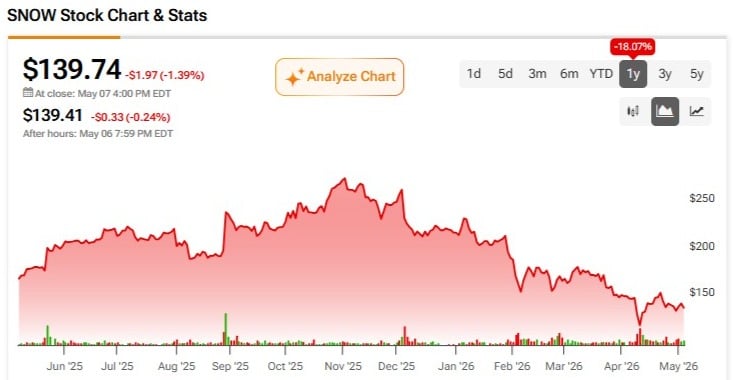
After an initial phase of hypergrowth, Snowflake’s (SNOW) shares have been volatile as revenue growth has cooled and investors reassess how much usage-based demand remains amid tighter cloud spending. Snowflake believes artificial intelligence (AI) can help restart growth and get it back on track, but the company still needs to prove it can turn that opportunity into more stable demand.
Claim 55% Off TipRanks
Forget margin or options. Here's how the pros trade AMZNSnowflake operates a cloud-native data platform that lets enterprises store, process, and analyze data across public clouds and has recently started repositioning itself as an AI Data Cloud with added capabilities in governance, data sharing, and AI workloads. A mix of solid execution and high expectations now leaves the valuation full, keeping me neutral until Snowflake can show that AI and applications translate into a sustained re-acceleration in growth.
Usage Volatility: Strong Cohorts, Slow Expansion
According to Snowflake’s financial results, the company’s key performance indicator (KPI) remains its net revenue retention rate, which has held around 125% in Q4 2026. That stability suggests existing customers continue to increase their workloads and use cases on Snowflake, underlining the platform’s importance to their data architecture.
Snowflake closed its latest fiscal year with 733 customers generating more than $1 million over the prior 12 months, a 27% year-over-year increase, underscoring the depth of its large customer base. It had a product revenue of $1.23 billion, growing at roughly 30% year-over-year, down from 50% year-over-year during Snowflake’s hyper-growth era.
Is AI the Next Growth Frontier?
Snowflake’s pivot into AI and application development is a strategic ploy to serve as a growth engine, not just an add-on to its core data business. The company is rolling out Snowflake Intelligence to embed agentic AI capabilities into the data layer. At the same time, Cortex Code integrates with external systems such as Amazon (AMZN) Web Services (AWS) Glue and Databricks, enabling customers to build and operate AI workflows near their data.
In addition, management has emphasized on earnings calls that AI workloads are growing faster than the core platform. Meanwhile, Snowflake Marketplace allows third-party providers to monetize data sets, AI models, and applications via transaction fees, creating a higher-margin revenue stream beyond pure consumption and possibly offering higher incremental margins.
Despite a recent lawsuit over inflated share prices in 2023 and early 2024, the optimistic outlook is that as enterprises roll out AI more broadly, they will concentrate spending on a small number of data control planes rather than on numerous fragmented ones. Snowflake’s AI Data Cloud could be among them. If Snowflake succeeds, AI applications and marketplace transactions could turn today’s volatile usage spikes into more embedded, recurring revenue streams tied to products rather than one-off queries.
Margins Are Improving, but the Market Wants More
While growth has slowed, Snowflake’s profitability profile has improved. The company has pushed non-GAAP operating margin to 10–11%, and management is guiding to roughly 12%, up from about 9–10% previously.
This metric places Snowflake in the camp of high-margin, capital-light software businesses, though it still trails the 25%-plus non-GAAP operating margins earned by mature cloud names like Microsoft (MSFT) and Adobe (ADBE). Snowflake’s usage-based pricing model makes its revenue more volatile than with regular subscriptions, so investors demand substantial growth and visible profitability to justify a premium multiple.
Because the stock is more expensive than its software peers, the market expects the company to deliver both fast growth and high profits simultaneously.
How Does It Stack Up Against Datadog and MongoDB?
Investors often classify Snowflake alongside Datadog (DDOG) and MongoDB (MDB) as part of a modern data stack cohort, but their financial profiles and valuation setups are distinct. Datadog pairs solid revenue growth with expanding operating margins, which support a robust EV/sales multiple. MongoDB, with its document database and Atlas cloud service, has seen slow growth but continues to command a robust EV/revenue multiple of roughly 7–8x, given its strategic role in developer stacks.
Snowflake’s current growth profile is similar to, or slightly better than, those of Datadog and MongoDB. It trades at around 9.5x last 12 months EV/revenue and 8x FY2027 forward EV/revenue, reflecting higher expectations that AI and marketplace monetization will add a second chapter of growth.
If AI workloads deliver the product revenue growth implied by consensus estimates for Fiscal 2027, the multiple looks defensible. If not, Snowflake’s multiple could drift closer to the levels assigned to Datadog and MongoDB as investors reset expectations.
What Is the Market’s View?
On TipRanks, SNOW has a Strong Buy consensus rating. Based on 33 Wall Street analysts’ ratings over the past three months, the breakdown is 30 Buys, three Holds, and zero Sells. The average 12-month SNOW price target on TipRanks is $225.17, implying a 61.13% upside from the last price of $139.74.

The highest price target is $282, while the lowest is $125. Broader TipRanks data also assigns SNOW a Neutral Smart Score of six.
Final Thoughts
Snowflake remains a high-quality data and AI platform with excellent net revenue retention, a growing base of large customers, and improving profitability, but its once-explosive growth has settled into a more mature pace.
At today’s share price, a neutral stance looks objective. The AI and application-layer strategy is convincing on paper, yet investors need to see it translate into faster, more durable, and more profitable growth. Until that evidence is there, Snowflake’s current premium valuation seems justified.