


Shopify (SHOP) remains a strong growth story despite fears that artificial intelligence (AI) may change how consumers discover products. The stock is down nearly 25% year-to-date, badly trailing the S&P 500’s (SPX) roughly 5% gain over the same period, but I see that pullback as an opportunity. Shopify remains one of the most important commerce infrastructure platforms in the world, serving millions of merchants and continuing to gain share across small businesses, enterprise brands, international markets, payments, and emerging commerce channels.
Meet Samuel – Your Personal Investing Prophet
- Start a conversation with TipRanks’ trusted, data-backed investment intelligence
- Ask Samuel about stocks, your portfolio, or the market and get instant, personalized insights in seconds
I am bullish on Shopify because the underlying business appears much healthier than the stock chart suggests. While AI may influence product discovery, Shopify’s role in checkout, payments, merchant infrastructure, and commerce operations should remain highly relevant.
Shopify’s Growth Momentum Still Looks Strong
Recent data points suggest Shopify entered 2026 with strong momentum. U.S. Census data showed U.S. e-commerce sales rising about 10% year-over-year in Q1, accelerating from nearly 8.9% growth in Q4. Based on the relationship between Shopify’s gross merchandise volume (GMV) and broader e-commerce growth, Q1 GMV may have grown to over $110 billion, above consensus expectations in the range of $102 billion to $105 billion.
That would mark another strong quarter after Shopify delivered Q4 GMV of $123.8 billion, up 31.1% year-over-year and ahead of consensus. Revenue in Q4 rose 31% year-over-year to $3.7 billion, marking the company’s 11th consecutive quarter of over 25% revenue growth, excluding its divested logistics business.
Merchant growth also remains healthy. Store Leads data indicates Shopify’s total merchants rose 11% year-over-year in Q1, while Shopify Plus merchants increased 21%, the fastest growth rate since late 2021. That is important because Plus and enterprise merchants can drive larger GMV, higher payment volume, and broader adoption of Shopify’s merchant solutions.
Enterprise, Payments, and International Expansion Add Runway
Shopify is no longer just a platform for small online merchants. Larger merchants are becoming a major part of the story. Management noted that merchants generating more than $25 million in annual GMV are currently the fastest-growing cohort. Recent enterprise wins include brands such as Corsair (CRSR), Cole Haan, and Pressed Juicery.
Payments are another major growth lever. Shopify Payments penetration reached 68% of GMV in Q4 2025, up from 64% in Q4 2024. For the full year, Shopify Payments facilitated an additional $67.2 billion of GMV, up 37% year-over-year. Management expects payment penetration to continue rising, with one outlook calling for penetration to increase from 66% in Fiscal 2025 to 70% by 2027.
International growth is also encouraging. International revenue increased 36% year-over-year in 2025 and represented 32% of Shopify’s revenue mix. Europe remains a key opportunity, and management continues to invest in international marketing, with 40% of Q4 marketing spend outside North America.
AI Fears Look Overdone
The market is worried that AI agents could disrupt e-commerce discovery and reduce the value of platforms like Shopify. I think that concern is overstated.
Shopify is not simply a storefront builder. It is a commerce operating system that handles checkout, payments, merchant tools, fulfillment integrations, capital, point of sale (POS), business-to-business (B2B), and increasingly, external commerce channels. Management has emphasized that transactions routed through agentic commerce partners such as OpenAI would still flow through Shopify’s backend commerce system, including Shopify Payments, with no change to Shopify’s take-rate structure.
That is a crucial point. If AI agents become another shopping channel, Shopify can benefit by helping merchants sell wherever consumers choose to buy. In that sense, agentic commerce may be more of a channel expansion opportunity than an existential threat. Management also argues that checkout is “deceptively hard.” That is believable. Payments, fraud, taxes, inventory, merchant preferences, compliance, and customer data are all deeply complex. Shopify’s infrastructure gives it a real moat in this layer of commerce.
Margins Can Improve over Time
Shopify’s gross margin has faced pressure because Merchant Solutions, especially payments, is growing faster than Subscription Solutions. In Q4, gross margin was 46.1%, down 200 basis points year-over-year. Still, operating leverage is improving. Q4 operating income reached $631 million, or a 17.2% margin, ahead of consensus expectations.
In the longer term, margin expansion remains a key part of the bull case. I estimate adjusted operating margin to rise from 17.1% in Fiscal 2025 to 19% in 2027, with the potential to exceed the 24% range over time through operating leverage, AI-based automation, higher pricing, and deeper monetization of GMV.
Valuation Looks More Reasonable after the Pullback
Shopify is not a cheap stock in a traditional sense, but the valuation has reset meaningfully. I calculated Shopify’s intrinsic value using 12 valuation models, including EV/revenue multiples, a five-year discounted cash flow (DCF) revenue exit model, and P/E multiples. My fair value estimate is around $135 per share, implying roughly 11.45% upside from the current stock price.
Wall Street’s View
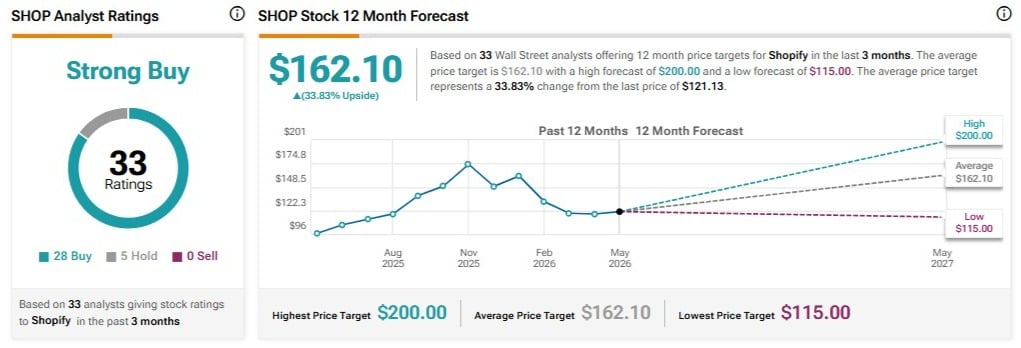
According to TipRanks, Shopify has a Strong Buy consensus rating, with 28 Buy, five Hold, and no Sell ratings. Based on 33 Wall Street analysts, the average 12-month price target is $162.10, implying 33.83% upside from the last price of $121.13.
Conclusion
I am bullish on Shopify because the company’s fundamentals remain strong despite the stock’s year-to-date decline. GMV growth is robust, enterprise adoption is accelerating, payments penetration continues to rise, international expansion is working, and AI fears appear overdone.
Shopify may face volatility as investors debate the future of commerce, but I believe it remains one of the best long-term growth platforms in software and e-commerce infrastructure. The recent pullback looks like a good opportunity for investors willing to look beyond near-term AI fears.