


Income-focused investors often compare top dividend ETFs to balance current income and long-term growth. While the Schwab U.S. Dividend Equity ETF (SCHD) is known for its high yield and the Vanguard Dividend Appreciation ETF (VIG) focuses on steady dividend growth, the iShares Core Dividend Growth ETF from BlackRock (DGRO) offers a mix of both income and potential price gains.
Claim 55% Off TipRanks
- Unlock hedge fund-level data and powerful investing tools for smarter, sharper decisions
- Discover top-performing stock ideas and upgrade to a portfolio of market leaders with Smart Investor Picks
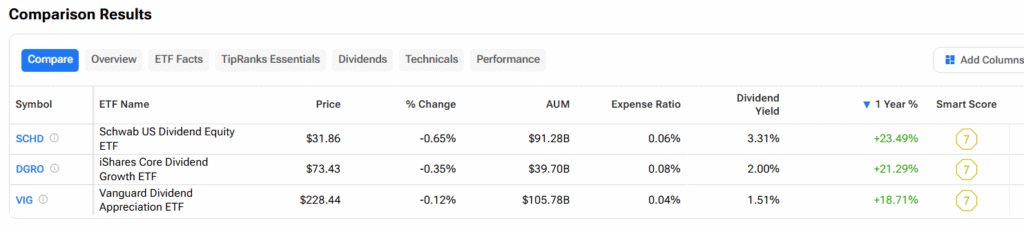
Using TipRanks’ ETF Comparison Tool, we compared these three funds to identify the best dividend ETF for investors right now.
Schwab U.S. Dividend Equity ETF (SCHD)
The Schwab U.S. Dividend Equity ETF (SCHD) is the primary choice for investors seeking strong current income. It focuses on 100 high-quality U.S. companies with a consistent dividend track record.
SCHD currently offers the highest yield in this group at 3.31% and pays a quarterly dividend of $0.331 per share. In addition, it has delivered the strongest one-year return, rising 23.49%. The fund manages about $91.28 billion in assets and remains cost-efficient with a low 0.06% expense ratio.
Is SCHD a Good ETF to Invest In?
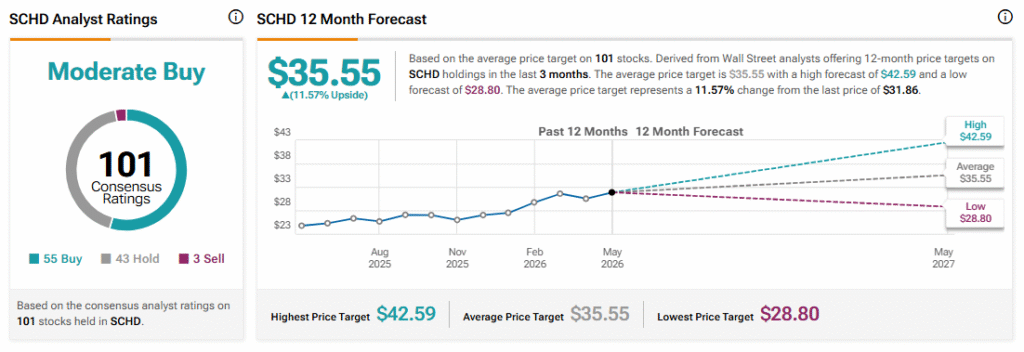
According to TipRanks’ ETF analyst consensus, SCHD is rated a Moderate Buy. The average price target of $35.55 implies an upside of about 11.57%. SCHD’s top two holdings with the highest upside are Broadridge Financial (BR) and Accenture (ACN).
iShares Core Dividend Growth ETF (DGRO)
The iShares Core Dividend Growth ETF (DGRO) tracks an index of U.S. companies with a strong record of growing dividends. It focuses on firms with consistent earnings and sustainable payout ratios, helping avoid companies with overly high or risky dividend yields.
DGRO offers a 2.00% yield and pays a quarterly dividend of $0.331 per share. Over the past year, the fund has gained 21.29%. It manages about $39.70 billion in assets. Meanwhile, the ETF has an expense ratio of 0.08%, slightly higher than its peers.
Is the DGRO ETF a Good Buy?
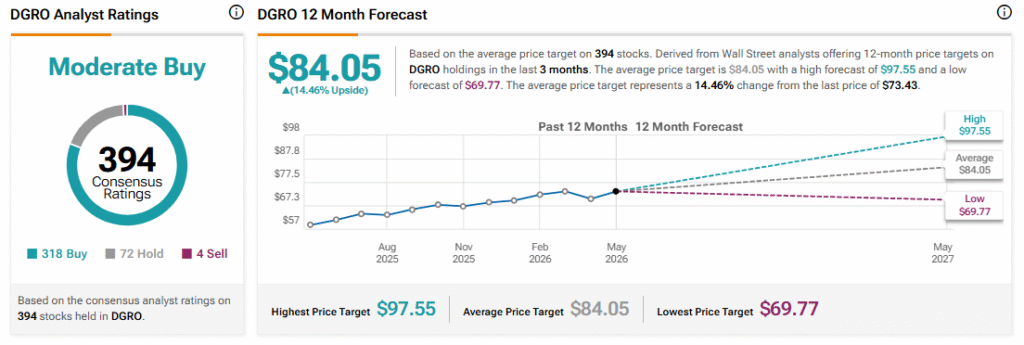
According to TipRanks’ unique ETF analyst consensus, determined based on a weighted average of analyst ratings on its holdings, DGRO is rated a Moderate Buy. The average price target of $84.05 implies an upside of about 14.46% over the next 12 months. DGRO’s top two holdings with the highest upside are Hamilton Lane (HLNE) and Wingstop (WING).
Vanguard Dividend Appreciation ETF (VIG)
The Vanguard Dividend Appreciation ETF tracks the S&P U.S. Dividend Growers Index and takes a more conservative approach. It invests in U.S. companies with a strong track record of consistently raising their dividends. To be included, a company must have increased its dividend for at least 10 consecutive years and cannot rank among the top 25% of highest-yielding eligible stocks.
As a result, VIG offers the lowest yield at 1.51% and pays a quarterly dividend of $0.884 per share. However, it still posted an 18.71% gain over the past year. Notably, it also has the lowest cost, with an expense ratio of just 0.04%.
Is VIG a Good ETF?
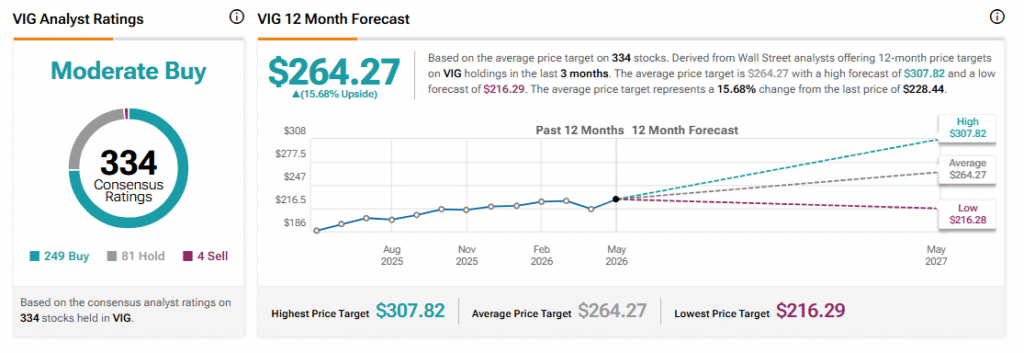
According to TipRanks’ unique ETF analyst consensus, determined based on a weighted average of analyst ratings on its holdings, VIG is a Moderate Buy. The Street’s average price target of $264.27 implies an upside of 15.68%. VIG’s top two holdings with the highest upside are Dolby Laboratories (DLB) and Texas Pacific Land (TPL).
Conclusion
SCHD stands out for investors focused on higher income today, supported by its strong yield and recent performance. DGRO, meanwhile, offers a more balanced mix of income and growth, making it a middle option between yield and stability. VIG is better suited for those who prefer a more conservative approach, with lower costs and a focus on long-term dividend growth.