


Rocket Lab (RKLB) reinforced the space infrastructure bull case with a record Q1 2026, as a doubled backlog and major defense wins confirmed its transition from small-satellite launcher into a vertically integrated defense prime. However, at roughly 105x sales and near all-time highs, RKLB stock remains vulnerable to near-term volatility. I remain bullish on RKLB and would view pullbacks in share price as long-term buying opportunities ahead of the anticipated SpaceX initial public offering (IPO).
Claim 55% Off TipRanks
- Unlock hedge fund-level data and powerful investing tools for smarter, sharper decisions
- Discover top-performing stock ideas and upgrade to a portfolio of market leaders with Smart Investor Picks
A Quarter That Redefines RKLB’s Earnings Floor
Rocket Lab’s Q1 2026 earnings release delivered across every metric. Total revenue reached a record $200.3 million, up 63.5% year-over-year and above the high end of its own guidance. Considering its individual segments, Space Systems, which provides spacecraft components, satellite buses, and on-orbit services to government and commercial customers, contributed $136.7 million.
Launch Services, anchored by the proven Electron rocket, generated $63.7 million; both segments beat analyst estimates. Wall Street noted that Space Systems contributed 68% of total revenue and overtook Launch Services.
Unlike launches, which face manufacturing and launch cadence constraints, Space Systems generates recurring revenue across propulsion, spacecraft components, solar arrays, optical communications, and satellite manufacturing. Thus, Rocket Lab’s vertical integration increasingly allows it to win business even when customers select a competitor’s rocket.
Adjusted earnings before interest, taxes, depreciation, and amortization (EBITDA) loss narrowed to $11.8 million versus guidance of $21–$27 million. Non-generally accepted accounting principles (non-GAAP) gross margin reached 43%, while GAAP gross margin also hit a record 38.2%, up from 30.6% in the year-ago quarter, reflecting the growing contribution of higher-margin Space Systems revenue. Finally, Q2 2026 revenue guidance of $225–$240 million topped the $207.5 million Wall Street consensus.
National Security Contracts Anchor the Long-Term Growth Thesis
Rocket Lab’s defense pipeline has become the backbone of its revenue visibility. In December 2025, the Space Development Agency (SDA), a division of the U.S. Space Force, awarded Rocket Lab an $816-million prime contract to design and build 18 missile-warning and defense satellites. Combined with an earlier SDA agreement, total SDA awards now exceed $1.3 billion.
In Q1 2026, Rocket Lab was also selected for the Space-Based Interceptor (SBI) program to demonstrate advanced capabilities. It was also selected by the Missile Defense Agency for the Scalable Homeland Innovative Enterprise Layered Defense (SHIELD) program, though it did not secure the primary contract.
These contracts support Rocket Lab’s shift from a subcontractor to prime contractor status with the U.S. government. Prime contractor status typically carries higher margins than subcontract work, a factor that should support margin expansion as the total backlog of $2.2 billion converts to revenue. Defense procurement spending also tends to remain more resilient than commercial launch demand, which is more exposed to conditions in capital markets and venture funding. The April 2026 acquisition of Mynaric further strengthened that positioning by internalizing critical optical communications capabilities for defense satellite programs.
Neutron, its medium-lift launch vehicle that is currently under development, is targeted for a late-2026 debut and remains the company’s next major growth catalyst. Rocket Lab signed five dedicated Neutron launches during Q1, contributing to the company’s largest launch backlog to date and reinforcing demand ahead of the first flight. Although any material delay to Neutron’s rollout would likely prolong cash burn beyond 2027, the early contract activity suggests the vehicle is already attracting meaningful commercial interest ahead of its inaugural launch.
Valuation Is Rich; a Pullback Is the Entry Point
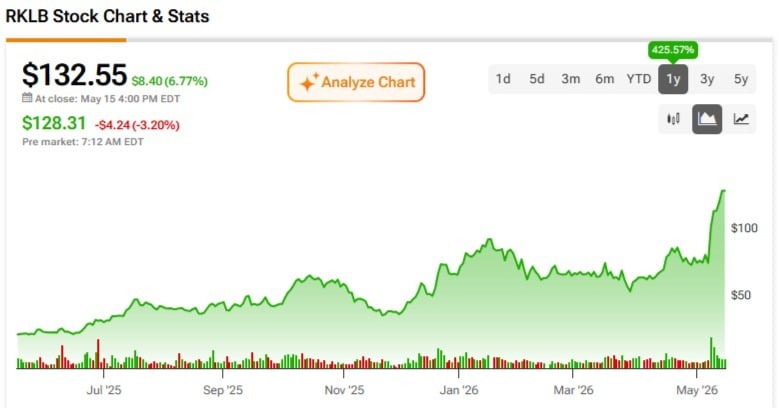
RKLB stock has surged roughly 410% over the past year and hit a new all-time high after Q1 earnings. Rich as the valuation is, the bull case for RKLB remains intact. Because Rocket Lab is not yet profitable, the price-to-sales (P/S) ratio is an important valuation metric: RKLB trades at roughly 105x on trailing revenue, compared with an Aerospace and Defense sector median of approximately 3.7x. That premium reflects the market’s confidence in Neutron’s commercial debut and ongoing backlog conversion rather than trailing earnings power.
For a company growing revenue at over 63% year-over-year, with a defense pipeline that now exceeds $1.3 billion in SDA awards alone, the elevated multiple is a bet on execution. Rocket Lab’s gross margin profile also helps explain why the sector P/S comparison alone understates the premium: at 38.2% GAAP, it is nearly double the Aerospace and Defense sector’s Q1 2026 gross margin of 21.42%, reflecting a business mix that is structurally closer to a technology platform than to a traditional defense prime.
The company is cash-flow negative at -$316 million over the trailing twelve months, though its $2 billion-plus liquidity provides substantial funding runway. Meanwhile, the approaching SpaceX IPO, reportedly targeting a valuation of roughly $1.75 trillion, is expected to reframe how public markets price the commercial space sector, rewarding companies that own scalable space infrastructure.
Three ETFs Reduce Single-Stock Risk without Exiting the Space Theme
For investors seeking exposure to Rocket Lab through an exchange-traded fund (ETF), three funds offer differentiated approaches. The Procure Space ETF (UFO) holds RKLB at approximately 6.5% across a diversified basket of global space companies, suitable for investors who prefer sector breadth. The Defiance Connective Technologies ETF (UFOX) allocates approximately 6% to RKLB within a space-and-technology infrastructure portfolio, appealing to cross-sector investors. Finally, the ARK Space Exploration and Innovation ETF (ARKX) holds RKLB at approximately 9.5%, the most concentrated choice for high-conviction space investors.
Is RKLB Stock a Buy, Sell, or Hold?
Rocket Lab currently carries a Moderate Buy consensus rating on TipRanks, based on 14 analyst ratings from the past three months, consisting of 10 Buys, four Holds, and no Sells. The average 12-month price target for RKLB is $100.17, implying a downside of approximately 24.43% from the current share price of approximately $132.55.

Conclusion
Rocket Lab is fast becoming an important company among space investors. Space Systems overtaking Launch Services for the first time, a defense pipeline exceeding $1.3 billion in Space Development Agency awards, and a growing Neutron manifest ahead of its first flight point to a business with a structurally stronger earnings profile.
However, RKLB stock’s valuation is genuinely rich, and the gap between the current share price and the average analyst price target suggests near-term volatility. That is the cost of owning a company transitioning from a niche launch provider to a scaled platform for space and defense infrastructure. I remain bullish on RKLB and would use pullbacks to build long-term positions rather than exit them.