Rigetti Computing, Inc. (RGTI), a full-stack quantum computing company focused on superconducting quantum processors, has signed a letter of intent with the U.S. Department of Commerce for a potential award of up to $100 million over three years.
Meet Samuel – Your Personal Investing Prophet
Explore IBX for 2X leverage on IBMFrom a market perspective, the key point is that the U.S. government is looking to back Rigetti’s work on scaling superconducting quantum computers, an area seen as strategically important for national security, advanced research, and future industrial competitiveness.
Meanwhile, RGTI shares exploded after the announcement, rising nearly 20% on Friday to close at $26.42.

What the Deal Covers
The proposed funding would come through the CHIPS Research and Development Office under the CHIPS Act. According to Rigetti, the money would support R&D projects aimed at solving major technical challenges in superconducting quantum computing.
The agreement also includes an important detail: the Department of Commerce would receive an equity stake in Rigetti tied to the total funding amount. That makes this more than a standard research grant, since the government would have a financial interest in the company’s progress.
Rigetti CEO Subodh Kulkarni said the investment would help the company “tackle key scaling bottlenecks more rapidly” and move closer to utility-scale quantum computing.
Why Rigetti Stands Out
Rigetti’s main bet is on superconducting qubits, the same broad technology path used by larger players such as International Business Machines Corporation (IBM) and Alphabet (GOOGL), but also adopted now by pure-play companies such as D-Wave Quantum (QBTS). The company says its systems can achieve gate speeds of 50 to 70 nanoseconds, which are much faster than those of some rival quantum approaches.
Its bigger differentiator may be architecture. Rigetti uses a chiplet-based design, combining smaller quantum chips into larger systems. Its 108-qubit Cepheus system, for example, is built from twelve 9-qubit chiplets. The idea is to improve scalability by avoiding some of the manufacturing and wiring challenges associated with building a single large quantum chip.
That gives Rigetti a different profile from IonQ, Inc. (IONQ), which is focused on trapped-ion quantum computing, and from IBM, which has a much larger ecosystem and deeper resources. Rigetti’s pitch is more engineering-driven: build fast superconducting systems, control more of the stack in-house, and sell both cloud-based and on-premises quantum systems.
For government customers and national labs, sensitive workloads often cannot rely only on public cloud access, which gives Rigetti a clearer role in U.S.-based quantum infrastructure.
The investor takeaway is that the $100 million LOI does not remove the biggest risk around Rigetti, namely, whether it can scale its systems and improve reliability fast enough to compete with better-funded rivals. But it does give the company a stronger strategic position. For a small quantum player, being tied to U.S. industrial policy could become an important advantage if government-backed quantum spending continues to grow.
Is RGTI Stock a Good Buy?
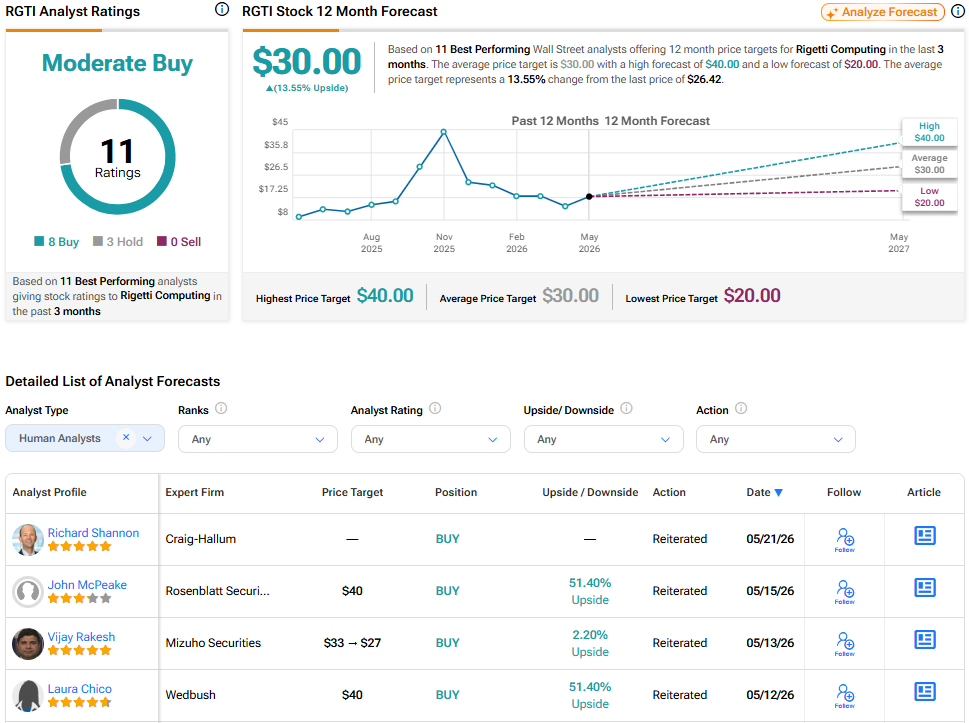
Turning to the Street, Rigetti Computing has a Moderate Buy consensus, based on 11 analysts’ ratings. The average RGTI stock price target is $30, implying about 13% upside from the current price.