Welcome to this week’s Monday quantum update. This round shows a clear theme across the sector. Quantum is still a long-term tech story, but more money, public plans, and real-world security use cases are starting to shape the market.
Claim 55% Off TipRanks
QBTX: an alternative to margin or options on QBTSLet’s begin.
1. Sitehop Brings Quantum Safe Security to Critical Infrastructure
First on the list is Sitehop, a U.K. cyber firm that builds hardware-based network security tools. The company launched SAFEcore Edge, a small quantum-safe device designed for energy sites, utilities, SCADA systems, oil platforms, and other hard-to-reach locations.
The key point is fairly simple. Sitehop is selling defense against future quantum risk. The device is built to protect data moving between remote sites and central control rooms, with very low delay. CTO Ben Harper said these sites face “unique security challenges” due to older systems, remote sites, and speed requirements, which make standard tools less useful. From a market perspective, this is a good sign of where near-term quantum demand may first appear: security, not raw compute.
2. Xanadu Posts Strong Sales Growth, but Losses Rise
Next, Xanadu Quantum Technologies Inc. (XNDU), a Canadian firm building light-based quantum computers, reported its first earnings update as a public company. Revenue rose fourfold to $2.8 million in the first quarter, up from $700,000 a year ago. However, the company’s net loss widened to $20.6 million from $12.2 million.
That mix tells the story. Xanadu is showing early sales growth, but it is still in a heavy spend phase. The company ended the quarter with $272.5 million in cash and is also in talks for up to about $285 million in support from Canada and Ontario. CFO Michael Trzupek said Xanadu is “in an investment phase,” with cash going into hardware, software, and talent. For the market, the question is whether this cash can turn Xanadu’s tech plan into a useful quantum data center over time.
3. G7 Says Banks Must Prepare for Quantum Risk
Meanwhile, the G7 central banks warned that quantum technology could change how banks protect data, payments, and market systems. The group said no quantum computer can break today’s main bank codes yet. Still, it sees a real chance that such machines could arrive in the next decade.
That risk, however, is real as banks often store sensitive data for years. Bad actors could steal encoded data now and try to read it later, when stronger quantum tools are available. As a result, the G7 said post-quantum cryptography is the most practical near-term fix. At the same time, it said quantum use cases in finance, such as fraud checks, risk models, and portfolio work, are still early. In short, banks may need to spend on quantum defense before they see much gain from quantum tools.
4. NSF Commits $1.5 Billion to New Quantum-Linked Labs
In the U.S., the National Science Foundation said it will spend $1.5 billion over the next decade on NSF X-Labs. These labs will fund teams that work outside the usual university or corporate model, with clear goals and staged funding.
The first topics include quantum sensing, AI-driven imaging, quantum links, and light-based parts for future quantum systems. Brian Stone, who is performing the duties of NSF director, said the plan is meant to build “sector-defining platform capabilities.”
5. Nord Quantique Joins Canada’s Quantum Unicorn List
Finally, Nord Quantique, a private Canadian quantum firm focused on hardware-level error correction, reportedly raised $30 million in a Fidelity-led round, valuing the company at about $1.4 billion. That makes it another high-value Canadian quantum name, along with D-Wave Quantum Inc. (QBTS), Xanadu, and Photonic.
Nord’s pitch is that quantum machines require fewer errors to be useful. Many firms try to address this by adding large numbers of extra qubits. Nord is taking a different route by working to correct errors inside the hardware itself. If that works, its systems could be smaller, less costly, and easier to place in normal data centers. For now, that remains a big technical bet. Still, Fidelity’s backing shows that private money is still chasing quantum teams with a clear path to scale.
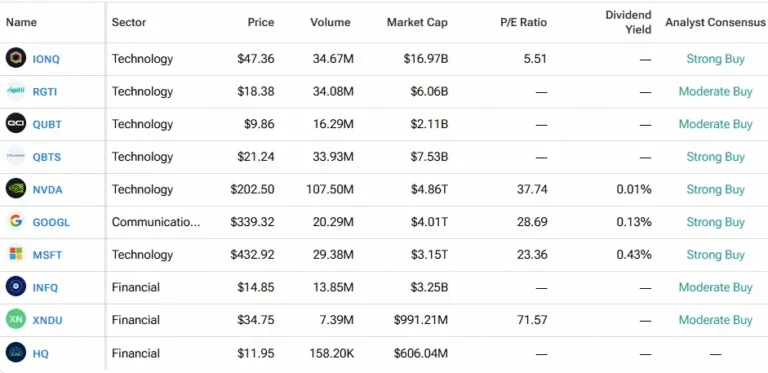
We used TipRanks’ Comparison Tool to track key names in the space, such as IonQ (IONQ), QCI (QUBT), and Horizon (HQ). The group shows how the field is moving toward secure systems, defense use, and chip-scale, while still working to prove real value.