Welcome to this week’s Monday edition of quantum news. This round comes with a clear market test. Quantum stocks have gained a lot of mindshare, but now investors want to see sales, orders, and proof that the tech can turn into real business.
Meet Samuel – Your Personal Investing Prophet
QBTX: an alternative to margin or options on QBTSLet’s begin.
1. Quantum Stocks Face a Key Earnings Test
First on the list is the public market test for Rigetti Computing Inc. (RGTI), Quantum Computing Inc. (QUBT), and D-Wave Quantum Inc. (QBTS). Rigetti is a quantum hardware firm that builds superconducting quantum systems. Quantum Computing Inc. builds quantum optics and chip-based tools. D-Wave builds quantum systems and software, with a focus on annealing and real-world use cases.
All three stocks are heading into earnings with a mixed setup. According to the chart data, Rigetti is down about 14.5% year-to-date, D-Wave is down about 13.7%, and QCI is down about 6.4%. So, the market is not giving the group a free pass. Instead, investors are asking a simple thing: where is the revenue?
For Rigetti, the focus is on cash, orders, and its 108-qubit plan. The company ended 2025 with about $590 million in cash and no debt, which gives it time. Still, sales remain small, with 2025 revenue of $7.1 million against a GAAP net loss of $216.2 million. The key will be order flow, such as the $8.4 million C-DAC deal and $5.7 million in Novera orders. In short, Rigetti has a road map. Now it needs to show that the road map can turn into sales.
Next, D-Wave may have the clearest sales story. The firm posted 2025 revenue of $24.6 million, up 179%, while cash and marketable assets stood at $884.5 million. It also said its pipeline grew by nearly 1,500% from last year, while year-end bookings topped $32.8 million. That makes D-Wave less of a pure lab story and more of a demand test. The key question is whether those deals can turn into steady sales fast enough to offset higher costs.
Meanwhile, Quantum Computing Inc. is the highest proof case. The firm has about $1.52 billion in cash and assets, but fourth-quarter revenue was only about $198,000. Its Luminar Semiconductor deal may help, yet investors still need signs that capital is turning into real client demand. For now, QCI has the balance sheet. What it needs next is sales traction.
2. IonQ and Quantinuum Push Quantum Closer to Big Market Scale
Next, IonQ Inc. (IONQ) cleared a key step in its plan to buy SkyWater Technology Inc. (SKYT). SkyWater stockholders approved the merger deal, and the close is expected in the second or third quarter of 2026, pending review and other closing terms.
The deal matters because it could give IonQ more control over chip supply, packaging, and U.S.-based production. SkyWater has sites in Minnesota, Florida, and Texas, and it works with both private firms and defense clients. That fits IonQ’s push to build a deeper quantum stack, not just a quantum lab tool.
At the same time, Honeywell International Inc. (HON), an industrial tech firm with exposure to quantum through Quantinuum, said Quantinuum has filed an S-1 for a planned IPO. Quantinuum plans to list on Nasdaq under the ticker $QNT. The terms have not been set yet, and the deal still depends on market terms and SEC review.
This is a key sign for the sector. Quantinuum is one of the best-known private quantum firms, and its public listing could give investors another way to track the space. It could also set a new bar for how the market values quantum firms with real tech, strong backers, and long-term goals.
3. Private Capital Still Backs the Quantum Buildout
Meanwhile, private money continues to flow into the space. Quantum Motion, a London-based quantum firm, raised $160 million in Series C funds to build quantum computers using standard 300-millimeter silicon CMOS tech. That is the same type of chip tech used in many common devices, such as phones and laptops.
The round was led by DCVC and Kembara, with Firgun Ventures also taking part. Porsche Automobile Holding SE also joined, which shows that old-line industry players are watching the field closely. Quantum Motion’s core idea is simple: use existing chip tools to make quantum systems easier to scale.
Scale is one of the main issues in quantum, with many firms needing special tools, rare setups, or complex build paths. Quantum Motion is trying to use the chip world’s current base to speed up the path toward large quantum systems.
Dr. Kris Naudts, co-founder of Firgun Ventures, said, “Scaling quantum computers is critical to unlocking the power that could help solve some of the world’s biggest challenges.” That is the main pitch. If quantum can scale with standard chip tools, the road to real use could become much shorter.
4. MIT Sloan Says Waiting May Be a Risk
Finally, MIT Sloan Management Review warned that firms may lose ground if they wait too long to test quantum. The key idea is that quantum may act like past core tech shifts, such as power grids or the internet. In those cases, the winners were often firms that tested early and learned how to use the tools before the market was fully ready.
The report said firms should not just wait for perfect proof. Instead, they should hire people who can link quantum tools to real business needs, test small use cases, and give teams space to learn. The point is not to find the one big use case right away. The point is to build skill before the tech matures.
As the report noted, “Companies want proof before experimenting, but proof often arrives only because companies experiment.” That line sums up the current market. Quantum firms need client demand to prove value, while clients want proof before they spend. That loop is hard to break.
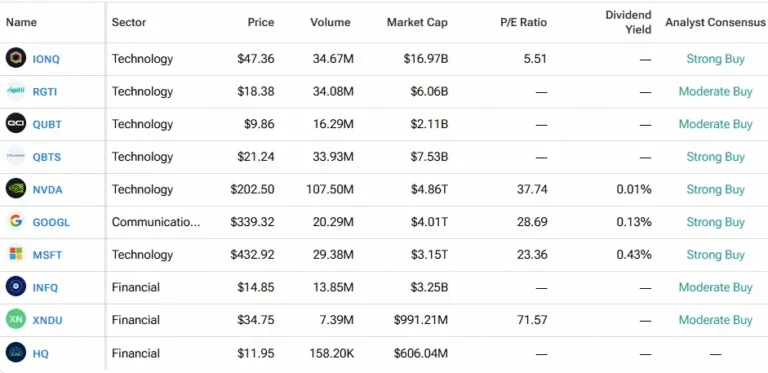
We used TipRanks’ Comparison Tool to track key names in the space, such as Xanadu Technologies (XNDU), Infleqtion (INFQ), and Horizon (HQ). The group shows how the field is moving toward secure systems, defense use, and chip-scale, while still working to prove real value.