Welcome to this week’s Thursday quantum update. This round is about a simple shift in the sector. Quantum firms are still spending a lot, but investors are now getting more signs of sales, field tests, new sites, and fresh private funds.
Claim 55% Off TipRanks
Trade QBTS with leverageLet’s begin.
1. Quantum Firms Push From Lab Work to Real Demand
First on the list is Quantum Computing Inc. (QUBT). The company said first-quarter sales rose to about $3.7 million, up from just $39,000 a year ago. However, that jump came mainly from its recent buys of Luminar Semiconductor and NuCrypt, not from core growth alone.
Still, the update gives QCI a clearer story. The company now has more chip, laser, and quantum network tools under one roof. At the same time, costs are rising fast. Operating expenses climbed 139% to $19.8 million, while the firm posted a net loss of $4.1 million. So, for investors, the key issue is not cash, since QCI still has about $1.4 billion in cash and assets. Instead, the question is whether those new assets can turn into steady demand.
2. D-Wave’s Revenue Falls 81%, but Bookings Surge Nearly 2,000%
Next, D-Wave Quantum Inc. (QBTS) gave the market a mixed but useful update. Revenue fell 81% to $2.9 million because last year had a large one-time system sale. However, bookings jumped nearly 2,000% to $33.4 million, helped by a $20 million system sale to Florida Atlantic University and a $10 million deal with a Fortune 100 firm. CEO Alan Baratz said the quarter showed “strong execution, expanding commercial adoption, and differentiated technology leadership.” That is the core bull case for D-Wave right now. Sales can look choppy, but bookings and future deals are moving in the right direction.
3. IonQ and Infleqtion Build for Defense and Scale
Meanwhile, IonQ Inc. (IONQ) opened a new 22,000-square-foot research and chip-test site in Boulder, Colorado. The site will support new ion trap chip design and testing, and IonQ expects its first quantum computer at the site to be fully installed by the third quarter of this year.
CEO Niccolo de Masi said, “Quantum is Now,” adding that IonQ is using its tech to help areas such as drug work, infrastructure, and manufacturing. For investors, the key point is simple. IonQ is still a long-term story, but it is adding real space, staff, and chip test tools to support that plan.
4. Infleqtion Targets Defense with Atom-Based Signal Sensing
In defense, Infleqtion (INFQ) launched what it calls Quantum Spectrum. The new push is based on atom-based radio signal sensing for hard signal zones, such as areas with jamming, spoofing, drone risk, and weak GPS. CEO Matt Kinsella said the firm is “building prototypes, running field trials, and hardening these systems for real-world deployment.”
That focus could give Infleqtion a clearer near-term use case than pure quantum computing. The company is working on defense programs in the U.S., the U.K., and Australia, partnering with Dell Federal, L3Harris, and SAIC. In plain terms, Infleqtion is trying to use atoms as a new kind of radio receiver. If the tech works in the field, it could help defense teams spot and sort signals when standard tools are under stress.
5. Private Money Still Backs the Quantum Buildout
Finally, private capital is still moving into the space. Photonic Inc., a private quantum firm building network-based quantum systems, raised 275 million CAD, bringing its total raised to more than 475 million CAD. The new round values the company at about $2 billion after the money.
Photonic’s pitch is that large quantum systems may need to operate across networks, not just within a single box. Its design uses silicon-based qubits with light-based links, so systems could scale over today’s fiber lines. Microsoft is still part of the story, with Microsoft Quantum executive Zulfi Alam saying that “distributed architectures will be an important way to scale quantum technology.”
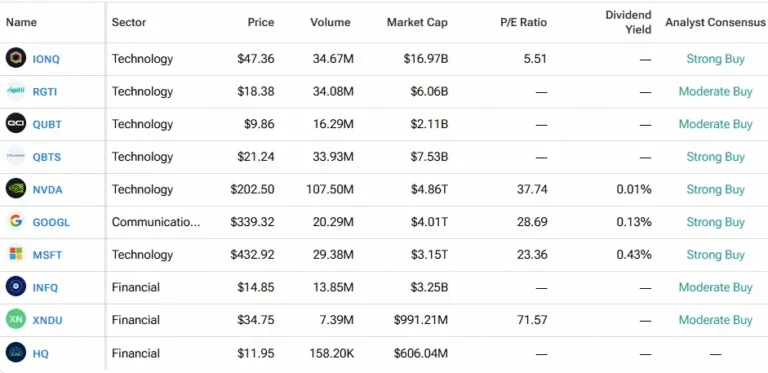
We used TipRanks’ Comparison Tool to track key names in the space, such as Xanadu Technologies (XNDU) and Horizon (HQ). The group shows how the field is moving toward secure systems, defense use, and chip-scale, while still working to prove real value.