Welcome to Monday’s addition of everything that is quantum. This round shows a sector that is still early but is also more tied to sales, policy, chips, defense, and public-market plans. In short, quantum firms are trying to prove that the tech can move from research into use cases that matter for firms, states, and long-term buyers.
Claim 55% Off TipRanks
Forget margin or options. Here's how the pros trade QBTSLet’s begin.
1. IonQ Says 2025 Marks a Key Turning Point
First on the list is IonQ Inc. (IONQ), which used its annual letter to frame 2025 as a key year for the firm and the wider quantum space. Chief Executive Officer Niccolò de Masi said IonQ has grown beyond its roots as a quantum computing firm and is now a broad quantum tech firm with work in compute, networks, sensing, and security. IonQ also said revenue rose 202% year-over-year, while its core quantum compute unit grew by nearly 80% organically.
In turn, that helps support the firm’s claim that demand is moving beyond tests and into paid use. De Masi said, “We have evolved beyond our origins as a quantum computing pioneer to become the world’s preeminent full-stack quantum platform and merchant supplier.” The firm also pointed to its planned buyout of SkyWater Technology Inc. (SKYT), which could help IonQ build more of its own parts in the U.S. Still, that deal is under close review by the Federal Trade Commission, so the path is not yet clear.
2. PsiQuantum Adds Intel CEO Lip Bu Tan to Its Board
Next, private firm PsiQuantum named Intel Corporation (INTC) Chief Executive Officer Lip Bu Tan to its board. The move is notable because PsiQuantum is betting that the quantum scale will come from the chip world. Tan also led Cadence Design Systems Inc. (CDNS), which gives him deep ties to chip tools and design flows. PsiQuantum said his role will help as it works on large fault-tolerant quantum systems built with silicon photonics.
The firm is also pushing large sites in the U.S., Australia, and the U.K., with planned hubs in Chicago and Brisbane. Tan said the firm’s focus on systems “that can be manufactured at scale using the semiconductor industry sets them apart.”
3. House Panel Moves U.S. Quantum Bill Ahead
Meanwhile, U.S. policy is also moving. The House Committee on Science, Space, and Technology passed the National Quantum Initiative Reauthorization Act out of panel, moving the bill closer to a full House vote. The bill seeks to renew and update the U.S. quantum plan, with more focus on real-world use, jobs, supply chains, and work with allies. It also adds NASA as a formal partner in quantum research. This is significant to the market because public funds and clear rules can shape where firms build, hire, and test new systems.
However, there is still some doubt around the 2026 funds. Rep. Zoe Lofgren said, “We do not yet have fiscal year 2026 spending plans for the agencies,” which makes it hard to set the right spending levels. So, while the policy tone is clear, the final funding path still needs work.
4. Liquid Instruments Raises $50 million for Smarter Test Tools
Next, Liquid Instruments, an Australia-based quantum software solution firm, raised $50 million in a Series C round led by Keysight Technologies Inc. (KEYS) and Australia’s National Reconstruction Fund Corporation. Liquid Instruments builds software-based test tools that can replace several lab tools with one system. That can help engineers work faster and cut the time it takes to build custom test setups. The firm said the cash will support AI-led product work and growth in key fields such as space, defense, and chips. Keysight will also enter a new sales deal with the firm, which may help Liquid Instruments reach more users.
Chief Executive Officer Daniel Shaddock said, “As systems grow more complex, our users need more flexible, AI-driven tools.” This story is not pure quantum computing, but it fits the same trend: better tools are needed as next-gen tech gets harder to test and scale.
5. Quantum X Labs Rebrands and Shifts Toward Quantum Tech
Finally, Viewbix Inc., an Israeli digital advertising firm, rebranded as Quantum X Labs Inc. (QXL) after acquiring Israeli quantum company – Quantum X Labs Ltd. in March 2026. The move marks a shift from digital ads toward quantum tech, though the firm will still keep its ad business as a separate unit. Quantum X Labs is now pursuing a broad set of quantum bets, including GPS-free navigation, atomic clocks, quantum security, drug development, and error correction. Its 40%-owned unit, Quantum Gyro, is working on chip-based gyroscope tech for use when GPS is not in reach or may be blocked.
That could make the tech useful for defense, drones, ships, and other hard settings. The firm also has units tied to atomic clocks, simulation, security, and drug research. For public market readers, the key point is that Quantum X Labs is trying to turn its new name into a new growth story, but it will still need to prove that its broad quantum push can lead to real sales.
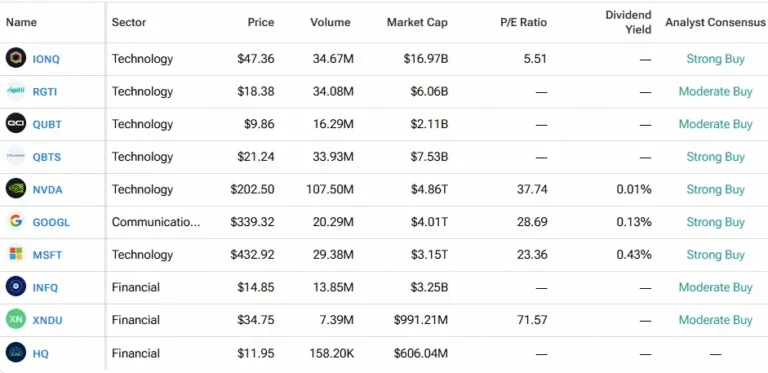
We used TipRanks’ Comparison Tool to track key names in the space, such as Xanadu Technologies (XNDU), Rigetti Computing (RGTI), and D-Wave Quantum Inc. (QBTS). The group shows how the field is moving toward secure systems, defense use, and chip-scale, while still working to prove real value.