Welcome to this week’s closing edition of everything that is quantum. This round shows a market that is still young but is also moving closer to real budgets, real tools, and real public-market bets. In short, quantum is now tied to cyber spend, chip scale, defense work, software layers, and investor demand.
Claim 55% Off TipRanks
Trade IBM with leverageLet’s begin.
1. Quantum Security Moves from Risk Talk to Budget Plans
First on the list is the rise of quantum security. Global spend on data security is set to reach $244.2 billion in 2026, up 13.3%, as firms begin to plan for a world where quantum tools could break existing code. The Global Risk Institute now sees a 28% to 49% chance that a sufficiently advanced quantum computer could arrive within the next 10 years.
In turn, Quantum Secure Encryption released QPA v2, a platform designed to help firms identify weak code, assess risk, and plan a move to safer tools. Chief Executive Officer Ted Carefoot said, “Organizations are now moving from understanding quantum risk to actively planning for it.” That shift matters for public market names too, since Cloudflare Inc. (NET), IonQ Inc. (IONQ), and Cisco Systems Inc. (CSCO) are all tied in some way to the push for quantum-safe cyber tools.
2. Cloudflare Adds Quantum Safe Tools to Its Network
Next, Cloudflare is trying to make quantum-safe security easier to use. The firm added post-quantum support to its SASE platform, helping firms link staff, apps, and networks more securely. The move covers wide area network use cases through Cloudflare IPsec and the Cloudflare One Appliance. It also builds on Cloudflare’s Zero Trust work, which is a key part of its cyber pitch.
Chief Executive Officer Matthew Prince said, “By bringing this protection to our entire SASE platform, we’re making post-quantum security the default.” That is the key point for buyers. Rather than ask firms to add new gear or make hard setup changes, Cloudflare is putting the tools into its core network.
3. IonQ Pushes Deeper into Defense and Quantum Trust
Meanwhile, IonQ is working with the Air Force Research Laboratory on SEQCURE, a program meant to build a Zero Trust model for key quantum systems. The goal is to protect quantum gear, cloud links, data, and software through constant checks rather than old-style perimeter defense. IonQ said the work uses NIST SP800-207, a standard tied to Zero Trust design.
This comes as IonQ continues to grow its role in U.S. defense and public-sector work. The firm also reported $64.7 million in first-quarter 2026 revenue, up 755% from last year, and raised its 2026 sales view to $260 million to $270 million. Still, IonQ expects a large, adjusted EBITDA loss of $310 million to $330 million for the year. So, the growth story is clear, but the cost of scale is still high.
4. Quantum Motion Bets on Silicon as a Path to Scale
Next, private firm Quantum Motion raised $160 million to build quantum computers using tools from the chip world. The firm wants to turn standard silicon transistors into qubits, which could make quantum systems smaller, cheaper, and easier to scale over time. That path differs from the systems used by International Business Machines Corporation (IBM) and Alphabet Inc. (GOOGL), which rely on superconducting systems, and by IonQ, which uses trapped ions.
Chief Executive Officer James Palles Dimmock told Reuters that the firm asked, “What are the minimum adaptations that we can make to transistors to turn them into high-quality qubits?” That focus on chip scale is the main story. Quantum Motion says it has a path to build with GlobalFoundries Inc. (GFS), and it believes useful quantum systems could one day cost $10 million to $20 million.
5. Quantum Software Firms Try to Make the Tech Easier to Use
Finally, software is becoming a bigger part of the quantum market. Haiqu launched what it calls the first full-stack Agentic Quantum Operating System. The platform uses AI agents, a software toolkit, and a runtime engine to help teams build and test quantum apps with less time and lower cost. Haiqu said one test cut molecular dynamics run from about $30,000 and more than nine hours to about $25 and 30 seconds.
At the same time, Horizon Quantum Holdings Ltd. (HQ) reported wider losses after its Nasdaq debut, as it builds a hardware-neutral quantum software platform. The firm bought a 256-qubit system from IonQ and is also working with Alice & Bob and Alpine Quantum Technologies. That plan gives Horizon more ways to test software across quantum hardware types. For investors, the key theme is simple: hardware may get the headlines, but software may decide how fast users can turn quantum tools into real work.
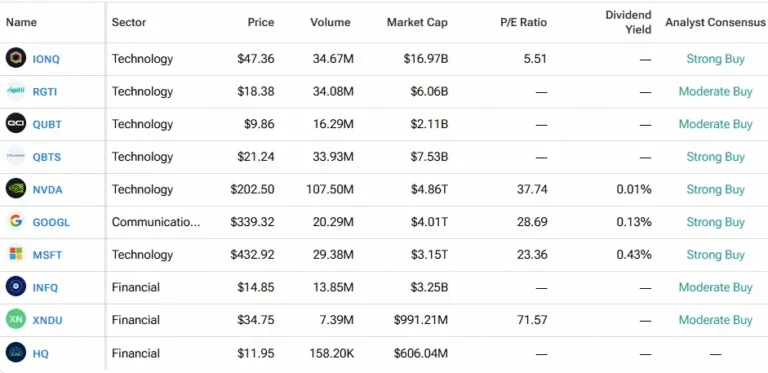
We used TipRanks’ Comparison Tool to track key names in the space, such as Xanadu Technologies (XNDU), Rigetti Computing (RGTI), and D-Wave Quantum Inc. (QBTS). The group shows how the field is moving toward secure systems, defense use, and chip-scale, while still working to prove real value.