Quantum Computing Inc. (QUBT) is a quantum tech firm that builds quantum machines, chip tools, and photonics systems for business and government use.
Meet Samuel – Your Personal Investing Prophet
Double your QUBT exposure with Tradr's QUBXQCI gave Wall Street a lot to like in its latest Q1 update. Revenue rose to $3.7 million from just $39,000 a year ago, helped by the deals for Lumina Semiconductor and NuCrypt. The company also ended the quarter with $1.4 billion in cash and investments, which gives it room to fund growth while it builds out its tech base.
Even so, the stock is under pressure. Shares fell more than 6% on Wednesday and slipped another 1.5% in pre-market trading. That move shows that investors are not just focused on the long-term quantum story. They also want to see clear proof that QCI can turn its new assets into steady sales.
The main issue is that much of the growth came from recent deals. On its own, QCI had $204,000 in revenue in the quarter. At the same time, costs rose fast. Operating costs reached $19.8 million, while general and admin costs were hit by about $6 million in deal costs.

Analysts Stay Upbeat, But with Some Caution
QCI has made clear progress. Management pointed to the first commercial data-center Dirac launch, early foundry sales, a $16 million backlog, and work on next-gen quantum products. The company also said Fab One has started small-batch output, while Fab Two is being planned for scale.
Still, the market wants more than a strong plan. It wants proof of steady demand, better use of fab space, and a path to higher margins. Until then, QCI may trade less like a normal earnings story and more like a high-risk growth stock.
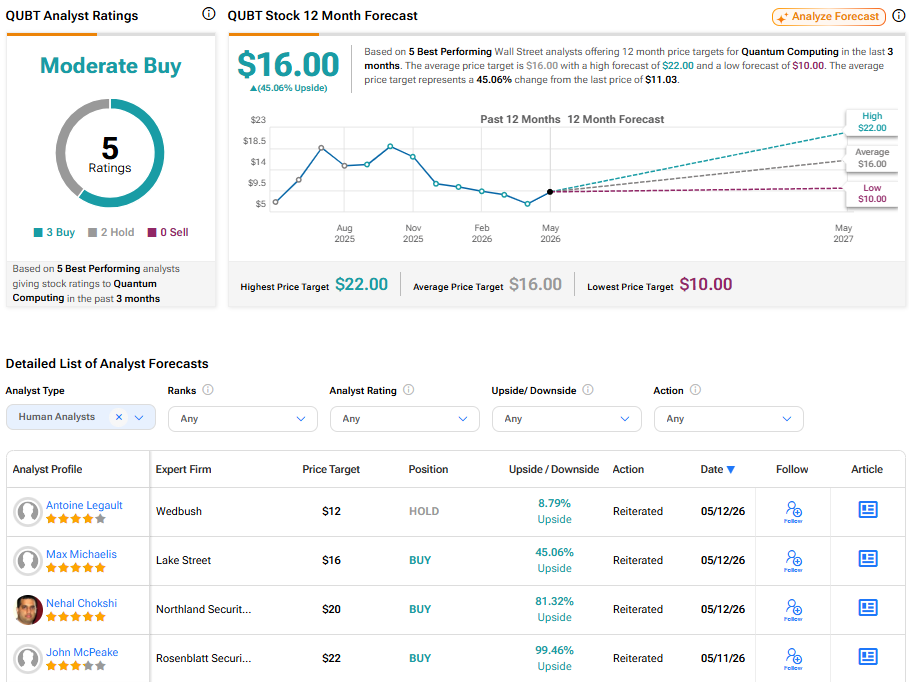
As a result, Wall Street still sees upside in the stock, with QCI boasting a Moderate Buy rating and an average QUBT stock price target of $16. However, the range of price targets tells a more careful story. Some analysts see the stock near $12, while others see it moving above $20. In other words, analysts seem to agree that QCI has real promise. Still, they differ on how much credit the company should get today.