After Tesla (TSLA) lost its electric-vehicle (EV) crown to China’s BYD (BYDDY), CEO Elon Musk may now be facing another challenge, this time in brain-computer interfaces. Chinese brain-computer interface (BCI) startup Gestala, which uses ultrasound-based BCI technology, appears to be competing with Musk’s neurotechnology firm Neuralink, highlighting China’s growing influence in advanced technology sectors.
Claim 55% Off TipRanks
Trade NVDA with leverageChina’s EV Triumph Over Tesla
In 2025, China’s BYD surpassed Tesla to become the world’s largest seller of battery-electric vehicles. BYD delivered more than 2.25 million EVs, representing roughly 28% year-over-year growth, compared with Tesla’s 1.65 million vehicles.
Tesla’s global sales declined for two consecutive years as competition intensified from lower-cost Chinese automakers. Domestic EV adoption in China exploded, with BYD leveraging massive scale and supply chains to undercut Tesla’s pricing.
Even so, Tesla recorded a 91% increase in China-made car sales in early 2026, reflecting strong local demand. But what began as competition around Tesla is now expanding into other areas of Musk’s technology empire.
Gestala Raises $21.6 Million Two Months After Launch
Just two months after its official launch, Gestala raised $21.6 million (CN¥150 million) in funding at a valuation between $100 million and $200 million. This marks one of China’s largest early-stage investments in BCIs and the second-largest globally in the segment, after OpenAI co-founder Sam Altman’s Merge Labs, which raised $252 million.
Other major BCI players, including Musk’s Neuralink, which raised $649 million in a Series E funding in July 2025, have also secured significant capital in recent years. The oversubscribed round was co-led by Guosheng Capital and Dalton Ventures, with participation from Tsing Song Capital, Gobi Ventures, Fourier Intelligence, Liepin, and Seas Capital, attracting over $58 million in commitments.
According to sources familiar with the matter, Phoenix Peng, the founder of Gestala and veteran of implantable BCI firm NeuroXess, will use the funds to expand R&D, grow the engineering team from 15 to 35 specialists, and build a dedicated factory.
Gestala’s BCI Technology Could Target Neuralink’s Dominance
Gestala says it represents China’s first ultrasound-based BCI company. Its technology provides non-invasive, bi-directional capabilities and allows multi-target neural circuit regulation, interacting with the brain without the surgical risks associated with Neuralink.
Gestala emphasizes that its edge lies in speed and scale, with China’s clinical trial costs at just 20–33% of U.S. rates. The startup also plans to leverage large datasets to build an “Ultrasound Brain Bank” for AI-driven development. With first devices expected by year-end, Gestala is signaling its intent to compete directly with Neuralink.
Is Tesla Stock a Buy or Hold?
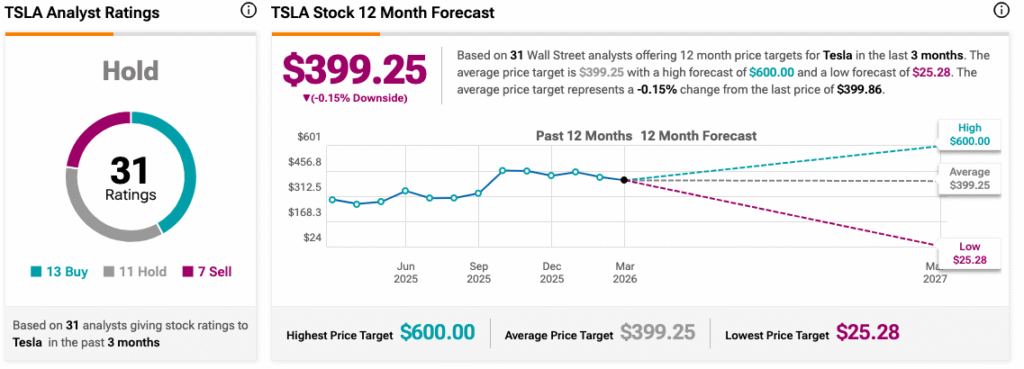
Tesla (TSLA) has been analyzed by Wall Street analysts, with a TipRanks consensus rating of “Hold.” While 24 analysts suggest holding, 23 recommend buying, and only 14 advise selling. Meanwhile, Gestala and Neuralink are still private companies. Investors interested in AI stocks like TSLA can consider top players such as Microsoft (MSFT), Meta Platforms (META), and Nvidia (NVDA) on TipRanks Stocks Comparison Center.