


Palantir Technologies (PLTR) confirms that enterprise artificial intelligence (AI) demand is durable rather than episodic, by posting its highest quarterly revenue growth rate as a public company on May 4. Even so, you would not know it from the stock, which still sits roughly 35% below its 52-week high. Investors’ downbeat reaction to Palantir’s stellar earnings reflects valuation concern, not a deterioration in fundamentals.
Claim 55% Off TipRanks
Trade ARKK with leverageIn Palantir’s case, revenue acceleration shows that AI spending is translating into real deployment and commercial traction. The Colorado-based company builds and deploys AI-powered data analytics platforms for government and commercial customers worldwide through four core products: Gotham, Foundry, Apollo, and the Artificial Intelligence Platform (AIP). I remain bullish on PLTR stock and regard the current dip in Palantir’s share price as a compelling entry point for long-term investors.
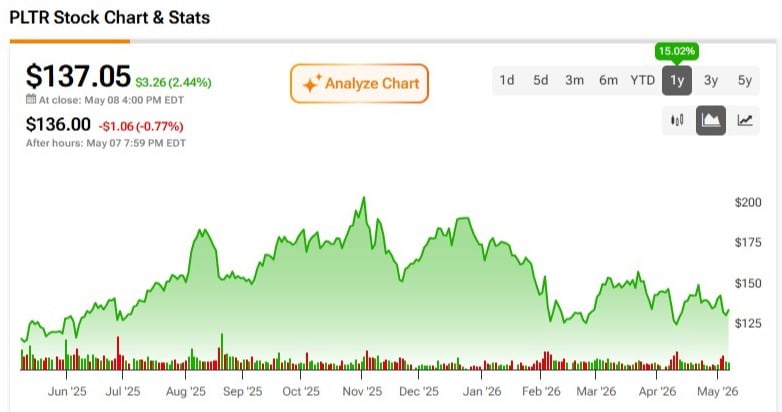
Q1 Results Confirm the AIP Is Driving Structural Demand
The primary catalyst for a long-term bullish stance on Palantir is the sheer velocity of AIP-driven top-line expansion. Q1 2026 revenue of $1.633 billion grew 85% year-over-year, its highest reported growth rate as a public company. The U.S. commercial revenue of $595 million surged 133% year-over-year and 18% sequentially, while U.S. government revenue grew 84% year-over-year, bringing total U.S. revenue to $1.282 billion, up 104% year-over-year. Wall Street noted that existing customers have been expanding platform deployments and not merely renewing baseline contracts.
In addition to impressive revenue growth, what potentially distinguishes Palantir from the broader AI investment landscape is the quality and capital efficiency of that growth. A fundamental risk facing the broader AI market is the unsustainable capex cycle required to build physical data infrastructure. Yet, for Palantir, adjusted operating margin reached 60% in Q1. The company generated $925 million in adjusted free cash flow (FCF) in the quarter, representing a 57% FCF margin, and ended the period with $8 billion in cash against negligible debt.
The Rule of 40, a software industry benchmark that combines revenue growth rate and profit margin, reached 145% in Q1, up from 127% in Q4 2025. TipRanks readers may be interested to know that many large enterprise software companies struggle to sustain a score above 40%. Palantir spent just $7.4 million on capex in Q1, well under 1% of quarterly revenue. That capital-light model allows 57% FCF margins alongside 85% revenue growth, a combination that gives Palantir the financial flexibility to fund product development and hiring without diluting shareholders or taking on debt.
An $11.8 Billion Deal Pipeline Anchors the Multi-Year Revenue Trajectory
Beyond the quarterly metrics that signal that demand for Palantir’s AIP platform is accelerating, Palantir’s forward indicators are compelling as well. Remaining deal value reached $11.8 billion, up 98% year-over-year, while remaining performance obligations (RPO) grew 134% year-over-year to $4.5 billion. Contracted future revenue is expanding faster than reported revenue and provides multi-year visibility that the headline growth rate alone does not fully capture.
Among notable Q1 wins, the U.S. Department of Agriculture awarded a contract worth up to $300 million to enhance farmland security, supply chain resilience, and fraud prevention. The U.S. Department of the Navy’s deployment of Ship OS or Shipbuilding Operating System reduced a key manufacturing approval process from around 160 hours to 10 minutes and cut monthly material planning time by 94%, illustrating the measurable operational impact that drives contract renewals and expansions. In other words, Palantir demonstrates that real, sustainable AI monetization is happening at the application layer.
Management raised its full-year Fiscal 2026 revenue guidance to $7.65–$7.66 billion, representing year-over-year growth of 71%. It also increased its U.S. commercial revenue guidance to 120% growth, which means commercial enterprises should increasingly adopt its AIP platform to deploy operational artificial intelligence systems. It is worth noting that commercial revenue tends to scale fast and can generate high incremental margins once deployment costs are absorbed.
Valuation Is the Primary Risk, but the Growth Trajectory Justifies Patience
Critics of Palantir frequently point to its premium trading multiples as a reason to stay on the sidelines. Palantir trades at a forward P/E of around 94x, indicating the stock is clearly priced for sustained execution with minimal tolerance for operational stumbles. The decline in Palantir’s share price following the earnings results reflects this tension: exceptional fundamentals offset by a stretched valuation of PLTR stock.
However, looking only at Palantir’s near-term multiples may miss the bigger picture for an enterprise scaling at this pace. As Palantir expands its total U.S. commercial customer count, which grew 42% year-over-year to 615 in Q1, and deepens its existing customer relationships, its rapid growth will quickly compress these premium multiples for patient, long-term investors.
As long as U.S. commercial growth remains near triple-digit territory and full-year guidance continues to move higher, I believe the current multiple reflects a growth premium rather than speculative excess.
Palantir is not a cash-burning AI concept stock. What 11 consecutive quarters of growth acceleration and an $11.8 billion deal pipeline suggest is that demand is structural and here to stay. The price-to-earnings-to-growth (PEG) ratio of around 1.13 suggests the market has not fully discounted the earnings trajectory embedded in current guidance.
Three ETFs for Investors Who Want Palantir Exposure without Single-Stock Risk
Investors seeking Palantir exposure through exchange-traded funds (ETFs) have three options. The First Trust Indxx Aerospace & Defense ETF (MISL) allocates 9.5% to PLTR, making it a suitable choice for investors aligned with Palantir’s government and defense thesis. The ARK Innovation ETF (ARKK) holds approximately 3.2% in PLTR across an actively managed disruptive technology portfolio, appealing to growth investors. Finally, the Technology Select Sector SPDR Fund (XLK) holds approximately 2.4% of a broad passive technology index, making it a suitable option for investors who prefer sector diversification.
Is PLTR Stock a Buy, Sell, or Hold?
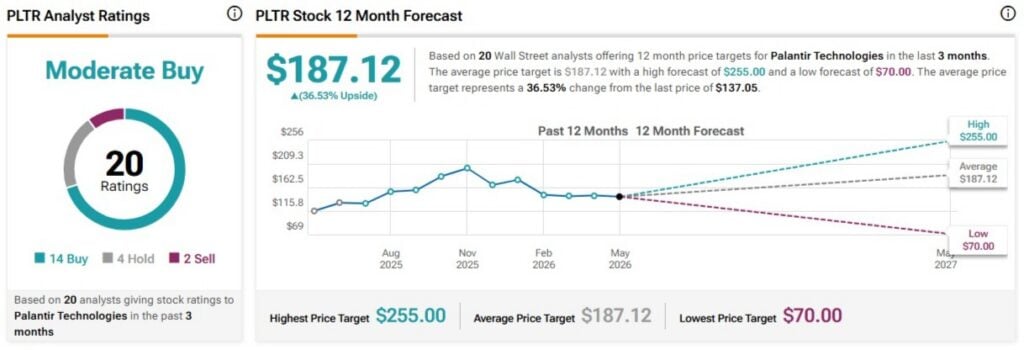
Palantir Technologies currently carries a Moderate Buy consensus rating, based on 20 analyst ratings assigned in the past three months, consisting of 14 Buys, four Holds, and two Sells. The average 12-month price target for PLTR is $187.12, implying upside of approximately 36.53% from the current share price of $137.05.
Conclusion
Palantir’s Q1 results reflected broad-based operating momentum and were a clear beat. An $11.8 billion deal pipeline and full-year 2026 free cash flow (FCF) guidance of $4.2–$4.4 billion confirm that Palantir’s earnings momentum is strong. Customer demand is converting into recurring contracts rather than one-off pilot projects. Yet, the market’s reluctance to bid PLTR higher after a record quarter reflects the same valuation concern it has held for months, not a change in Palantir’s operational trajectory.
At roughly 35% below its 52-week high, the gap between price and fundamental momentum is wide enough to act on. Despite the current volatility, I remain bullish on PLTR stock. I recommend using the current pullback to accumulate Palantir shares or to invest in diversified ETFs to add PLTR to long-term portfolios.