


After a long time, I can finally say that Palantir (PLTR) is expensive but worth it. That may still sound hard to accept for anyone with a traditional view on valuation multiples. However, the latest results announced on May 4 make it much harder to dismiss Palantir as just a speculative artificial intelligence (AI) trade being driven by enthusiasm alone. The data analytics software company is now delivering extraordinary growth acceleration at scale alongside exceptional margins, with the valuation actually starting to look supported by the underlying numbers.
Claim 55% Off TipRanks
- Unlock hedge fund-level data and powerful investing tools for smarter, sharper decisions
- Discover top-performing stock ideas and upgrade to a portfolio of market leaders with Smart Investor Picks
Palantir continues to expand its customer base, deepen engagement, and improve profitability at a pace few large software businesses can match. Along with an ever-expanding Rule of 40 and no signs of a slowdown, the valuation starts to look fairly reasonable at today’s levels. For this reason, I am bullish on PLTR stock.

The Engine of Unstoppable Acceleration
What initially hit me when Palantir reported its Q1 results on May 4 wasn’t just the size of its growth, but the trajectory. Palantir reported total revenue of $1.63 billion, which represents a staggering 85% year-over-year increase. However, the “wow” factor is the acceleration. This isn’t a one-off spike but rather the 11th consecutive quarter in which the year-over-year growth rate has accelerated.
It’s almost unheard of for a company of Palantir’s scale to actually grow faster as it gets larger. Most firms see their growth curve flatten as they penetrate the market, but Palantir is doing the opposite, almost like finding a second, third, and fourth gear.

The primary driver here is clearly Palantir’s Artificial Intelligence Platform (AIP). It is evolving into the central nervous system of its clients. Look at the U.S. commercial sector, which grew by 133% year-over-year. That kind of demand doesn’t arise unless the product solves a mission-critical problem. A perfect example of that is their deepening partnership with GE Aerospace (GE). GE employed Palantir’s agentic AI solutions to increase engine production by roughly 26%, according to some reports.
When a software platform can demonstrably fix a global supply chain bottleneck in a high-stakes industry like aviation, the sales pitch becomes effortless. There are numerous examples like that across various industries, such as healthcare and agriculture. Then you have the government sector, where the company is making incredible headway. Among them, I really liked the new $300 million USDA contract, which shows that Palantir is insulating itself against private-sector volatility by becoming the default operating system for the U.S. government.
The Logic of Limitless Margins
Beyond the top-line growth, we need to talk about the “Rule of 40.” In the software world, this is the holy grail metric. It’s the sum of your growth rate and your profit margin. Most “great” companies aim for a 40. Palantir just posted a Rule of 40 score of 145%. That is a number so high it almost feels like a typo, yet it’s the result of the underlying revenue acceleration we just discussed and margin expansion.
Specifically, Palantir’s adjusted operating margin has climbed to 60%, and its GAAP net income margin hit 53% in Q1, as operating expenses grow at a much softer pace.

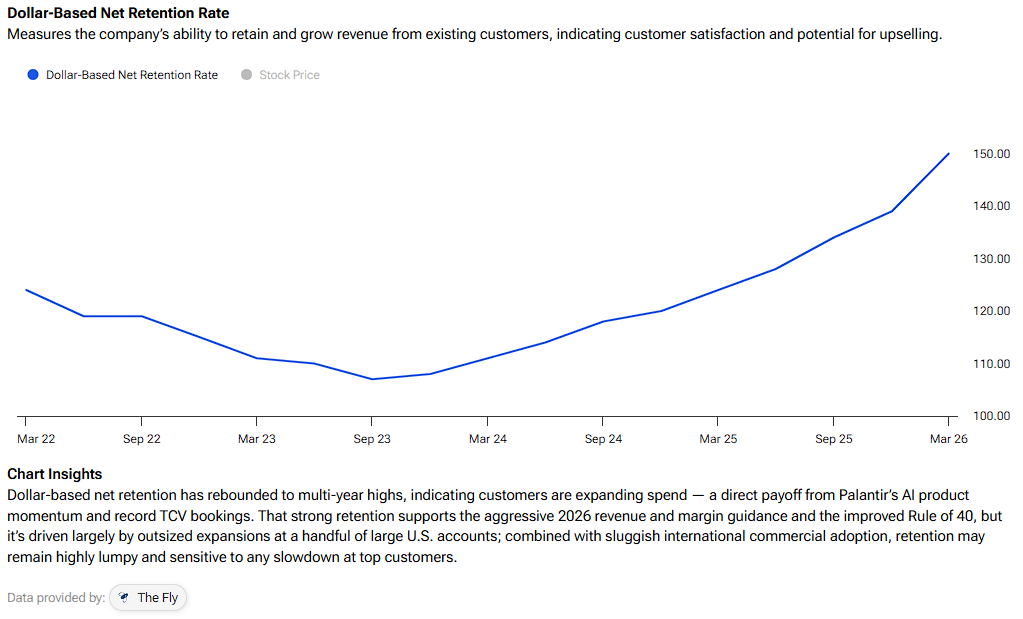
The beauty of these margins is how they’ve developed quarter after quarter. As Palantir’s “Bootcamp” strategy for AIP takes hold, the cost of acquiring a customer is dropping while the “stickiness” of the revenue increases. With a net revenue retention of 150%, they are growing exponentially among their existing clients, not just onboarding new ones. This trend suggests that the bottom line will continue to grow significantly faster than the top line.
When you combine accelerating revenue with this kind of operating leverage, you get a recipe for explosive earnings per share (EPS) growth, which is why I am starting to believe that today’s valuation might not actually be that crazy.
A Valuation That Earns Its Keep
Now, even after the recent pullback from 52-week highs, the stock looks undeniably pricey at first glance. We are looking at a forward P/S multiple of 42x this year’s consensus revenue estimate of $7.72 billion and a forward P/E of 93x this year’s consensus EPS estimate of $1.46. By any traditional metric, that’s expensive. Compared to the broader IT sector median of about 4.5x and roughly 28x P/S and P/E, respectively, Palantir commands a massive premium.
Palantir has made a habit of smashing estimates. The consensus has historically looked in the rearview mirror, and in turn, analysts have been forced to raise their estimates quarter after quarter.
If Palantir manages to double its EPS this year, which I believe is entirely on the table given that they just grew adjusted EPS from $0.12 to $0.33 in Q1, and even the consensus forecasts 96% growth in that $1.46 estimate compared to last year, those forward multiples will collapse much faster than the bears expect.
Even if growth were to eventually decelerate to a “modest” 30%, the company’s moat is so deep and its revenue so predictable that a forward P/E of 40x–50x once growth normalizes could actually represent fair value. You are paying a premium for a company with zero debt, $8 billion in cash, and a product that is becoming as essential to modern business as electricity is to the businesses it serves. In a world where every enterprise is desperate to stay relevant in the AI age, Palantir might prove to be a hedge against obsolescence.
Is PLTR a Buy, Sell, or Hold?
Despite the stock’s poor performance recently, Palantir still has a Moderate Buy consensus rating on Wall Street, based on 13 Buy, four Hold ratings, and two Sell ratings. In addition, PLTR’s average price target of $188.31 implies nearly 45% upside potential over the next 12 months.

Final Thoughts
Palantir is a controversial company, and I get why even investors who might otherwise like the stock may remain hesitant to go long, that is, even after its prolonged decline. However, we have to admit that the company is operating at a level we may have never seen before. It boasts triple-digit U.S. commercial growth with world-class margins, suggesting its lofty valuation might not be a bubble. The high multiples reflect its dominance, and that just might prove fair. The price entry is steep, but the sheer operational momentum makes PLTR a compelling “buy and hold” for the long term, in my view.