New reports show that OpenAI, the artificial intelligence (AI) firm behind ChatGPT, had mulled over splitting its robotics and consumer hardware units into separate firms ahead of a potential initial public offering (IPO). The discussion, led by OpenAI CEO Sam Altman, aimed at giving these units more independence. The move would also allow the firm’s core AI business to grow without extra pressure from other divisions.
Claim 55% Off TipRanks
Trade AMZN with leverageOpenAI Spin-Off Plan Aimed at Flexibility but Faced Limits
OpenAI’s proposed spinoff would have let the robotics and hardware units raise outside funding and work independently. This is because both divisions already run separately within OpenAI and report directly to Altman. In fact, some employees even refer to them as startups within the company.
However, the plan was later denied because even if the divisions were dismantled, the new firms might still be included in OpenAI’s balance sheets. If this happens, it would reduce the financial clarity the spinoff was meant to achieve.
These discussions show how OpenAI is carefully weighing its options as it prepares for a public listing. While the company has backed many big projects, it is now focusing more on projects that directly bring in money beyond its AI chatbot.
Last May, the private company started its consumer hardware unit after buying IO, a startup led by former Apple (AAPL) designer Jony Ive, for $6.5 billion. The deal also included IO’s 55-person team.
Altman has hinted that the unit is now working on a new product that reacts to a user’s sound and could become a third key device to go with the MacBook Pro and iPhone. The product should be ready for users in February 2027.
IPO Pressures Drive Shift Toward Core AI Growth
As OpenAI’s IPO draws closer, the firm is focusing on boosting its core AI business. It is building a “super app” designed to draw in developers and enterprise users as it competes with its biggest rival, Anthropic.
Recent reports show that OpenAI missed its internal users and revenue growth targets. This raised immediate concerns about whether the AI company can keep up with the high costs of running advanced AI systems.
In response, OpenAI said it is shifting resources to its main products. For instance, it stopped its AI video tool, Sora, to free up computing power for more important work. The company has also been exploring long-term changes, including a business model similar to Alphabet Inc’s. (GOOGL) model. The move is set to split its main revenue units from experimental projects, like Alphabet does with Waymo and Verily.
What Are the Best AI Stocks to Buy?
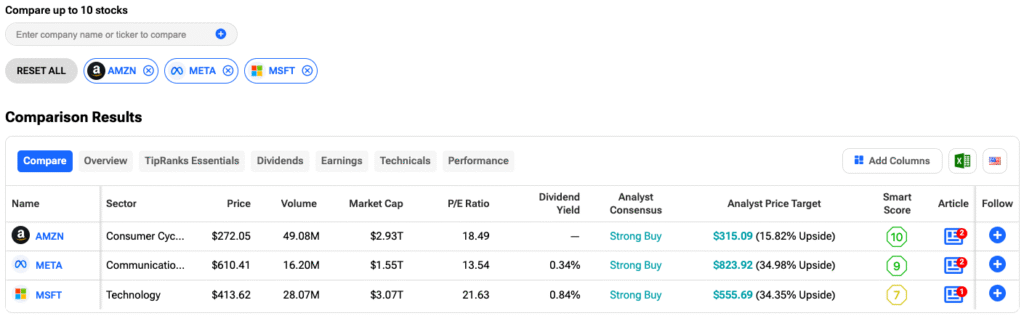
Wall Street analysts rate A stocks such as Amazon (AMZN), Meta Platforms (META), and Microsoft (MSFT) a Strong Buy, based on TipRanks consensus data. Among these stocks, MSFT has the highest upside potential of roughly 34.35% with an average price target of about $555. For more information on the performances, ratings, and price targets of these stocks, visit TipRanks Stocks Comparison Center.