OpenAI, the AI firm behind ChatGPT, is facing scrutiny after missing key internal targets tied to user growth and revenue. The company’s 2025 goal was to reach 1 billion weekly active ChatGPT users, a milestone it did not achieve.
Claim 55% Off TipRanks
Forget margin or options. Here's how the pros trade AMZNDespite this, its finance chief insists demand remains strong and could continue to rise. As a result, OpenAI now finds itself navigating the gap between missed expectations and ongoing market interest in its products.
OpenAI CFO Frames Target Miss as “Vertical Wall” Demand
OpenAI CFO Sarah Friar has downplayed concerns about the firm’s recent performance. Friar said the company is still meeting its main goals and that demand for its products is rising, going up a “vertical wall.” However, she admitted that results can vary from time to time.
Frair explained that OpenAI is still a young company, so not every metric is easy to predict. She added that the firm sets “stretch goals” internally that may differ from the ones it shares publicly. She also noted that every company she’s worked at has used stretch goals, and not having them would mean not doing her job properly as a CFO.
Notably, Frair has held senior finance roles at Goldman Sachs (GS), Salesforce (CRM), Nextdoor (KIND), and Block (SQ). She also pointed to product growth, noting that OpenAI’s coding tool Codex recently reached 4 million weekly users, up from 3 million just two weeks earlier.
This growth is being used internally to show that adoption is still speeding up. According to Friar, the company’s main issue is not demand but computing capacity. She said for now, expanding data centers and infrastructure is critical as OpenAI grows usage across its products.
OpenAI Missed Targets Raise Execution Concerns
Frair’s confident outlook has done little to calm the worries after OpenAI missed several key internal targets for 2025. The company failed to reach its goal of 1 billion weekly active ChatGPT users. It also fell short of various monthly revenue projections tied to its expansion plans.
Previously, Friar had privately raised concerns about whether OpenAI can fund its future computing needs if revenue does not grow fast enough. After the report, shares of some OpenAI partners declined, reflecting the firm’s strong influence across the AI sector.
OpenAI, however, rejected the report. It called the claims “clickbait” and maintained that its business remains strong and active across all product lines. At the same time, OpenAI is facing growing competition from Anthropic and Google (GOOGL), both of which have released strong rival AI models.
The firm declared a “code red” late last year as rivals gained ground and has since shifted focus toward its core products and AI agents. OpenAI is currently valued at $852 billion after raising $122 billion in March. The main question now is whether strong demand can turn into revenue fast enough to cover rising AI and computing costs.
Is OpenAI on the Stock Market?
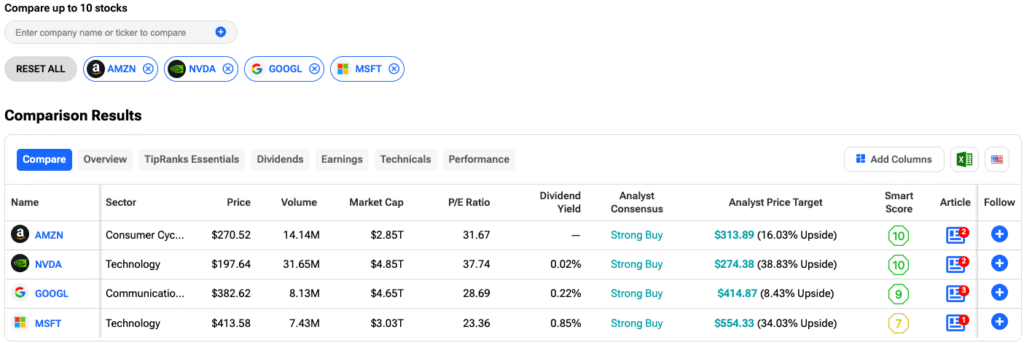
OpenAI is a private company, so its shares are not traded on any public stock market. However, investors can gain indirect exposure through partners such as Microsoft (MSFT), Nvidia (NVDA), and Amazon (AMZN), all of which have ties to the firm’s AI ecosystem. TipRanks Stocks Comparison Center lists all four with Strong Buy, according to ratings from Wall Street analysts.