


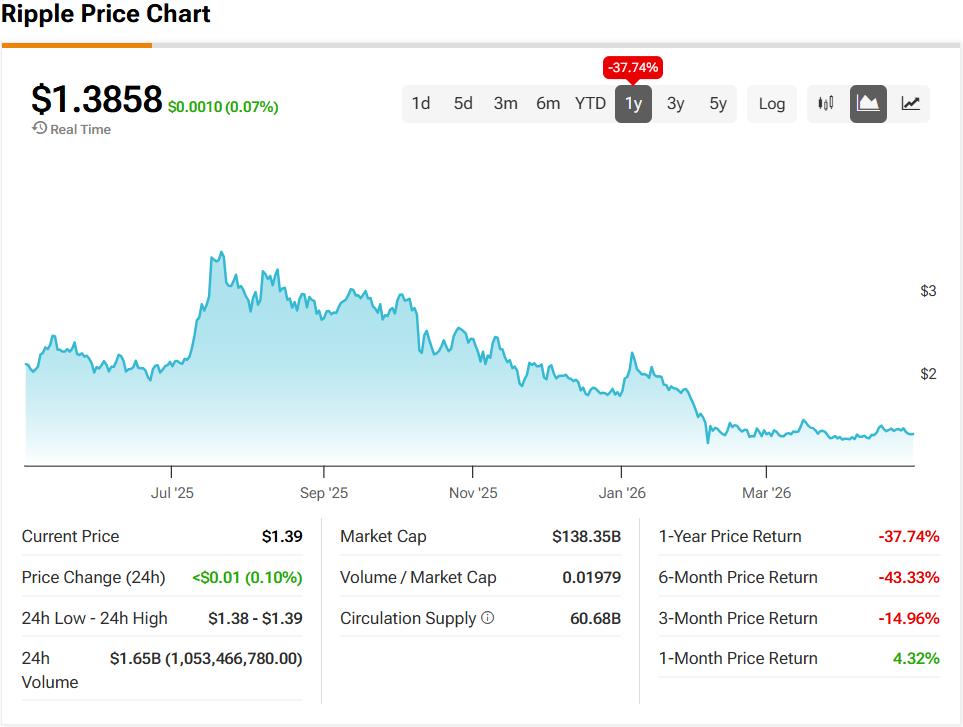
XRP (XRP-USD) has shed 38% over the past year and currently trades for $1.38. But if you’re thinking of picking up some tokens of the cross-border payments-focused crypto at a depressed level, one investor thinks there might be plenty of downside still in the cards.
Claim 55% Off TipRanks
- Unlock hedge fund-level data and powerful investing tools for smarter, sharper decisions
- Discover top-performing stock ideas and upgrade to a portfolio of market leaders with Smart Investor Picks
Investor Alex Carchidi believes that XRP could be on its way to below $1, and ominously, he thinks it could stay down there for a while.
Carchidi’s bear case rests on “two significant headwinds” XRP faces right now.
For one, Carchidi points to a shaky macro backdrop, with the conflict with Iran emerging as a key source of risk for assets like crypto. Disruptions to oil flows through the Strait of Hormuz have lasted several weeks, pushing inflation expectations higher at the “worst time for crypto” and making the Federal Reserve less likely to cut interest rates in the near term, thereby limiting the liquidity that typically supports the space. At the same time, higher energy prices add to inflation, keeping rates elevated and increasing the appeal of safer assets like U.S. Treasuries, which pulls capital away from riskier investments. As a result, XRP could get “weighed down by the same currents,” and if the conflict or related uncertainty persists for a quarter or longer, these conditions may drive a broader crypto downturn. “Of course,” Carchidi added, “if this happens, it could be considered a prime opportunity to buy the dip, as the downturn wouldn’t imply anything being wrong with XRP or its investment thesis.
Yet, competition is another key part of the bearish case for XRP, and it is intensifying. The original thesis that XRP would serve as a bridge currency for cross-border payments is being weakened by stablecoins, which can fill that role, as well as by renewed efforts from traditional players. For example, SWIFT is developing its Global Payments network, involving more than 50 banks across 25 corridors with almost-instant settlement and a planned launch by mid-2026. If it reduces the gap in speed and cost enough, banks may stick with familiar systems rather than adopt XRP.
At the same time, competing cryptocurrencies like Ethereum are positioned to “siphon capital away from XRP.” Ethereum supports $16.6 billion in tokenized real-world assets (RWAs), an area XRP is trying to build into, and it has a significantly broader ecosystem than the XRP Ledger. By comparison, the XRP Ledger holds $537.2 million in tokenized real-world assets.
“Combine the strong possibility of a bearish macro environment with the reality of competitive erosion, and XRP’s path to below a price of $1 for a year or two becomes uncomfortably plausible,” Carchidi warns.
That said, the investor also points out that this bearish scenario is “not a verdict on the future.”
XRP is more likely to keep progressing than to collapse. In April, spot XRP ETFs saw their strongest inflow streak of 2026, bringing in $55.3 million over the first 17 days with no net outflows, indicating continued demand despite macro uncertainty and rising competition.
For investors, then, it makes sense to monitor the key risks and be prepared to buy during downturns driven by geopolitical events. However, if competitors begin pulling financial institutions away from the XRP Ledger, that would signal a deeper structural issue and would “call the validity of the bull thesis into sharper question.”
“Either way,” Carchidi summed up, “be aware that this is not the right moment to bet the farm on this asset.” (To watch Carchidi’s track record, click here)
Disclaimer: The opinions expressed in this article are solely those of the featured investor. The content is intended to be used for informational purposes only. It is very important to do your own analysis before making any investment.