Nintendo Co. (NTDOY) is a Japan-based game firm best known for the Switch console, Mario, Zelda, and Pokémon. Its shares fell 7% in Tokyo on Monday after the firm raised Switch 2 prices and gave a soft view for the year ahead.
Claim 55% Off TipRanks
- Unlock hedge fund-level data and powerful investing tools for smarter, sharper decisions
- Discover top-performing stock ideas and upgrade to a portfolio of market leaders with Smart Investor Picks
The stock move was not just about one weak guide. It also showed how the global memory chip crunch is now hitting the consumer tech market. Nintendo said the Japan-only Switch 2 model will increase by 10,000 yen to 59,980 yen starting May 25, while prices in the U.S. and other markets will rise starting September 1.
Because Nintendo sells to a wide, price-aware base, such as families, kids, and casual gamers, it’s a big part of its reach. So, a higher price can hurt demand right when the Switch 2 needs to build sales in its key second year.
Morningstar analyst Kazunori Ito warned that “the year-on-year decline in game shipment guidance risks signaling that Nintendo lacks confidence in its pipeline.” Still, he said that view may be “too pessimistic,” since user growth often picks up in year two of a new console cycle.

AI Demand Creates Clear Winners
Of course, the broader issue is memory shortage. AI data centers need huge amounts of high-end memory chips, which has tightened supply and pushed prices higher. As a result, memory firms are among the big winners.
Samsung Electronics (SSNLF), SK Hynix, and Micron Technology (MU) have gained from strong demand for DRAM and high-bandwidth memory. These chips are vital for AI servers, where firms are willing to pay up to secure a supply.
Sony Group (SONY) also looks better placed for now. Sony shares rose 10% in Tokyo after it gave a more solid profit view for its game unit. The firm is also broader than Nintendo, with games, music, film, image sensors, and other units. That gives it more ways to guard profit when chip costs rise.
Asymmetric Advisors analyst Amir Anvarzadeh said Sony is “in a much better position to pass higher costs of memory chips to consumers.” That line sums up the split well. Some firms can pass on costs. Others risk a hit to demand.
Consumers Are Starting to Push Back
The losers are the firms that sell price-sensitive tech. That includes game consoles, PCs, phones, and other devices that rely on memory but have little room for price hikes.
Nintendo is the cleanest case. A higher Switch 2 price may help protect margins, but it also risks changing how buyers see the product. A family console near $500 feels less like an easy buy and more like a major spend.
This is where the story gets bigger than Nintendo. The AI boom is lifting chip firms, but it is also adding cost pressure across the tech chain. Consumers may not see AI servers, but they may start to feel the cost in game gear, laptops, phones, and other devices.
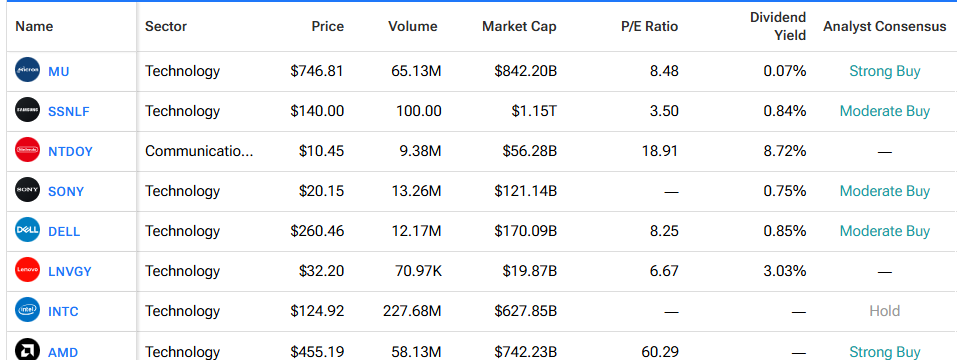
We used TipRanks’ Comparison Tool to align all related tickers appearing in the piece alongside other notable memory chip manufacturers, including Dell Technologies (DELL), Intel (INTC), and Advanced Micro Devices (AMD). It’s a great tool to gain an in-depth view of each stock and the broader AI chip industry.