


Netflix (NFLX) at 35% off its 52-week high looks too cheap. The recent pullback has been driven by what the market sees as weak guidance and the content streaming giant’s leadership outlook. Still, there is no deterioration in the business itself. If anything, the bullish story looks stronger than it has in quite some time, with top-line growth reaccelerating, margins rising, and the ad-supported model adding a new layer of earnings power. That disconnect between sentiment and fundamentals is exactly what makes the current setup so interesting. That is why I remain bullish on NFLX today.
Claim 55% Off TipRanks
New trading tool for AMZN bulls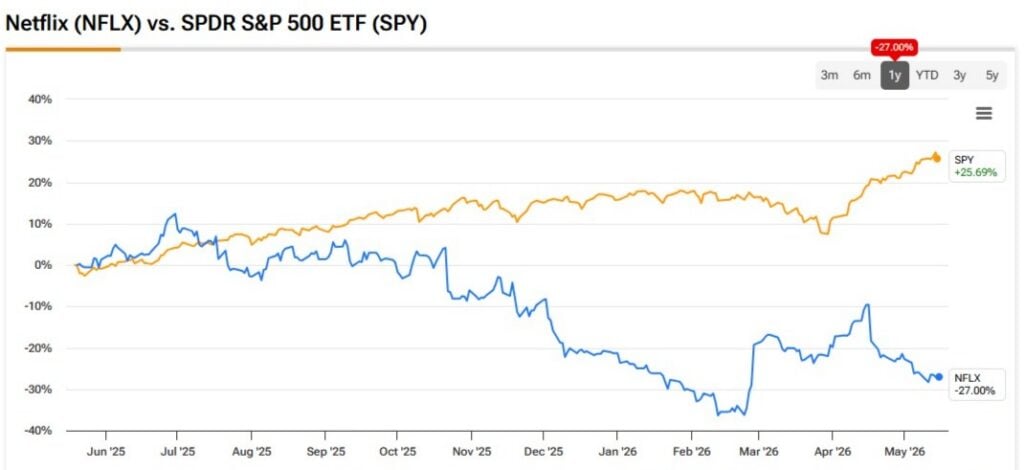
The Market’s Crisis of Faith
It’s been a rough stretch for Netflix year-to-date. After a blistering start to the year, sentiment worsened further following last month’s Q1 results. While its headline numbers looked good on the surface, investors probably found management’s guidance for the second quarter and the rest of 2026 rather uninspiring. There’s a growing fear that the easy wins from the password-sharing crackdown are now in the rearview mirror, leaving the company to face the “gravity” of traditional growth again.
In addition, the market clearly didn’t love the announcement that co-founder Reed Hastings would step down from the board in June 2026. It honestly feels like the final goodbye to the old guard, even if we know that Ted Sarandos and Greg Peters have been at the helm for a while now. Pair that with management’s Q2 revenue outlook of $12.57 billion, which sat just a hair below the $12.64 consensus estimate, and you get a recipe for a sell-off.
Traders are worried that without a new “magic trick” to pull out of the hat, Netflix might struggle to maintain its premium valuation in a world where every dollar of subscriber growth is hard-fought.

Netflix Is Incredibly Resilient
Despite these somewhat valid reasons to worry, the point that bears are missing is that the core business is incredibly resilient. In fact, it’s accelerating. In last year’s Q1, Netflix posted revenue growth of 12.5%. In this year’s report, that figure jumped to 16.2%, which is absolutely incredible when you realize the scale at which Netflix is now playing. The company is aggressively pivoting into advertising and live events, such as its recent push into regional sports and gaming, which are undoubtedly starting to pay real dividends in engagement.
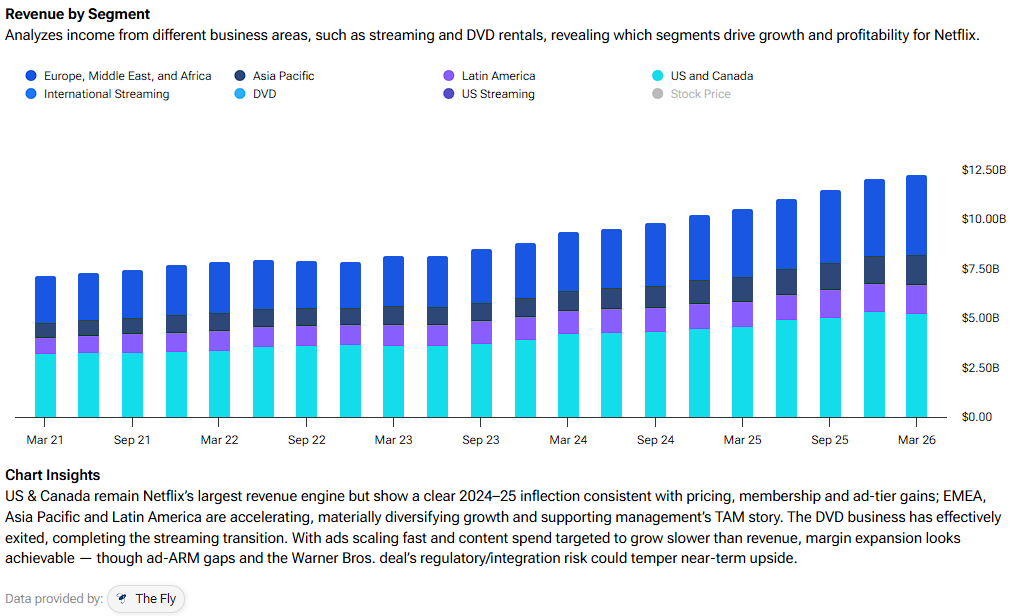
However, what’s more impressive is what’s happening with the operating margins. The company has managed to expand margins toward the 31.5%–32% range by being incredibly disciplined with content spending, keeping it in the $17 billion–$20 billion sweet spot, while simultaneously scaling the high-margin ad tier.
The ad-supported plan now accounts for over 60% of new sign-ups in supported regions. That’s a huge shift. Management has basically figured out how to get paid twice, once by the subscriber and once by the advertiser, all while keeping the churn at record lows. I believe this is a level of operational excellence that the rest of the industry hardly knows how to even start to replicate.
Cash Flow as the Ultimate Arbiter
Now, looking at Netflix’s cash flow makes the bullish story undeniable, in my humble opinion. The mix of accelerating revenue and expanding margins has caused free cash flow (FCF) to absolutely explode. We saw a massive $5.1 billion in FCF in the first quarter alone. That was partly boosted by a one-time windfall from the termination of the Warner Bros. Discovery (WBD) deal, but the underlying trend is what matters. The market is now looking at a record FCF of $12.5 billion for the full year 2026, up from the initial $11 billion, and a low-to-mid-teens billion range in 2027.
Therefore, at today’s prices, you’re looking at a stock priced at about 27.7x FY2026 FCF and 25.6x FY2027 FCF. That is way down from the 36x–65x FCF multiples the company commanded a couple of years ago, representing a steep discount to its normalized post-pandemic trading average of roughly 45x–50x FCF. Also, in the context of a company growing in the mid-teens, expanding its profitability, and essentially owning the global streaming market, those multiples look rather cheap on a standalone basis.
It’s kind of wild that Disney (DIS), Paramount (PSKY), Amazon (AMZN) with Prime Video, and the rest have spent years trying to make streaming work and still can’t seem to turn it into a steady, profitable segment. Netflix, meanwhile, is throwing off cash quarter after quarter. Somehow, it’s the one company that actually won streaming, but the market keeps treating it like it’s the one in trouble.
Is NFLX a Buy, Sell, or Hold?
Despite the stock’s prolonged year-to-date sell-off, Netflix still has a Strong Buy consensus rating on Wall Street, based on 27 Buy and eight Hold ratings. It’s interesting that no analyst rates the stock a Sell. Also, NFLX’s average price target of $115.89 implies about 33% upside potential over the next 12 months.

Final Thoughts
Investors have punished Netflix for cautious guidance. However, the business keeps delivering. Revenue growth has picked up, while margins continue to expand. At the same time, the fairly new ad tier now contributes meaningful profits. These trends are set to sustain a rising free cash flow, and with the stock well below its highs, I believe Netflix remains quite compelling here following its prolonged sell-off.