


Snowflake (SNOW), the cloud-based data warehousing platform, has a real opportunity in artificial intelligence (AI), but the path to monetization remains unclear. The company sits at the center of one of the most important shifts toward data-driven AI, yet the stock is down more than 41% from its November 2025 highs. While that pullback may appear attractive at first glance, I am not ready to turn bullish. For now, I remain neutral, as the story feels promising but not yet fully proven.
Meet Samuel – Your Personal Investing Prophet
- Start a conversation with TipRanks’ trusted, data-backed investment intelligence
- Ask Samuel about stocks, your portfolio, or the market and get instant, personalized insights in seconds

A Strong Platform in the Right Place
Snowflake’s core strength remains intact. The company built its reputation as a cloud-native data platform that allows enterprises to store, process, and analyze data across multiple use cases. That foundation is increasingly important in an AI-driven world, where data organization and accessibility are prerequisites for meaningful deployment.
This is why Snowflake continues to benefit from a broader “data before AI” trend. Enterprises are still migrating workloads to the cloud, consolidating data environments, and preparing infrastructure for future AI use cases. That underlying demand is visible in continued consumption growth and large enterprise deals, including multi-year agreements that signal long-term commitment to the platform.
Importantly, Snowflake is not losing relevance in this transition. If anything, its platform is becoming more central to enterprise workflows. The question is not whether Snowflake has a role in AI — it clearly does — but how much incremental value it can capture from that role.
AI Is Expanding the Opportunity, but Adding Complexity
Snowflake has moved aggressively to position itself as an AI-enabled data platform. Products like Cortex Code, Snowflake Intelligence, and the recently introduced SnowWork platform reflect a clear effort to expand beyond traditional analytics into more application-level and agent-driven use cases.
Early signs of engagement are encouraging. Management has highlighted strong developer interest in Cortex Code, a coding agent embedded within Snowflake’s ecosystem. At the same time, SnowWork aims to broaden adoption by making AI tools accessible to less technical users through pre-built workflows and persona-based interfaces. This is directionally the right strategy. AI is shifting enterprise software toward more automated, agent-driven interactions, and Snowflake is trying to position itself at the center of that transition.
However, this is also where uncertainty begins to emerge. Snowflake now has multiple AI-related products, but it remains unclear which of them will become the primary driver of long-term growth. Management has emphasized potential, yet there is limited visibility into how these products translate into meaningful revenue contribution today. In other words, the opportunity is expanding — but so is the story’s complexity.
Growth Remains Solid, but the Shape Is Changing
Snowflake’s core business continues to grow at a healthy pace, supported by consumption-based pricing and expanding enterprise adoption. Product revenue growth of around 30% year-over-year and remaining performance obligations nearing $9.77 billion suggest that demand for the platform remains strong.
At the same time, the growth profile is beginning to shift. Management has guided to around 27% growth in product revenue for the current fiscal year, implying some deceleration from prior levels. That is not necessarily a negative. Snowflake is now operating at a much larger scale, but it does reinforce the need for new growth drivers to emerge.
AI is expected to fill that gap, but it is still early. While management has described AI tools like Cortex Code as “game changers,” the actual revenue contribution from AI products remains relatively small and less clearly defined. That disconnect between narrative and measurable impact is one reason I am not ready to get more constructive on the stock.
Margins and Monetization Remain Open Questions
Another important consideration is profitability. Snowflake’s core analytics workloads carry attractive margins, but AI workloads introduce new dynamics. Many of these services rely on third-party large language models, which increases the cost of goods sold and can pressure gross margins.
Management has acknowledged that AI-related workloads and new AI products could weigh on margins in the near term, even if they ultimately drive higher revenue. While that trade-off may make sense strategically, it adds another layer of uncertainty to the financial model.
The key question is whether Snowflake can scale its AI offerings to improve efficiency over time. That may happen, but it is not guaranteed — and it is not yet visible in current results.
Competition Is Getting More Intense
Snowflake is not operating in a vacuum. The competitive landscape is evolving, particularly with the rise of platforms like Databricks, which are also targeting AI-driven data workflows.
Both companies are gaining share from legacy systems, but Databricks appears to be moving faster in certain AI-related areas, particularly around model training, inferencing, and integrated AI tooling. At the same time, hyperscalers continue to expand their own data and AI capabilities, creating additional competitive pressure.
Snowflake still has strong positioning, especially in data warehousing and analytics. However, as AI becomes a larger part of the conversation, differentiation becomes more complex — and potentially harder to sustain.
Wall Street’s View
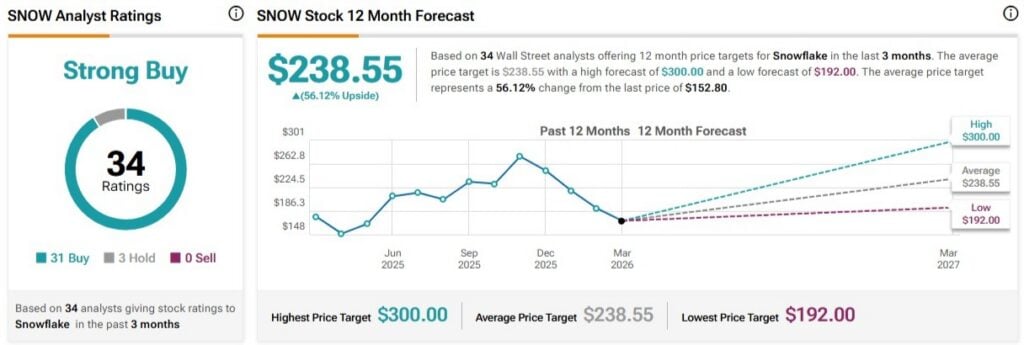
According to TipRanks, Snowflake carries a “Strong Buy” consensus rating, with 31 Buy, three Hold, and no Sell ratings. Based on 34 Wall Street analysts, the average price target is $238.55, implying about 56.12% upside from the recent share price of $152.80.
Conclusion
Snowflake is clearly a company with real strategic relevance in the AI era. Its platform sits at the intersection of data, cloud infrastructure, and emerging AI workflows — an enviable position in today’s technology landscape.
However, that positioning alone is not enough to justify a bullish stance right now. The company is still in the early stages of translating its AI ambitions into tangible, measurable growth drivers. At the same time, margins, competitive dynamics, and product focus all introduce additional uncertainty.
After a significant pullback, the stock may look more attractive than it did at its highs — but I do not think the story is fully de-risked yet. That is why I remain neutral on SNOW.