Micron (MU) and Nvidia (NVDA) are both major AI beneficiaries, but Wall Street’s current outlook points to Nvidia as the stock with more room to run. Micron has become a major way to play the AI memory shortage, especially as demand for high-bandwidth memory keeps rising. However, the stock has already moved so aggressively that the analyst consensus now points to downside risk. Nvidia, meanwhile, still has the stronger analyst-backed upside case because demand for AI compute remains extremely tight, and several firms continue to raise their expectations for Blackwell, Rubin, and hyperscaler AI spending.
Meet Samuel – Your Personal Investing Prophet
Explore NVDS for 2X short leverage on NVDAMicron: Some Analysts Still See Upside
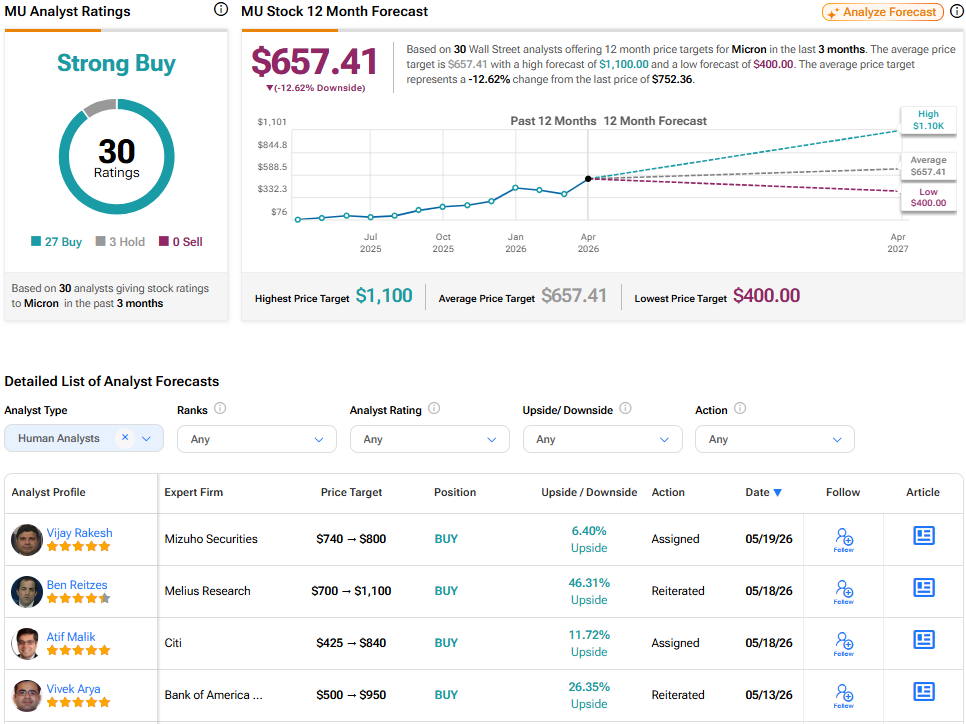
Before dismissing Micron, it’s worth noting that some analysts still see major upside. Melius Research analyst Ben Reitzes recently raised his Micron price target to $1,100 from $700 and kept a Buy rating. He argues that memory and other AI “bottleneck stocks” can keep working as AI infrastructure demand stretches supply.
Separately, Deutsche Bank (DB), led by five-star-rated analyst Melissa Weathers, raised its Micron target to $1,000 from $550, while Citigroup’s (C) Atif Malik lifted his target to $840 from $425. Bank of America (BAC) has also been positive, with Vivek Arya raising his price target to $950 due to Micron’s AI-driven HBM opportunity.
Nevertheless, the problem is that Micron’s stock has already priced in a lot of that optimism. Interestingly, the stock still has a Strong Buy consensus, but the average Micron price target of $657.41 per share implies 12.6% downside risk after the stock’s sharp rally. That makes the setup more complicated than the individual bullish calls suggest. In other words, analysts may love the AI memory story, but the stock has run ahead of the average Wall Street target.
Nvidia: Analyst Case Looks Cleaner
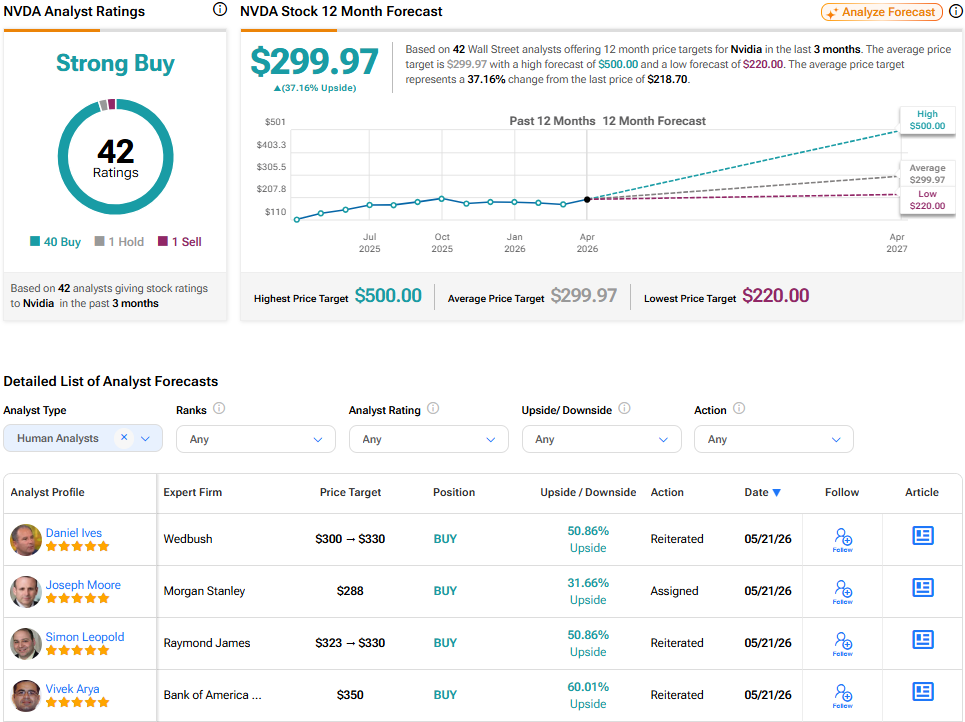
In contrast, Nvidia’s analyst case looks cleaner because the company remains the central supplier of AI compute. Cantor Fitzgerald, led by five-star analyst C.J. Muse, recently raised its Nvidia target to $350 from $300, thanks to an extraordinarily tight compute supply and the possibility that Nvidia is effectively sold out through 2026 and 2027. The firm also pointed to strong token demand from companies like Anthropic and OpenAI, which supports the idea that AI infrastructure spending is producing real returns rather than just hype.
Wedbush’s Dan Ives also raised his Nvidia (NVDA) price target to $330 from $300 and kept a Buy rating after the company delivered a strong first quarter. The five-star analyst said that Nvidia’s revenue and earnings per share both beat Wall Street expectations, while management’s $91 billion Q2 revenue guide also came in ahead of what many investors were expecting. Wedbush also believes that Nvidia may have left a few billion dollars of cushion in that guidance, which could set the company up for another beat next quarter.
In addition, gross margins remain at around 75%, while CEO Jensen Huang expects nearly $20 billion in CPU sales alone this year. On top of that, Huang suggested that Nvidia’s upcoming Vera Rubin platform will likely remain supply-constrained throughout its life cycle, which points to continued strong demand. As a result, Wall Street has a Strong Buy consensus rating on Nvidia stock. But, unlike Micron, the average Nvidia price target of $299.97 per share implies 37.2% upside potential.