


After a recent pullback cooled momentum across memory stocks, today’s rebound has investors reconsidering whether the broader AI rally remains intact.
Meet Samuel – Your Personal Investing Prophet
Two ETFs for long or short leverage on SNDKFor those looking for reassurance that this was merely a pause in the upswing rather than the start of a deeper shift, a recent report from 5-star Melius Research analyst Ben Reitzes may offer some encouragement.
The analyst still feels “incrementally good” about “bottleneck stocks” like memory stalwarts Micron (NASDAQ:MU) and Sandisk (NASDAQ:SNDK).
Reitzes believes the “tokenization of software” is still in its early stages as AI agents scale rapidly, driving memory, CPU, and networking requirements well beyond prior expectations. There is increasing evidence that hyperscalers are becoming more willing to enter longer-term, more predictable purchasing agreements, such as long-term agreements (LTAs) and supply commitment agreements (SCAs), to secure capacity even at higher pricing. Recent commentary from Samsung, Hynix, and Kioxia supports this trend.
More specifically, memory has emerged as the “binding constraint on AI performance,” with demand now significantly outpacing supply, meaning the industry has “repriced from commodity to infrastructure.” Micron stands out as the only scaled U.S. producer across all three critical layers where this constraint is most acute: HBM (high bandwidth memory), the stacked bandwidth layer integrated directly with AI accelerators; DRAM, which underpins active server compute workloads; and NAND, which provides persistent storage for model weights and key-value cache.
Reitzes’ MU estimates now sit above consensus for 2027 and 2028, reflecting his expectation that the supply-demand imbalance will persist. In contrast to the Street, the analyst expects EPS to grow year-over-year through fiscal 2028 and “at least a few years beyond that.” While long-term growth is likely to moderate as ASP inflation normalizes, EPS should remain supported by SCAs, which establish effective floors for both supply allocation and margins. Micron is also positioned to benefit structurally as each new wave of AI training and inference increases memory requirements per accelerator, sustaining industry-wide undersupply compared to previous commodity cycles, further constrained by limited cleanroom capacity.
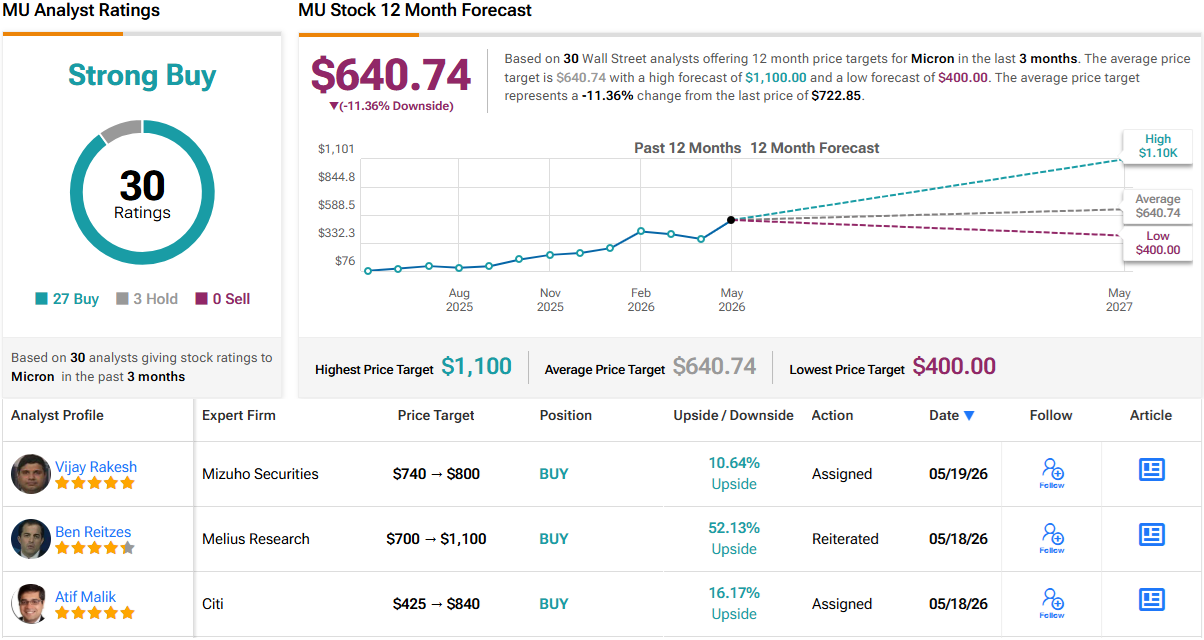
To this end, Reitzes rates MU stock a Buy while his price target goes from $700 to $1,100, implying the shares will gain 61% in the months ahead. (To watch Reitzes’ track record, click here)
The analyst consensus rates MU stock a Strong Buy, based on a mix of 27 Buys vs. 3 Holds. However, the $640.75 average price target factors in a one-year drop of 11%. Considering this discrepancy, watch out for further price target hikes, or conversely, rating downgrades shortly. (See MU stock forecast)
As for Sandisk, it benefits as an AI infrastructure supplier due to its manufacturing cost advantage, vertically integrated stack, and a new NBM (new business model) framework, where customers sign long-term agreements that secure supply and pricing, which “structurally rewriting” the NAND industry.
A key driver is KV cache offload, where parts of the AI model’s working memory (the key-value cache used during inference to speed up token generation) are shifted from expensive high-bandwidth memory into NAND storage. This effectively creates a new, large source of demand for flash memory. Sandisk estimates this could add 75–100 exabytes of NAND demand in calendar year 2027 alone, equivalent to roughly 10–15% of current industry supply, a contribution Reitzes says does not currently feature in any model.
Accordingly, Reitzes has raised his SNDK price target from $1,500 to $2,350, suggesting the stock will gain 76% over the coming months. Reitzes’ rating stays a Buy.
Elsewhere on the Street, the stock claims an additional 12 Buys and 3 Holds, for a Strong Buy consensus view. At $1,516.88, the average price target offers one-year upside of 10.5%. (See SNDK stock forecast)

Disclaimer: The opinions expressed in this article are solely those of the featured analyst. The content is intended to be used for informational purposes only. It is very important to do your own analysis before making any investment.