Meta Platforms (META) ran into the Chinese Wall in its push into AI, after China moved to block its planned $2 billion deal for startup Manus. The news broke a day before Meta’s scheduled earnings report tomorrow, April 29.
Claim 55% Off TipRanks
Forget margin or options. Here's how the pros trade NVDABloomberg noted that the Chinese regulators “didn’t give a detailed explanation,” yet the broader signal is clear. China and the American administration both see certain AI assets as too important to let go. However, this new step by the Chinese government raises questions over future deals in the AI space, involving American and Chinese companies.
Nevertheless, the decision came after Meta had already agreed to acquire Manus, an AI platform known for its ability to carry out complex tasks with little input. While the deal had moved forward, China’s regulators stepped in and ordered it to be unwound, leaving the outcome unclear.
Meanwhile, META shares are slightly down in pre-market trading, indicating the blocked deal hasn’t impacted investor sentiment much.

What Makes Manus Different
To start, Manus is part of a new wave of AI tools known as agents. Unlike chatbots that answer questions, these systems can act on their own. They can browse the web, write code, manage files, and complete tasks from start to finish.
In practice, Manus can handle work like stock research, travel booking, and customer service tasks. It can also learn user habits over time, which makes it more useful as an ongoing tool.
This level of autonomy has drawn strong interest across the tech sector. Companies like Alphabet (GOOGL), OpenAI, and Anthropic are all working on similar systems, aiming to move beyond simple chat tools.
Meta saw Manus as a fast way to close that gap. The startup had reached more than $100 million in annual revenue within months, which made it one of the fastest-growing AI firms to date.
Why China Stepped In
At the same time, China’s move points to a deeper issue. Even though Manus had moved its base to Singapore and cut ties with China on paper, Beijing still viewed it as a Chinese company.
The founders and much of the team are Chinese nationals, and parts of the core tech were built in China. That gave the government leverage.
In addition, the block fits into a wider pattern. The U.S. has placed limits on China’s access to advanced AI chips, many of which are made by firms like Nvidia (NVDA). In response, China appears focused on keeping its own AI talent and tech from moving abroad.
As a result, the Manus deal has become more than a single case. It shows that cross-border AI deals may face new limits, even after firms try to move outside China.
What It Means for Investors
This case highlights the growing risk in the AI space, as long as geopolitical tensions rule the land, especially when they touch on U.S.-China ties.
Meta may still look for ways to keep parts of the deal, such as through a license or a joint setup. However, the loss of the core team could reduce the asset’s value.
Is Meta a Good Stock to Buy Now?
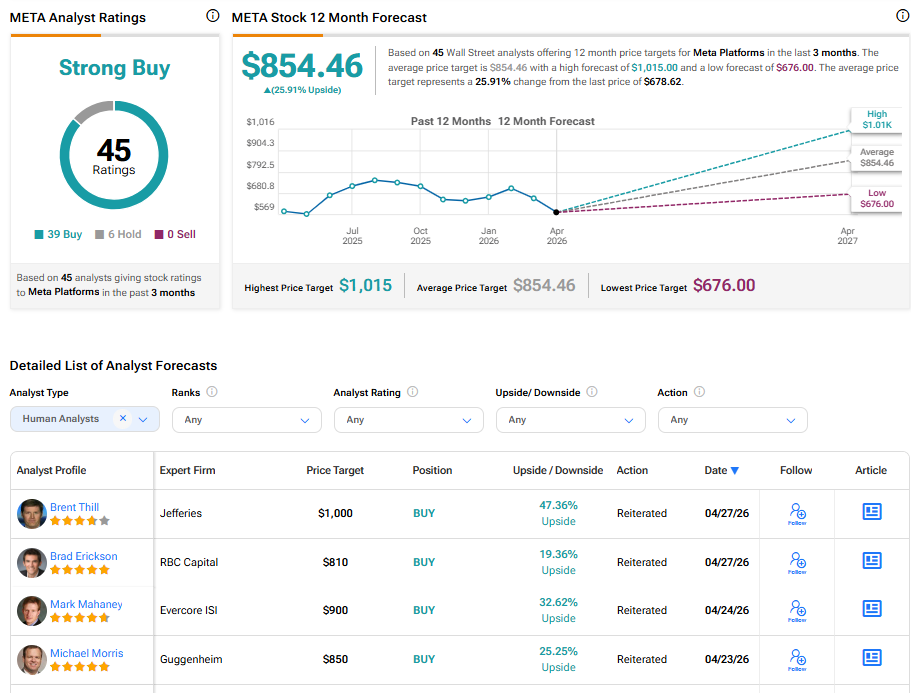
Turning to the Street, Meta Platforms boasts a Strong Buy consensus. Out of 45 ratings issued over the past three months, 39 analysts rate the stock a Buy, while six rate it a Hold. The average META stock price target is $854.46, implying a 25.91% upside from the current price.