


McDonald’s (MCD) stock just got cheaper for the wrong reasons. Last week’s Q1 report gave the market a few reasons to worry, but not really much evidence that the broader investment case has meaningfully weakened. If anything, the reaction seems to treat a high-quality, cash-generative franchise as a business facing real structural pressure, and I do not think that is what the numbers show.
Claim 55% Off TipRanks
- Unlock hedge fund-level data and powerful investing tools for smarter, sharper decisions
- Discover top-performing stock ideas and upgrade to a portfolio of market leaders with Smart Investor Picks
With global expansion still underway and the royalty model intact, the fast-food chain’s setup looks quite appealing today, especially given what appears to be a discounted valuation. That is why I remain bullish on MCD following its recent sell-off.

A Sour Aftertaste in the First Quarter
The selling pressure really ramped up last week after McDonald’s dropped its Q1 results. On the surface, the numbers weren’t exactly a disaster. Revenue hit $6.52 billion, up over 9%, but these days, the market has become a spoiled toddler that screams if it doesn’t get exactly what it wants. Wall Street was looking for U.S. comparable-store sales of around 4.1%, while the Arches posted “only” 3.9%. There’s a nagging fear that the American consumer is finally buckling under the weight of persistent inflation, choosing to stay home rather than grab a Quarter Pounder.

What likely upset the market more, though, was the sequential dip in gross margins. We saw them slide to 55.9% from a peak of 58% just a couple of quarters ago. For a company as well-run as McDonald’s, that kind of friction makes investors nervous, because they are not used to it. So concerns arise, such as whether the “McValue” platform is eating too much into the bottom line or whether labor costs are becoming harder to control. So even though the company reaffirmed its full-year guidance, the lack of an upward revision in a choppy environment felt like a lack of confidence to the bears.
Given the current sentiment, I’d point to the odd “Big Arch” marketing misstep involving CEO Chris Kempczinski. The video from a few months back, in case you missed it, was an awkward taste test in which he takes a tiny, careful bite of the new burger while speaking in very polished corporate language. It went viral, but not in the way McDonald’s would have wanted.
A lot of people made fun of the video because it felt staged, disconnected, and overly corporate. By itself, that might seem like a small thing. However, clips like that can leave investors wondering whether management really understands the regular customer buying a $5 meal deal late on a Tuesday night. So when even one metric comes in a little soft, it can reinforce an already shaky mood around the stock.
Why McDonald’s Growth Is Actually Roaring
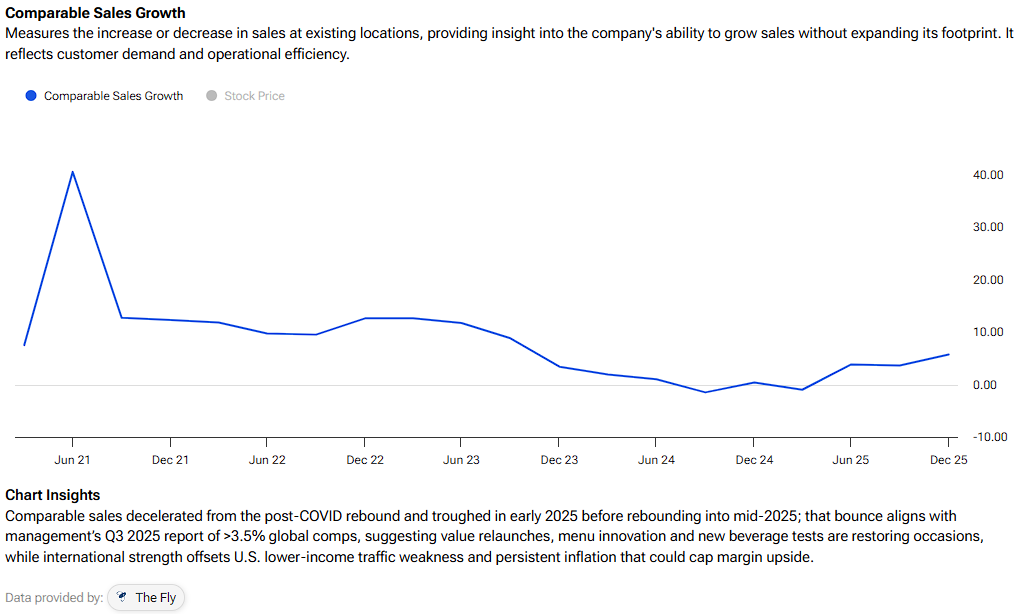
Yet the truth is that, despite some missteps and margin pressures, the underlying business is thriving on almost every meaningful metric. That 9.4% revenue growth we saw this quarter was the strongest top-line performance the company has posted in the last eight quarters. This isn’t a business in decline. Quite the contrary, this is a business that is aggressively expanding its footprint. Notably, they are still on track to hit a massive 50,000-unit target by 2027, with 2,100 net new restaurant openings planned for this year alone.
The organic growth story looks strong, too. The “Best Burger” rollout, which focused on softer buns and a better sear, shows that McDonald’s can still make small improvements to the core menu that actually matter to customers. The digital side may be even more important. McDonald’s aims to reach 250 million 90-day active loyalty users by 2027. That gives the company a huge amount of customer data, plus a direct way to reach people without relying as heavily on traditional ads. Moreover, when you see comparable sales up 3.9% in major international markets like the UK and Germany, it’s a reminder that the brand still has real strength globally.
To go back to the viral Big Arch clip, as bad as it was, it might not have been a total loss. Sales of the burger seem to have come in better than expected after the whole cringe campaign, which is funny, but also very McDonald’s. They can put out a weird video of the CEO nibbling a burger in a V-neck, get roasted for it, and still end up selling the thing. That’s the “annoying” strength of the brand. The marketing can be awkward, the internet can laugh at it for a week, and people still end up in the drive-thru ordering fries.
The Blue-Chip Bargain
With shares continuing to slide after the earnings call, I think we’ve entered territory where the valuation has gotten too attractive to ignore. According to current consensus estimates, McDonald’s is expected to post earnings per share (EPS) of about $12 for this year. At a share price near $275, the stock trades at a P/E multiple of roughly 22.7x. For context, this is a company that has historically traded at much higher premiums, often in the 25x to 27x range, because of its unique, low-risk business model.
So today, I believe you’re essentially getting a “Dividend Aristocrat” at a discount. Remember that this isn’t just a burger franchise but one of the world’s greatest real estate and royalty businesses. They own the land and collect a percentage of every sale made by franchisees, regardless of whether an individual store is struggling with labor costs. That royalty-based model provides a tremendous cushion during economic downturns. In fact, McDonald’s is notoriously “recession-proof.” When families stop going to expensive sit-down restaurants, they trade down to the Golden Arches.
Is MCD a Buy, Sell, or Hold?
Despite the stock’s lackluster performance, McDonald’s still has a Moderate Buy consensus rating on Wall Street, based on 15 Buy and 11 Hold ratings. Notably, no analyst rates the stock a Sell. In addition, MCD’s average price target of $335.76 implies over 21% upside potential over the next 12 months.

Conclusion
I think the market read too much into the quarter. There was no guidance raise; there was a little pressure on margins. Not ideal, but it does not really change what McDonald’s is. After the sell-off, the stock is finally in a more reasonable spot. It is still one of the most profitable restaurant businesses in the world, and at about 22x earnings, investors are no longer paying a stretched multiple. That is why I see the pullback as more of an opening than a red flag. For anyone willing to be patient, McDonald’s looks a lot more interesting here than it has in a while.