


Lockheed Martin (LMT) stock’s recent decline underscores a disconnect between price and earnings quality that both the $186.43 billion backlog and reaffirmed full-year 2026 guidance contradict. At 16.88x forward earnings, LMT trades below many defense peers despite a backlog that management has reaffirmed as the foundation for multi-year revenue and cash flow growth. I remain bullish on LMT and view the current price as a compelling entry point for long-term investors.
Claim 55% Off TipRanks
- Unlock hedge fund-level data and powerful investing tools for smarter, sharper decisions
- Discover top-performing stock ideas and upgrade to a portfolio of market leaders with Smart Investor Picks
Founded in 1912 and headquartered in Bethesda, Maryland, Lockheed Martin is the world’s largest defense contractor. It designs and develops advanced technology systems across Aeronautics, Missiles and Fire Control, Rotary and Mission Systems, and Space for the U.S. Department of Defense and allied governments worldwide.
Despite the Recent Sell-Off, Demand Remains Intact
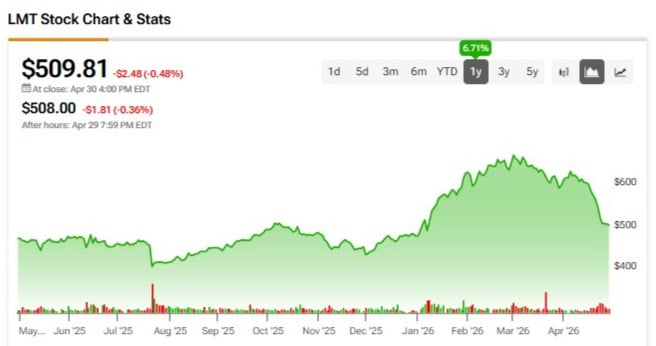
LMT shares hit an all-time high (ATH) of $692 on March 2, but have since fallen nearly 27% to $508.60. Although the broader market pressure on defense names like Lockheed Martin was the initial catalyst behind the sell-off, Q1 results released on April 23 added a further leg down. The headline numbers explained the negative reaction on Wall Street: diluted earnings per share of $6.44 fell approximately 12% year-over-year, and free cash flow turned negative at $291 million.
Yet, when we look past the headline figures, LMT’s fiscal picture changes considerably. Free cash flow turned negative because of working capital timing and an enterprise resource planning (ERP) billing system rollout in one business area, a disruption management expects to resolve in Q2. Aeronautics segment profit fell approximately 14% year-over-year due to design rework and flight-test delays on a new F-16 configuration, with deliveries already resuming.
Rotary and Mission Systems declined approximately 19% year-over-year, reflecting the absence of a prior-year intellectual property license recovery rather than any deterioration in program health.
Critically, management reaffirmed its full-year 2026 guidance: mid-single-digit sales growth, operating profit of $8.4 billion to $8.7 billion, and free cash flow of $6.5 billion to $6.8 billion, with cash expected to be back-end weighted as billing normalization takes effect in Q2. That reaffirmation is important because the numbers released in Q1 were not due to a demand problem. As those factors resolve over the remainder of 2026, the current gap between the LMT stock price and the business’s underlying earnings power looks increasingly difficult to justify.
A Record $186B Backlog Validates the Long-Term Bull Case
The foundation of the bullish thesis sits in Lockheed Martin’s $186.43 billion backlog. In Q1 alone, Missiles and Fire Control secured approximately $7 billion in Patriot Advanced Capability-3 (PAC-3) orders, including a $4.7 billion undefinitized contract for accelerated production. The Pentagon submitted a Fiscal Year 2027 budget request for 85 F-35 aircraft.
Production is expanding to meet that demand. Factory output is up more than 60% versus two years ago, and Missiles and Fire Control grew both revenue and operating profit by 8% year-over-year in Q1. Management is investing in more than 20 facilities to support munitions production ramps, with Patriot production targeted to scale from roughly 650 to 2,000 units per year over the next several years. Supply chain constraints in solid rocket motors and seekers are real but reflect capacity expansion challenges, not weakening demand.
The Space segment adds a distinct layer of credibility. The Orion spacecraft completed a near-flawless Artemis 2 lunar mission, validating Lockheed Martin’s engineering execution on a high-stakes national program, with units already in assembly for Artemis 3 through 5. These are contracted deliveries on programs with demonstrated performance, supporting sustained high-margin service revenue for years ahead.
The Valuation Gap and Dividend Reinforce the Entry Case
At 16.88x forward earnings, LMT trades at a discount to General Dynamics (GD) at 20.67x, Northrop Grumman (NOC) at 20.17x, and L3Harris Technologies (LHX) at 27.78x. Given Lockheed Martin’s backlog scale, reaffirmed guidance, and multi-segment program diversification, that discount is difficult to justify on fundamentals. Meanwhile, a nearly 2.7% dividend yield adds an income component that supports the total return case while investors wait for the valuation gap to close.
Yet investors seeking defense exposure while limiting single-name concentration in LMT shares could consider three well-differentiated options through exchange-traded funds. The most direct route is the Global X Defense Tech ETF (SHLD), which holds LMT as its largest position, at roughly 8% to 9% across a concentrated basket of defense and aerospace names, including cybersecurity and artificial intelligence applications for defense. It suits investors who want to stay close to the defense thesis with meaningful LMT weighting.
The American Century STOXX U.S. Quality Value ETF (VALQ) includes LMT as a smaller position within a broad quality-value framework. It suits investors who prefer the valuation argument embedded in a quality-factor framework rather than a pure sector position. Finally, the Franklin U.S. Low Volatility High Dividend Index ETF (LVHD) also holds LMT, but at roughly 3%, and it offers an income-oriented, lower-volatility profile with a 30-day U.S. Securities and Exchange Commission (SEC) yield of 3.26%
Is LMT Stock a Buy, Sell, or Hold?
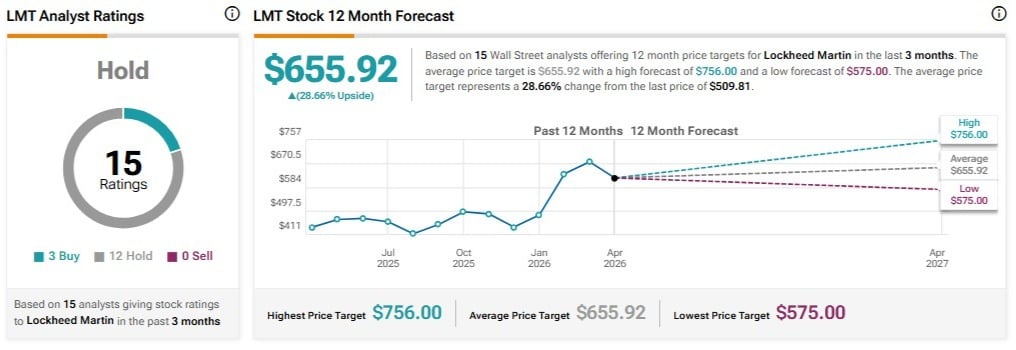
According to Wall Street analysts covering Lockheed Martin over the past three months, LMT has a Hold consensus rating based on 15 analyst ratings, including three Buys, 12 Holds, and no Sells. The average 12-month price target of $655.92 implies upside of approximately 29% from the share price of $509.81.
Conclusion
Lockheed Martin’s decline from its all-time high of $692 reflects broader market pressure compounded by a shortened fiscal period, an ERP billing disruption, and the absence of prior-year one-off benefits in Q1, not a change in demand or long-term earnings power. The $186.43 billion backlog, reaffirmed full-year 2026 guidance, and a forward multiple that sits below defense peers all point to a business the market is currently undervaluing. A near 2.7% dividend yield provides additional support for patient investors. I remain bullish on LMT at these levels.