


JPMorgan Chase (JPM) increasingly looks less like a traditional bank stock and more like a durable long-term compounder. The company continues gaining market share across consumer banking, investment banking, wealth management, and trading, while delivering the kind of profitability and consistency that very few large financial institutions can match.
Claim 55% Off TipRanks
- Unlock hedge fund-level data and powerful investing tools for smarter, sharper decisions
- Discover top-performing stock ideas and upgrade to a portfolio of market leaders with Smart Investor Picks
The stock has rallied strongly over the past year, outperforming many U.S. and European banking peers. Even so, I still believe the market may be underestimating the company’s long-term earnings power and growth potential. Strong net interest income, rising dividends, and consistently high returns on tangible common equity (ROTCE) continue to support the bull case, which is why I remain bullish on JPM shares.

Rate Sensitivity and Earnings Show Resilient Net Interest Income
JPMorgan’s Q1 2026 results emphasized how sensitive its earnings remain to policy rates, but also how much of that leverage it has already captured. Net income was $16.5 billion, up 13% year-over-year, on net revenue of $50.5 billion, up 10% year-over-year, while net interest income (NII) of $25.5 billion rose roughly 9% year-over-year.
Net interest income has been an essential profit engine since the sharp rise in interest rates, and management has already warned that it will likely moderate as funding and deposit costs catch up. If the Federal Reserve cuts rates more gradually than previously expected, JPMorgan’s net interest income is likely to decline less and later than investors modeled at the start of the year.
However, the Q1 reaction signals that the market is already skeptical about upside from here. In other words, JPMorgan looks less like a pure beneficiary of future ‘higher-for-longer’ rates and more like a bank that has already captured much of the rate windfall.
Diversified Growth beyond NII
On the bright side, the latest quarter showed that JPMorgan is not solely reliant on net interest income, as non-interest revenue remains a meaningful contributor, generating $25.1 billion, up 11%. Trading and investment banking rebounded, and asset and wealth management continued to benefit from higher market levels and net inflows. Also, JPMorgan partnered with Ripple and other companies to successfully execute a cross-border redemption of tokenized Real-World Assets (RWAs).
This breadth of earnings matters if interest rates eventually normalize. As net interest income growth compresses, fee-based businesses such as payments, securities services, and asset management can support a greater share of the earnings load, making the bank look more like a diversified financial services platform than a pure rate play. That diversification is a major reason JPMorgan maintains returns on tangible common equity, even as credit costs normalize and regulatory capital demands rise.
Credit quality is gradually normalizing from the unusually favorable post-pandemic conditions period. Even so, JPMorgan’s scale, diversified loan book, and underwriting standards remain a buffer. Provisions are moving higher as management builds reserves against consumer and commercial portfolios. The combination of normalizing credit costs and plateauing path for net interest income reinforces the idea that earnings growth will likely decelerate from here.
Fundamental Analysis and Valuation Context
In Q1 2026, JPMorgan delivered a 23% return on tangible common equity (ROTCE), up from about 21% a year earlier, placing it firmly at the top of the peer set, while many competitors struggle.
JPMorgan’s P/B ratio is roughly 2.2x, well above its peer median of about 1.4x and higher than many peers that still trade closer to book or below tangible book value. While that means bargain hunters may gravitate toward cheaper names, those banks often face lower returns, more concentrated business models, or higher regulatory and balance-sheet risk — areas in which JPMorgan compares favorably.
Capital Returns and Market Positioning
JPMorgan’s capital return strategy is a major part of its thesis. Strong earnings and a robust capital base give management the flexibility to increase dividends, continue buybacks within regulatory constraints, and support organic growth. Over time, that capital deployment has translated into steady book value per share growth and rising dividends, aligning the stock more with the profile of a quality compounding financial.
Compared to peers that trade at larger discounts to book value, JPMorgan stands out less as a deep-value cyclical and more as a high-quality financial utility with embedded growth options in payments, wealth, and digital infrastructure. This makes JPMorgan look more like a core financial than a tactical trade on inflation or rates. Investors who prioritize stability and quality may still favor it despite its premium.
Furthermore, JPMorgan solidifies its dominance in global tech banking by backing early-stage startups and successfully converting them into major investment banking clients. Technology-related deals accounted for over 22% of JPMorgan’s $2.9 billion in investment banking fees in Q1 2026.
What Is the Market’s View?
On TipRanks, JPM has a Moderate Buy consensus rating. Based on 16 Wall Street analysts’ ratings over the past three months, the breakdown is nine Buys, seven Holds, and zero Sells. The average 12-month JPM price target on TipRanks is $336.23, implying an 11.80% upside from the last price of $300.73.
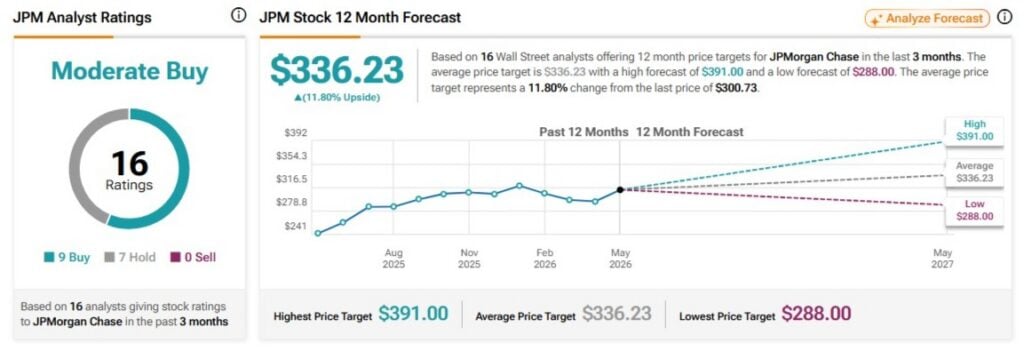
The highest price target is $391.00, while the lowest is $288.00. Broader data from TipRanks also assigns JPM a neutral Smart Score of 6, with bulls citing strong trading activity and bears citing regulatory constraints.
Final Thoughts
JPMorgan remains one of the strongest and most profitable banks in the world, with Q1 2026 results showing that it can sustain strong profitability even as rate and credit tailwinds fade.
However, today’s valuation already reflects much of that strength, making the stock look more like a core, steady compounder that can keep growing book value and dividends through a range of rate outcomes than a mature cyclical that has already exhausted its rate-driven upside.