Blue Origin, an aerospace firm founded by Jeff Bezos, is reportedly considering its first-ever external funding round. The company wants to hasten rocket launches, expand operations, and compete more directly with the Elon Musk-led rocket firm SpaceX. The move comes after workers at Blue Origin expressed discontent and anger over its previous payout plan, which placed strict limits on share cashouts.
Claim 55% Off TipRanks
- Unlock hedge fund-level data and powerful investing tools for smarter, sharper decisions
- Discover top-performing stock ideas and upgrade to a portfolio of market leaders with Smart Investor Picks
Speaking on the proposed funding plan during a recent meeting, Blue Origin’s CEO, Dave Limp, said that achieving the firm’s long-term launch ambitions would require more money than any single investor could provide. For this reason, the firm is weighing an outside funding round rather than relying on its founder, Jeff Bezos, who has been funding Blue Origin through regular sales of his Amazon (AMZN) stock.
Blue Origin Pushes for More Launches and Expansion
Blue Origin has been improving its operations after successfully reaching orbit with its heavy-lift New Glenn rocket for the first time in January 2025. The launch marked a major milestone for the company as it tries to compete better in the space industry.
Blue Origin is currently competing with SpaceX for commercial launch contracts and lunar missions linked to NASA’s Artemis program. The Bezos-led firm is now working to improve its services, satellite launches, and reusable rocket devices.
The private company is still considering between 8 and 12 New Glenn launches this year, although an earlier internal target reportedly aimed for 14. The firm also plans to reach a milestone of 100 launches annually.
To support that growth, Blue Origin has been spending a lot on infrastructure and development projects. These include an 800,000-square-foot manufacturing facility, a second launch pad in Florida, and more work on reusable boosters and space systems.
Analysts at Capstone expect Blue Origin to spend roughly $4.8 billion this year alone, bringing its estimated total budget since inception close to about $28 billion. Reports also note that inflation and growing competition for aerospace talent have increased costs in recent years.
The company’s CEO also told staff that external fundraising is the only option “on the table” for it to achieve its long-term goals. This is because investors are becoming more interested in space firms due to SpaceX’s upcoming initial public offering (IPO).
Previous Staff Complaints Added Pressure
The fundraising talks come after staff voiced their anger and frustration over Blue Origin’s previous stock option structure. Reports said several workers had become unhappy with the design of the earlier incentive plan.
Several current and former staff had complained that options under the previous plan were almost expiring without payouts. They also claimed they could only benefit if Blue Origin went public or was sold.
Since Bezos had not shown interest in selling the company and there were no immediate plans for an IPO, many employees feared their stock options could become worthless despite years spent at the firm.
Reports also suggested that the rivalry with SpaceX increased internal pressure. This is because workers compared payout plans and liquidity opportunities at SpaceX to Blue Origin.
In response to the complaints, the company introduced a new stock incentive structure. This gives employees more ways to benefit financially and puts payouts on par with those at other firms in the space sector.
The updated plan also brings a new strike price of $9.50 per share and increases the types of “liquidity events” that could trigger payouts. These now include outside fundraising rounds and tender offers rather than just an IPO or buyout.
What are the Best Aerospace Stocks to Buy?
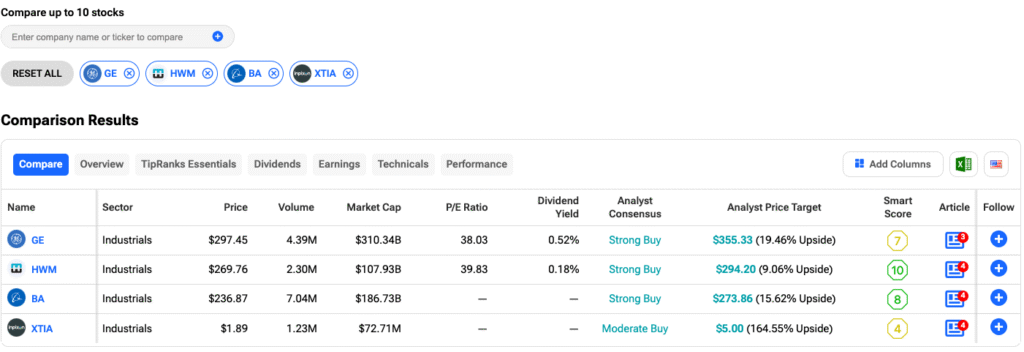
Wall Street analysts rate Boeing (BA), GE Aerospace (GE), and Howmet Aerospace (HWM) as Strong Buys, while XTI Aerospace (XTIA) is rated a Moderate Buy based on TipRanks consensus data. For more information on the performances, ratings, and price targets, visit the TipRanks Stocks Comparison Center.