


Duolingo (DUOL) still looks like a buy to me after its sharp post-earnings sell-off, even as slowing guidance and softer monetization trends have started to worry investors. The latest quarter was not disastrous, but it did show signs that the business is maturing after an extended period of near-flawless growth. Even so, the broader story remains intact.
Claim 55% Off TipRanks
- Unlock hedge fund-level data and powerful investing tools for smarter, sharper decisions
- Discover top-performing stock ideas and upgrade to a portfolio of market leaders with Smart Investor Picks
The gamified language learning platform continues to grow rapidly, deepen user engagement, and generate strong free cash flow, which is why I remain bullish on the stock, especially at current valuation levels.

Earnings Hangover: The Growth Deceleration Wall
The market is a fickle beast, and it apparently decided it had seen enough of Duolingo’s high-flying valuation if the growth wasn’t going to remain exponential. The Q1 report landed with a thud on May 4, and while the headline revenue of $291.9 million was up a respectable 27% year-over-year, it was the forward-looking guidance that caused the sell-off.
Management signaled that 2026 revenue growth is likely to land in the 15%–18% range, a far cry from the 40% levels we saw just a couple of years ago. For momentum-hungry investors, Duolingo’s recent slowdown felt like hitting a brick wall.

The “weakness,” such as it was, came from Duolingo Max, the company’s higher-end artificial intelligence (AI) tier. Penetration reached about 8%–9% of paying users, but Wall Street wanted a faster move into the pricier plan. When you combine that with a 10%–12% full year bookings growth forecast and a somewhat soft Q2 top-line guidance, the narrative quickly shifted from that of an unstoppable juggernaut to a “maturing utility.” We are basically seeing a classic “reset” year, with numbers compared to a phenomenal 2025, and the deceleration looks worse than it actually is because of those tough comps.

It didn’t help that the earnings call touched on a slight sequential dip in Monthly Active Users (MAUs), which fell to around 133 million. For a company whose entire valuation was built on an ever-expanding top-of-funnel, any contraction, no matter how small, triggers the alarm bells. The market is effectively punishing Duolingo for not being able to sustain a frantic pace indefinitely, ignoring the fact that the company is still adding millions of users and significantly expanding its Daily Active User (DAU) base.
The Long Game: Why Users Trump Near-Term Dollars
However, if you actually listen to what CEO Luis von Ahn is saying, or if you’ve been aware of the strategy shift Duolingo announced at the end of last year, the “slowdown” is sort of on purpose. Duolingo has explicitly shifted its priority toward user retention and engagement, going for a “DAU-first” model, even if it means leaving some money on the table right now.
They reached 56.5 million DAUs this quarter, up 21%, which is a massive achievement. The idea here is that if they can get someone to stay for a 365-day streak, the monetization eventually takes care of itself. Forcing ads or aggressive Max upsells too early risks breaking the habit that makes the company so valuable in the first place.

This pivot toward “teaching quality” over short-term subscription squeezes is exactly what a long-term holder should want to see. The company is using its generative AI capabilities not just to make a fancier subscription tier, but to automate content creation. In Q1 alone, they published over 20,500 course units, nearly triple what they published just a year ago. Beyond just languages, it’s now also about the rapid expansion into Math, Music, and the recently launched Chess course, which is now their fastest-growing subject. This proves that Duolingo is building a multi-subject learning ecosystem.
Management is choosing growth and engagement over squeezing average revenue per user (ARPU) right now. That should strengthen the moat. It looks like they are betting that a user who learns Chess and Spanish on the same app is far less likely to churn than someone just dabbling in a language. I believe this “user-first” approach might make the quarterly revenue growth look a bit pedestrian compared to the past, but it builds a far more resilient business. It’s about building the “learning super-app,” and that takes a level of patience that the average day trader simply doesn’t possess.
A Cash Machine in Disguise
Now, the real reason I am quite bullish on the stock is that the valuation is starting to look absolutely ridiculous following the continued post-earnings share price decline. While the stock price has taken a beating, the underlying cash generation has done the exact opposite. In Q1 alone, Duolingo generated a staggering $147.8 million in free cash flow (FCF). That is a 50.6% FCF margin.
For every dollar of revenue, about fifty cents is converted into FCF that the company can reinvest or return to shareholders, after accounting for typical operating cash flows and capital expenditures. That cash‑flow calculation already includes the non‑cash impact of stock‑based compensation.
If you run management’s own numbers, Duolingo is guiding to over $350 million in FCF this year. With a market cap of around $4.7–$5.2 billion, the stock trades at around 13–15x FCF. That said, for a high‑margin tech company with 20% user growth and a dominant global brand, the valuation is still far below the multiples it fetched during its growth‑stock phase. Plus, the company is sitting on roughly $1.1–$1.2 billion in cash and short‑term investments, or about $1.0 billion in net cash, giving it significant optionality to fund AI development, share buybacks, and further growth.
Management isn’t just sitting on those piles of green, either. They’ve already initiated a $400 million share buyback program and have already retired over half a million shares to offset dilution from employee stock options. I believe this provides a massive margin of safety, because you’re getting a company that is essentially “self-funding” its own growth, protecting its shareholders, and trading at a multiple usually reserved for dying legacy businesses. The “red open” post-earnings could, therefore, prove a gift for anyone who understands that cash flow, not just revenue “beats,” is what eventually drives a stock higher.
Is DUOL a Buy, Sell, or Hold?
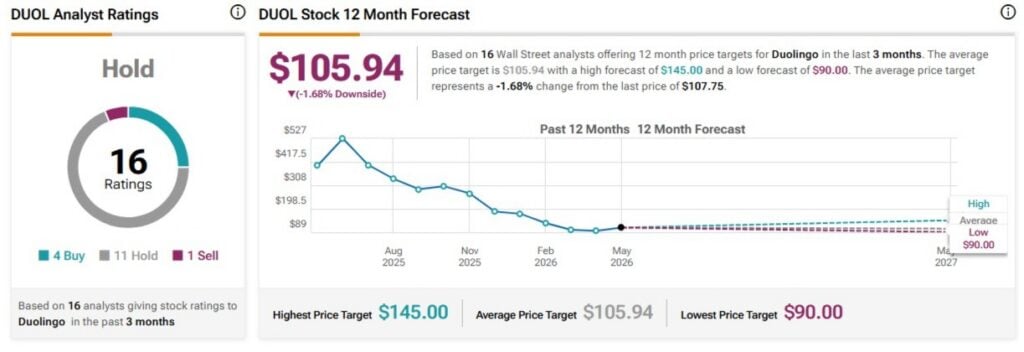
Wall Street remains skeptical about Duolingo, with analysts’ consensus of Hold rating based on four Buy, 11 Hold, and one Sell ratings. Still, DUOL’s average price target of $105.9 implies modest downside potential over the next 12 months.
Conclusion
Duolingo may be stuck and way down from its high-flying days. That said, I believe the business itself looks better than ever. Management is forgoing some near-term revenue upside to deepen user loyalty and continue expanding the platform. With cash generation at record levels and what seems to be a rather depressed valuation, this could be a setup phase rather than a real slowdown.