


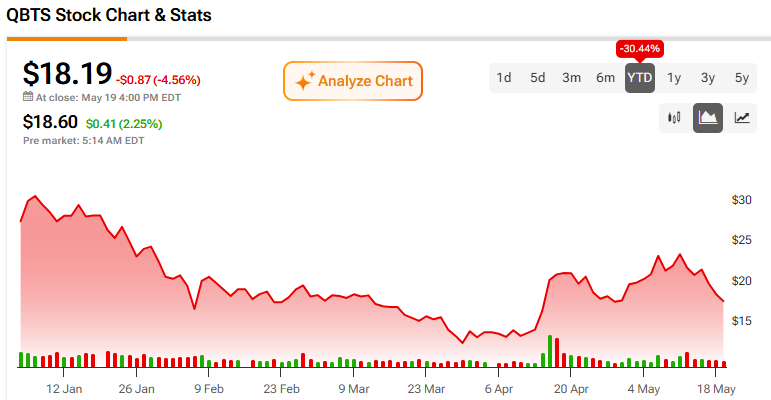
Quantum computing stocks fell again on Tuesday, extending a pullback that started last Friday. The move was milder than the first leg of the selloff, but it showed that investors are still cutting risk in one of the market’s hottest tech trades.
Claim 55% Off TipRanks
Double your QBTS exposure with Tradr's QBTXThe drop hit several key names in the space, putting pressure on quantum stocks, including IonQ Inc. (IONQ), Rigetti Computing Inc. (RGTI), D-Wave Quantum Inc. (QBTS), Quantum Computing Inc. (QUBT), Xanadu Quantum Technologies Ltd. (XNDU), and Infleqtion Inc. (INFQ).
Investors Are Taking a Harder Look at the Trade
Nevertheless, the latest slide does not look like a loss of faith in quantum computing. Instead, it looks like the next stage of a sector reset. After a sharp run tied to earnings, deal news, and fresh hype around the space, investors are now asking a more basic question: how long will it take for these firms to turn promise into real profit?
That shift matters because many quantum names still trade on future growth rather than current profit. So, when the market gets more cautious, these stocks can fall fast.
IonQ is a good case in point. The company recently posted strong Q1 revenue of $64.7 million and raised its 2026 revenue outlook to $260 million to $270 million. CEO Niccolo de Masi also said IonQ had delivered its “biggest quarter” in company history. Even so, the stock was not spared from the broader pullback.
Higher Yields Are Adding More Pressure
At the same time, the wider market backdrop has become less friendly for early-stage growth stocks. Long-term Treasury yields moved higher this week, with the 30-year yield reaching 5.18%, its highest level since 2007. The 10-year yield also climbed to 4.668%, its highest level since January 2025.
That matters for quantum stocks because much of their value is based on gains that may come years from now. When yields rise, investors tend to put less value on those far-off gains. As a result, stocks tied to long-term tech themes often face more pressure.
For now, the quantum story remains intact. However, the trade has become more fragile. Investors still see real promise in the space, but they are also asking for more proof. Until these firms show a clearer path to steady sales, lower losses, and real profit, strong growth alone may not be enough to keep the stocks moving higher.
We used TipRanks’ Comparison Tool to align all the stocks appearing in the piece. It’s a great tool to gain an in-depth view of each stock and the broader quantum computing sector.
