


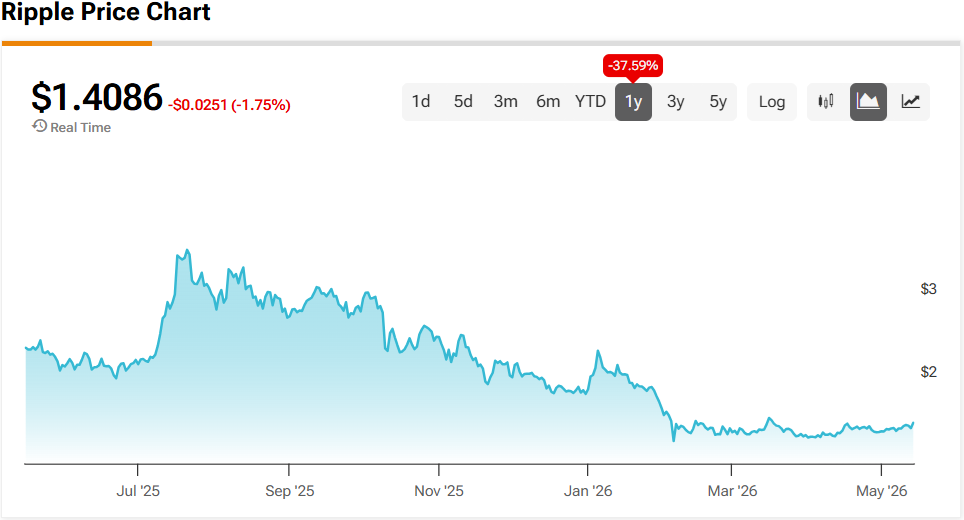
XRP (XRP-USD) has fallen a long way in less than a year, with the cross-border payments-focused token currently trading about 60% below last summer’s peak. For investors following a classic ‘buy low, sell high’ strategy, that might seem like an opportunity in the making.
Claim 55% Off TipRanks
- Unlock hedge fund-level data and powerful investing tools for smarter, sharper decisions
- Discover top-performing stock ideas and upgrade to a portfolio of market leaders with Smart Investor Picks
However, investor Anthony Di Pizio thinks XRP’s problems run deeper, making the current investment case very flimsy.
“XRP is contending with a series of structural issues that will be difficult to overcome, so it could face further downside,” the investor said.
In fact, Di Pizio believes XRP’s real-world utility is “under threat” from the broader ecosystem built by its creator, Ripple.
To understand why, international banks do not all operate through the same payment infrastructure. While many rely on SWIFT, others still depend on intermediary banks for cross-border transactions, a process that often slows transfers and increases costs.
Ripple Payments was designed to let banks transact directly across different systems, enabling near-instant settlement at very low cost. XRP can be used in these transactions to reduce foreign exchange fees.
The investment case is that wider adoption of Ripple Payments could drive XRP demand. However, the system does not require XRP, since banks can still settle transactions using fiat currencies while benefiting from faster cross-border payments.
Ripple also introduced Ripple USD (RLUSD) in 2024, a stablecoin designed to avoid the price volatility seen in assets like XRP, making it more practical for payments. RLUSD does run on the XRP Ledger, meaning transaction fees are still paid in XRP. As a result, XRP does actually retain some utility even if it is not directly used as the primary settlement asset.
Nevertheless, that doesn’t make the investment case strong enough for Di Pizio.
Because Ripple created XRP, its prospects are closely linked to the company’s performance. Unlike Bitcoin, which is designed to be fully decentralized and not controlled by any entity, XRP is more exposed to centralized influence. That difference can periodically raise concerns for investors and pressure the token’s valuation.
Those structural concerns become more important after XRP’s recent boom-and-bust cycle. The token surged to $3.65 and reached a new all-time high in July 2025 for the first time since 2018. However, its subsequent 60% decline has started resembling XRP’s earlier cycle, when the token collapsed more than 95% after its 2018 peak before bottoming near $0.15 in March 2020. To revisit those post-2018 lows, XRP would still need to fall about 90% from current levels.
“I think history could repeat, given some of the headwinds I’ve highlighted… XRP would have to sink by 90% from its current price to match the post-2018 low, and it certainly appears to be trending in that direction right now,” Di Pizio summed up. (To watch Di Pizio’s track record, click here)
Disclaimer: The opinions expressed in this article are solely those of the featured investor. The content is intended to be used for informational purposes only. It is very important to do your own analysis before making any investment.