Space analytics company HawkEye 360 (HAWK) has raised $416 million in its U.S. IPO, signaling continued investor interest in the growing space technology sector. This values HawkEye 360 at roughly $2.42 billion. The company is expected to begin trading on the New York Stock Exchange (NYSE) under the ticker symbol HAWK on Thursday.
Claim 55% Off TipRanks
- Unlock hedge fund-level data and powerful investing tools for smarter, sharper decisions
- Discover top-performing stock ideas and upgrade to a portfolio of market leaders with Smart Investor Picks
For context, HawkEye 360 is a U.S.-based space technology company that uses satellites and radio frequency (RF) data to track and analyze activity across the globe. The company mainly serves government, defense, intelligence, and commercial customers by providing geospatial intelligence and real-time monitoring data. Its technology is used for applications including maritime tracking, border security, illegal fishing detection, and national security operations.
More Details About the IPO
The company sold 16 million shares at $26 apiece, the top end of its expected $24 to $26 price range.
At the same time, the company said the $416 million raised does not include underwriting fees and other offering-related expenses. Underwriters were also granted a 30-day option to purchase up to an additional 2.4 million shares at the IPO price, excluding discounts and commissions. If fully exercised, the option could increase the total size of the offering.
Why Space Stocks Are Heating Up Again in 2026
HawkEye is part of the fast-growing space analytics industry, where companies use satellite networks, AI, and data analytics to provide real-time intelligence and tracking services.
The IPO comes as space stocks regain momentum in 2026, driven by rising demand for satellite data, defense technology, and space-based intelligence services. Investors are paying closer attention to the sector as governments and private companies increase spending on national security and space infrastructure.
Several major developments have also boosted interest in space stocks this year. The White House recently launched the National Initiative for American Space Nuclear Power, while SpaceX continues to attract attention ahead of its potential IPO. Meanwhile, NASA’s Artemis II mission successfully brought astronauts back from deep space for the first time in more than 50 years, helping renew excitement around the future of space exploration.
Wall Street’s Take on Space Stocks
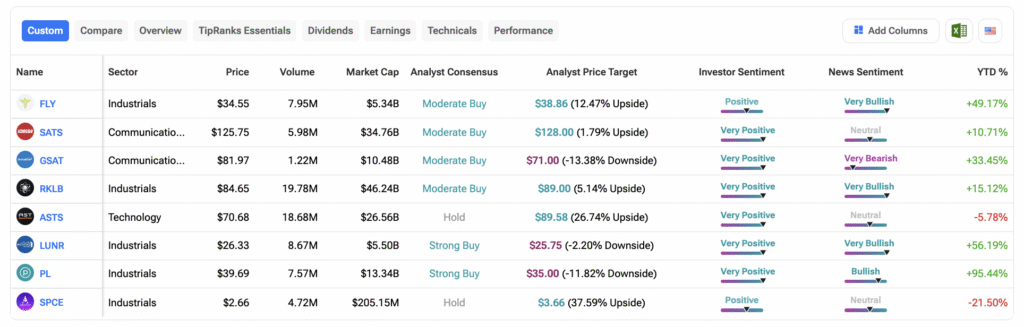
We used TipRanks’ Comparison Tool to see which of the above-mentioned space stocks analysts favor. According to analysts, Virgin Galactic (SPCE) stock has the highest upside potential of 38%. In contrast, Globalstar (GSAT) offers a downside risk of over 13%.