


Ask most investors, and they’ll sing the praises of diversification and the resulting spread of risk and reward. When the rain starts to fall or the clouds begin to gather, ETFs can serve as one way to help worried investors sleep through the night.
Claim 55% Off TipRanks
- Unlock hedge fund-level data and powerful investing tools for smarter, sharper decisions
- Discover top-performing stock ideas and upgrade to a portfolio of market leaders with Smart Investor Picks
And when one talks about ETFs, the Vanguard S&P 500 ETF (VOO) is often in the conversation. Not only does VOO have some $919 billion in assets under management, but among its 507 holdings are some of the biggest publicly-traded companies on the planet.
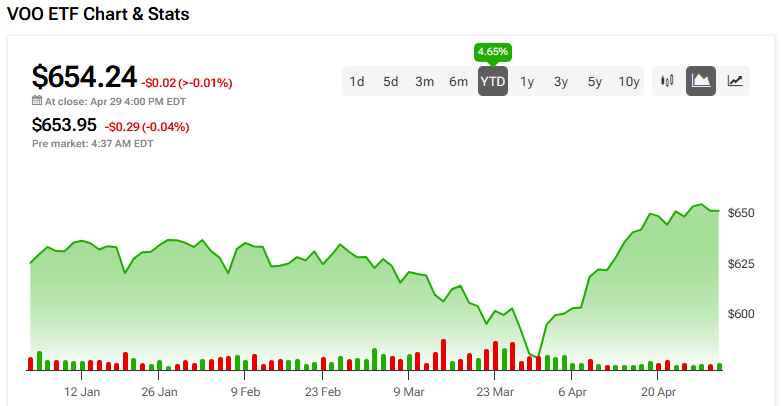
VOO tends to move with the market, as its Beta of 0.99 suggests. That’s been mostly up over the past few years, as VOO has clocked 1-, 3-, and 10-year gains of 28%, 71%, and 246%, respectively. It’s also a very cheap investment to hold, with an expense ratio of 0.03%.

However, the current year has thus far had its fair share of volatility, especially as VOO’s heavy reliance on big tech names has led to some drops in the early going. Should investors consider selling and moving away from equities and into fixed income?
Investor David Dierking thinks that volatility-inspired selling is generally a mistake.
“What they usually end up doing is selling low, buying high when they eventually decide to get back in, and missing out on any post-dip rally,” explains the investor.
Dierking is a long-term equity bull, citing the S&P 500’s historic performance through a litany of downturns including the Great Depression and the COVID-19 pandemic, among others.
And in spite of the dips, the S&P 500 has an average annual return of close to 10%, he notes.
“The stock market is still the greatest long-term wealth creation tool available to investors,” states Dierking, adding that “short-term volatility is part of the price of admission.”
Still, that doesn’t mean that investors should put all their chips on VOO. Though he believes it can be a central holding, Dierking professes that it’s “not a complete portfolio.” He points out that it doesn’t include other assets that might be of interest, such as fixed income, gold, or small-cap stocks.
However, that doesn’t detract from his overall thesis that VOO is a good fit for the majority of investors.
“Assuming that your timeframe and goals are unchanged, buy-and-hold is the way to go,” sums up Dierking, who calls VOO “a fantastic investment option for most investors.” (To watch Dierking’s track record, click here)
Disclaimer: The opinions expressed in this article are solely those of the featured investor. The content is intended to be used for informational purposes only. It is very important to do your own analysis before making any investment.