Analysts at investment firm Morgan Stanley (MS) say that Google (GOOGL), Amazon (AMZN), Meta Platforms (META), and Microsoft (MSFT) could add up to 34 gigawatts of compute capacity by 2027 as AI inference demand accelerates. In simple terms, inference is when AI models are actually used to answer questions, generate content, or complete tasks after they have already been trained. The scale of the buildout is massive, especially when compared to Amazon Web Services, which Morgan Stanley estimates added only about 5 gigawatts of compute during its first 18 years.
Claim 55% Off TipRanks
Trade AMZN with leverageHow Big Is a Gigawatt of Power?
The analysts estimate that hyperscalers could add about 20 gigawatts of compute next year, on top of the roughly 14 gigawatts added in 2026. To put that in perspective, 1 gigawatt can power 750,000 U.S. homes. That means that 34 gigawatts could support about 25.5 million U.S. homes. Google is expected to bring on the most capacity in 2027 at around 7 gigawatts, followed by Amazon and Microsoft at roughly 5 gigawatts each. Meta’s direct capex is expected to add about 3.5 gigawatts, but Morgan Stanley estimates that the figure is actually closer to 4 gigawatts when its overall hyperscale spending is included.
A large portion of that spending is expected to go toward GPUs, which is where Nvidia (NVDA) remains especially well positioned because of its power-efficiency advantage. The rest of the budget will likely go toward custom AI chips like Google’s TPUs and Amazon’s Trainium, as well as powered shells, DRAM, and high-bandwidth memory.
Looking into the rest of 2026 and 2027, Morgan Stanley believes Amazon, Microsoft, and Meta are doing the most forward buying, with at least 50% of this year’s capex likely coming online in 2027 or later. Google, on the other hand, looks different, with only about 10% of its 2026 capex expected to come online in 2027 and beyond.
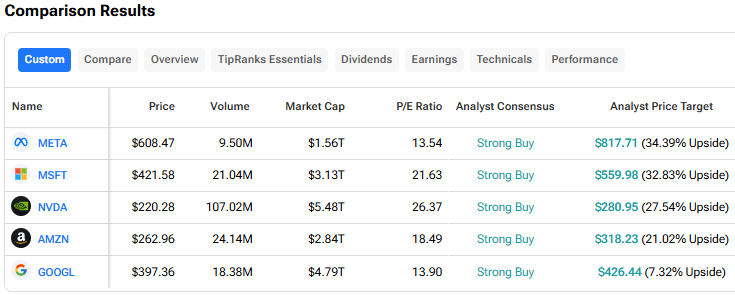
Which AI Stock Is the Better Buy?
Turning to Wall Street, out of the AI stocks mentioned above, analysts think that META stock has the most room to run. In fact, META’s price target of $817.71 per share implies 34.4% upside potential.