



A class action lawsuit was filed against battery storage solutions company Eos Energy Enterprises (EOSE) on March 6, 2026, over its revenue and production claims.
Claim 55% Off TipRanks
- Unlock hedge fund-level data and powerful investing tools for smarter, sharper decisions
- Discover top-performing stock ideas and upgrade to a portfolio of market leaders with Smart Investor Picks
Shareholders in the federal securities lawsuit allege that they bought EOS Energy stock at artificially inflated prices between November 5, 2025 and February 26, 2026, known as the Class Period. They are now seeking compensation for financial losses incurred upon public revelation of the company’s alleged misconduct during that time. To learn whether you may be eligible for a recovery under this securities lawsuit, click here.
What Does EOS Energy Do?
EOS Energy is an electrical equipment and parts business working in the industrial sector. It engages in the design, development, manufacturing, and marketing of energy storage solutions for various applications in the United States. According to the company, its products include Eos Z3 battery modules, and Eos Indensity and Cube storage systems. It also says its batteries and energy storage systems serve as effective alternatives to “lithium-ion for mid-duration intraday energy storage,” for its “utility, industrial, and commercial customers.”
EOS Energy was founded in 2008 and is based in Edison, NJ. It reportedly has 787 employees.
Why are Shareholders Suing EOS Energy?
Investors allege the company misrepresented its production capabilities, manufacturing automation progress, and revenue guidance, including previously issued full-year guidance of $150 million to $160 million, while promoting record quarterly growth and ambitious capacity targets.
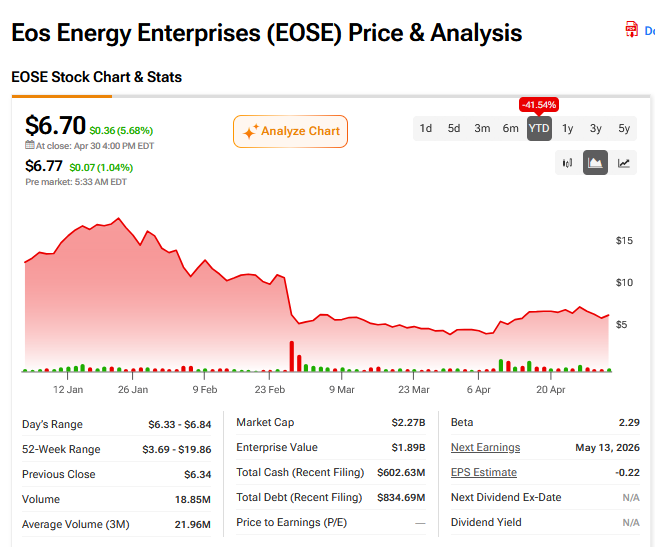
The complaint alleges that behind these optimistic projections, the company was experiencing severe battery line downtime running well above industry norms, delays in automated production quality, and an inability to achieve the ramp-up in production and capacity utilization required to meet previously issued guidance. When the company disclosed these operational failures on February 26, 2026, revealing full-year revenue that fell $36 million to $46 million short of guidance, the stock plummeted 39.4% in a single day, erasing significant shareholder value and triggering investor losses.
Its share price is down over 40% in the year-to-date – see below.
Actions You May Take
If you have purchased the company’s stock during the Class Period, you may join the lawsuit as a lead plaintiff, remain a passive class member, or opt out of this litigation and pursue individual claims that may not be available to the class as a whole. To learn more about your options, click here.
The deadline to file for lead plaintiff in this lawsuit is May 5, 2026.