Recently, news emerged about electric vehicle giant Tesla (TSLA), and the pay structure for CEO Elon Musk. In what sounded like a scene from South Park involving viral video personalities and the theoretical dollars they made, Tesla revealed it paid Musk $158 billion to be CEO…but he did not actually pocket a nickel of that money. The notion was apparently attractive to shareholders, who sent shares shooting up nearly 3% in Friday’s trading.
Claim 55% Off TipRanks
Looking for exposure to SpaceX & Anthropic? Check out AGIX ETF
So how does a company pay its CEO $158 billion, but said CEO walks away with less than the cost of a cup of coffee for it? The answer is “…an accounting-driven valuation…,” backed up by a regulatory filing. The filing shows that Elon Musk’s total compensation was $158,359,009,867, but Tesla noted that this does not reflect any money Musk actually received. The majority of that eye-watering figure is connected to the 2025 CEO Performance Award, which is a 10-year equity package that shareholders recently approved.
As of the filing date, no shares under that award have vested, and any shares that actually do vest are “…subject to an offset of $334.09 per share unless Musk elects to pay that amount in cash.” Thus, Musk received no actual payment for 2025’s work, and Musk has also not collected salary from Tesla over the last several years.
When the Driving AI Hallucinates
It is a safe bet that most, if not all, of us have encountered an artificial intelligence (AI) hallucination at one point or another. When the AI believes things that are not true, or sees things that do not exist, those are hallucinations. When you are asking an AI about the history of 13th-century France, that can be inconvenient. But when your AI is driving a car, it can be downright fatal.
So what are companies like Tesla—who depend heavily on AI for driving—doing about this? Tesla’s focus tends toward cameras and large-scale data collection. Such a solution may scale better, reports suggest, but it could leave Tesla’s systems more exposed to “hallucination” errors. This is likely a large part of why so much of Tesla’s autonomous systems come with the insistence on human supervision.
Is Tesla a Buy, Hold or Sell?
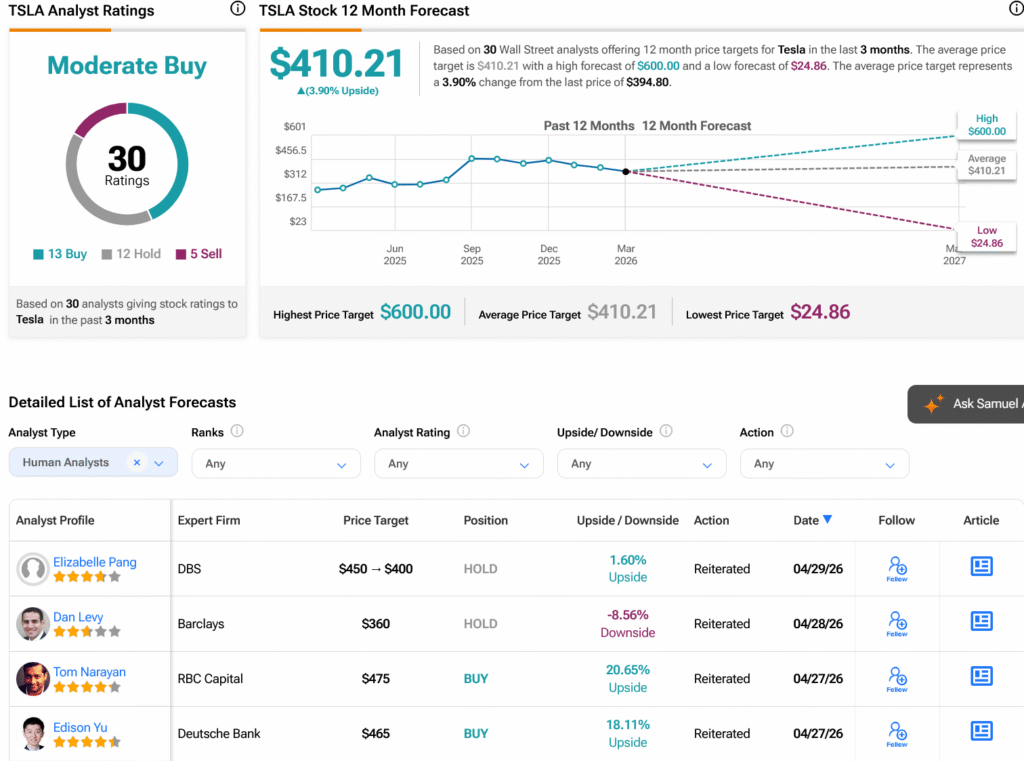
Turning to Wall Street, analysts have a Moderate Buy consensus rating on TSLA stock based on 13 Buys, 12 Holds, and five Sells assigned in the past three months, as indicated by the graphic below. After a 32.9% rally in its share price over the past year, the average TSLA price target of $410.21 per share implies 3.9% upside potential.