


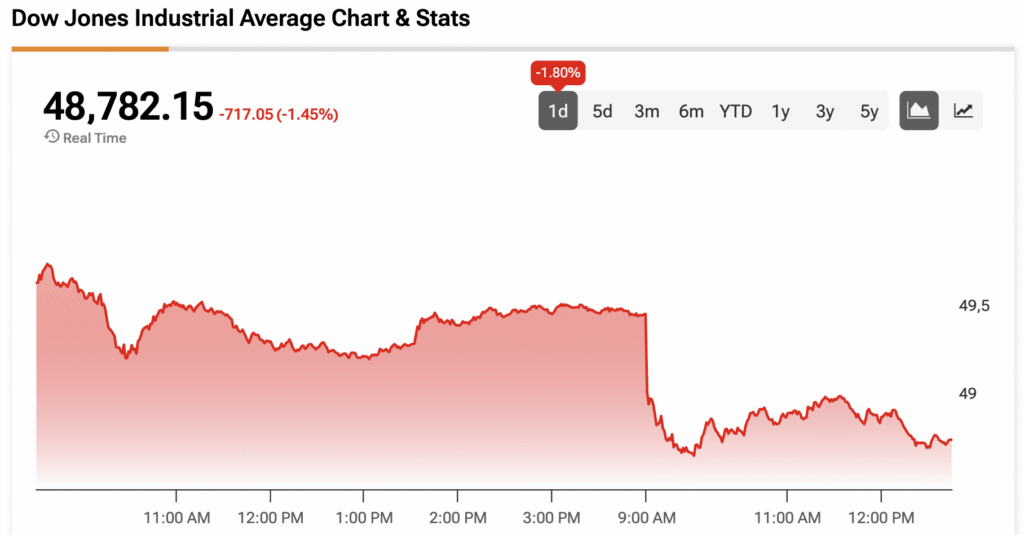
The Dow Jones (DJIA) is set to wrap up the week in negative territory following a higher-than-expected inflation reading and a downgrade on the U.S. stock market from UBS (UBS).
Claim 55% Off TipRanks
Trade QQQ with leverageIn January, the Producer Price Index (PPI) climbed 0.5%, marking its highest reading since October and exceeding expectations of 0.3%. Prices have now increased for a fourth consecutive month. Year over year, the index rose 2.9%, also above the forecast of 2.6%. PPI is closely watched because several of its components feed into the Personal Consumption Expenditures (PCE) index, the Fed’s preferred inflation measure.
Core PPI, which strips out volatile food and energy prices, rose 0.8% in January and increased 3.6% year over year, marking its highest annual rate since March 2025. Both readings came in well above expectations of 0.3% and 3.0%, respectively.
The PPI growth was largely driven by a 0.8% monthly rise in services, the highest since July 2025, while goods prices declined 0.3%. More than 20% of the services gain stemmed from a 14.4% jump in margins for professional and commercial equipment wholesaling.
“Retailers’ tariff bill has come down marginally in the last few months, but they have continued to lift their selling prices,” wrote Pantheon Macroeconomics Chief U.S. Economist Samuel Tombs.
Meanwhile, UBS downgraded American equities to “benchmark” in a fully invested global equity portfolio, citing factors including stretched valuations, weakness in the dollar, fewer corporate buybacks, and global diversification outside of the U.S. The firm noted that a 10% drop in the dollar’s trade-weighted index typically leads U.S. equities to underperform by about 4% on an unhedged basis. Additionally, U.S. buybacks have slowed and now closely match the rest of the world.
“The buybacks yield is no longer exceptional and this had been an important driver of funds flow, EPS and valuation,” wrote UBS Head of Global Equity Strategy Andrew Garthwaite.
The Dow Jones is down by 1.45% at the time of writing.
Which Stocks are Moving the Dow Jones?
Let’s pivot to TipRanks’ Dow Jones Heatmap, which illustrates the stocks that have contributed to the index’s price action.

Five of the six stocks in the tech sector are trading lower, with Salesforce (CRM) and Nvidia (NVDA) leading to the downside. Tech stocks have suffered steep losses in recent weeks over concerns of AI’s impact in the industry.
On the other hand, all of the stocks in the consumer defensive and healthcare sectors are in the green, with Walmart (WMT), Merck (MRK), and Amgen (AMGN) showing strong gains.
Elsewhere, the financial sector is dragging the index lower, with both Goldman Sachs (GS) and American Express (AXP) down by over 6%.
Is the Dow Jones a Good Long-Term Investment?
The SPDR Dow Jones Industrial Average ETF (DIA) is an exchange-traded fund designed to track the movement of the Dow Jones. As a result, DIA is falling alongside the Dow Jones today.

Wall Street believes that DIA stock has room to rise. During the past three months, analysts have issued an average DIA price target of $560.21, implying upside of 14.44% from current prices. The 30 holdings in DIA carry 30 buy ratings, zero hold ratings, and zero sell ratings.