


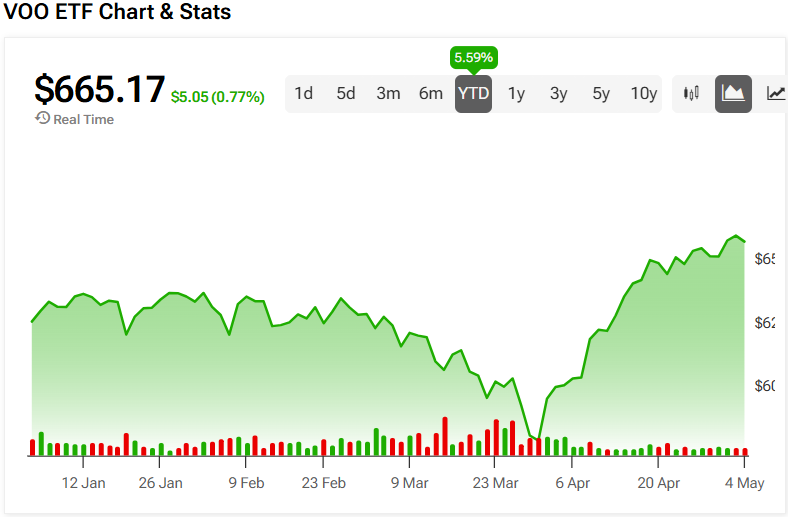
Vanguard S&P 500 ETF (VOO) is climbing in today’s session as the broader market pushes higher, driven by a stream of better-than-expected earnings that is reinforcing confidence in corporate growth and keeping buyers engaged. At the same time, easing pressure from oil prices and a more stable macro backdrop are supporting risk appetite, allowing equities to extend gains.
Claim 55% Off TipRanks
- Unlock hedge fund-level data and powerful investing tools for smarter, sharper decisions
- Discover top-performing stock ideas and upgrade to a portfolio of market leaders with Smart Investor Picks
Given that VOO closely mirrors the S&P 500, it tends to reflect these broader market moves, rising and falling in line with shifts in overall sentiment rather than company-specific developments. That means its performance is largely tied to macro drivers like interest rates, economic growth, and earnings trends across large-cap U.S. companies, making it a straightforward way to capture the market’s direction without taking on single-stock risk.
That dynamic also sets up the core challenge many investors face, because broad market exposure naturally comes with periods of both strength and weakness. Trying to time those swings can feel like the smartest move in the moment, especially when prices are moving and uncertainty creeps in. Yet, according to investor David Dierking, that instinct often leads investors in the wrong direction, pushing them to act at precisely the worst times for long-term results.
Dierking explains that many investors reduce exposure or exit positions during downturns, even when they originally intended to stay invested for the long haul. The investor warns that this behavior can be deeply damaging to portfolio performance, since selling during declines often means missing the rebound that tends to follow.
Instead of trying to predict market direction, Dierking leans on a more consistent approach built around dollar-cost averaging. The investor describes it as a process that naturally blends purchases made at both higher and lower prices, helping investors lower their overall cost basis over time. This steady accumulation, rather than well-timed entry and exit points, becomes the driver of stronger long-term returns.
A key part of his thesis rests on how markets have behaved historically, particularly when it comes to recovery cycles. Dierking emphasizes that the S&P 500 has always recovered from bear markets and eventually moved to new highs, even after severe drawdowns. The takeaway is not that downturns are easy to endure, but that they are temporary phases within a longer upward trajectory. Investors who stay invested through these periods position themselves to participate in the recovery, while those who step aside often struggle to reenter at the right time.
Timing becomes especially problematic because it requires getting two decisions right instead of one. An investor must sell before declines deepen and then reenter before the recovery gains momentum, a combination that proves difficult in practice. Dierking notes that those who exit and wait for clearer conditions frequently return only after prices have already advanced, leaving a meaningful portion of gains behind.
That is why he continues to favor broad, low-cost index exposure through funds like the VOO, which track the market and remove the need for constant decision-making. Rather than reacting to short-term moves, the strategy focuses on consistency, allowing time and compounding to do the heavy lifting.
“The Vanguard S&P 500 ETF remains one of the best vehicles for investing in the index. Investors should keep adding to it regardless of whether the market is going up or down,” Dierking summed up. (To watch Dierking’s track record, click here)
Disclaimer: The opinions expressed in this article are solely those of the featured investor. The content is intended to be used for informational purposes only. It is very important to do your own analysis before making any investment.